
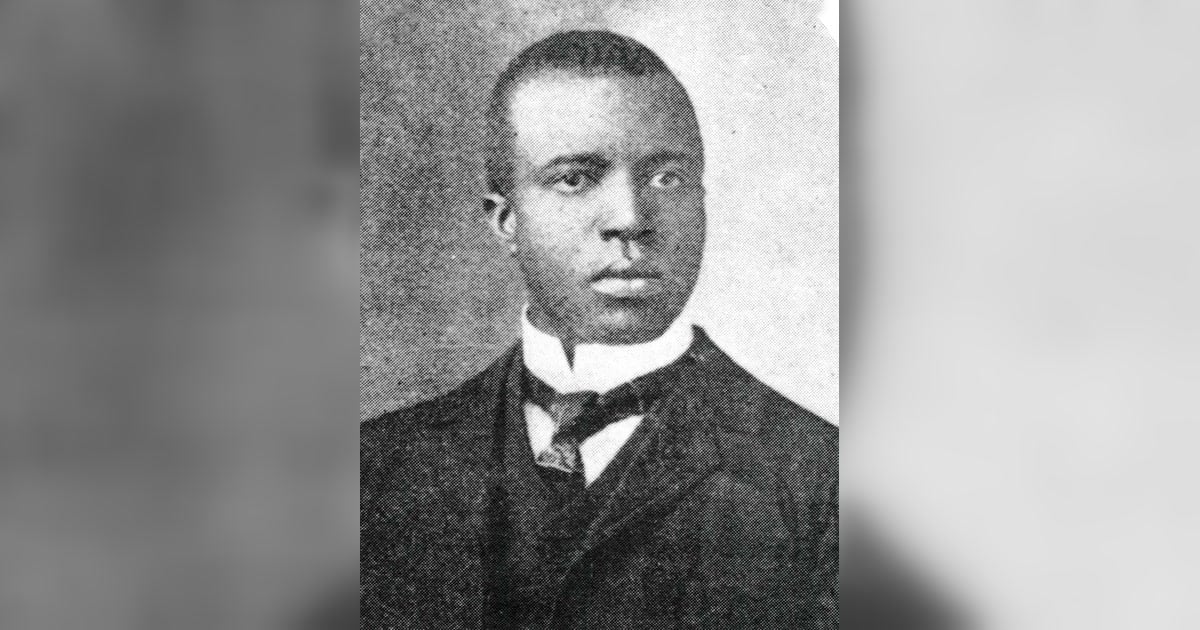
On Monday, Nov. 24, 1975, about 300 people crowded a parkway and spilled into a one-way street in downtown Texarkana to honor a composer who had been dead for 58 years and whose New York grave had gone unmarked until the year before.
It was Scott Joplin Day. Texas-side Mayor David L. Keller and Arkansas-side Mayor Bobby F. Ferguson had signed a joint proclamation four days earlier calling him a “native son of Texarkana.” Three busloads of students came. The Texas High and Arkansas High bands played his rags together. Fifteen Joplin relatives, including a niece and two great-nieces, sat on benches beside a new bust of the composer, United Press International reported.
“We are here today to honor a native son who has, through his music, reached not only the hearts of people in the United States, but also the world,” said Nick Demopulos, coordinating director of the Texarkana Joint Bicentennial Commission.
It was the day Texarkana formally claimed the “King of Ragtime.” Fifty-one years later, the claim that he grew up here is solid. The claim that he was born here, on that date, is not.
A front page in a first-year weekly
Joplin’s music had come roaring back two years earlier, when the 1973 film “The Sting” put his rags in front of a new audience. Texarkana staged a memorial Joplin concert during its own centennial that same year.
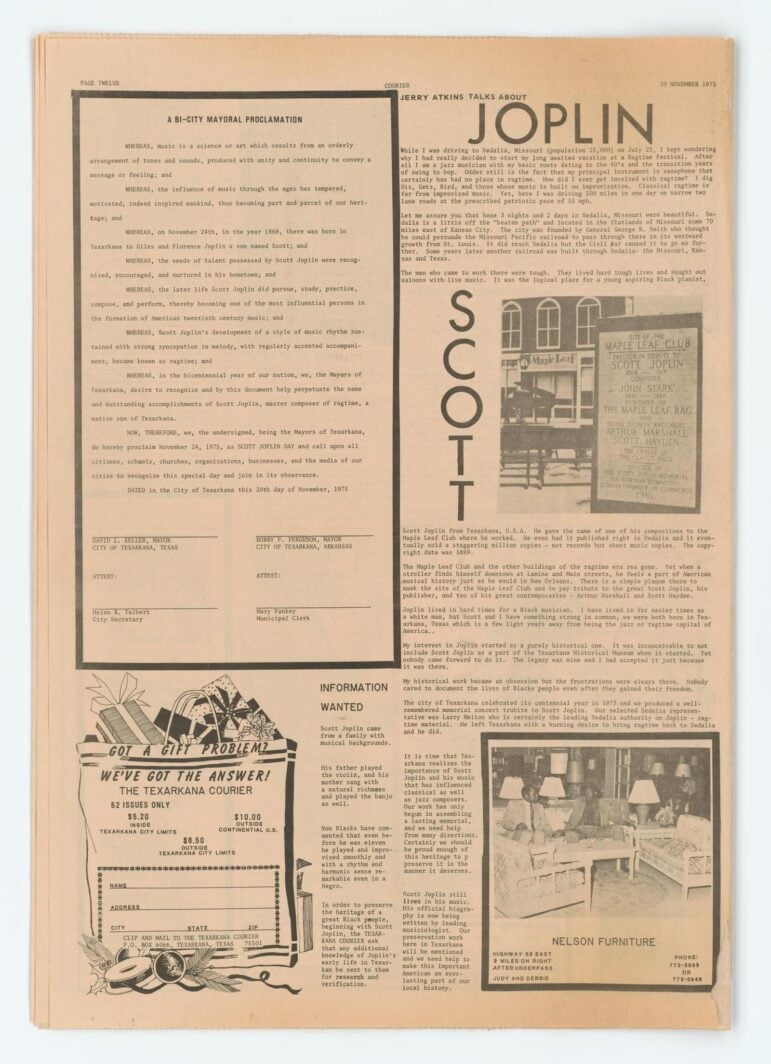
The fullest local record of the 1975 observance is in The Texarkana Courier, a Black-owned weekly then in its first year that billed itself as “The Black Voice of the Four States Area.” Its Nov. 20, 1975 edition gave Joplin the front page under the headline “Genius Rediscovered” and printed the mayors’ proclamation in full on the back page.
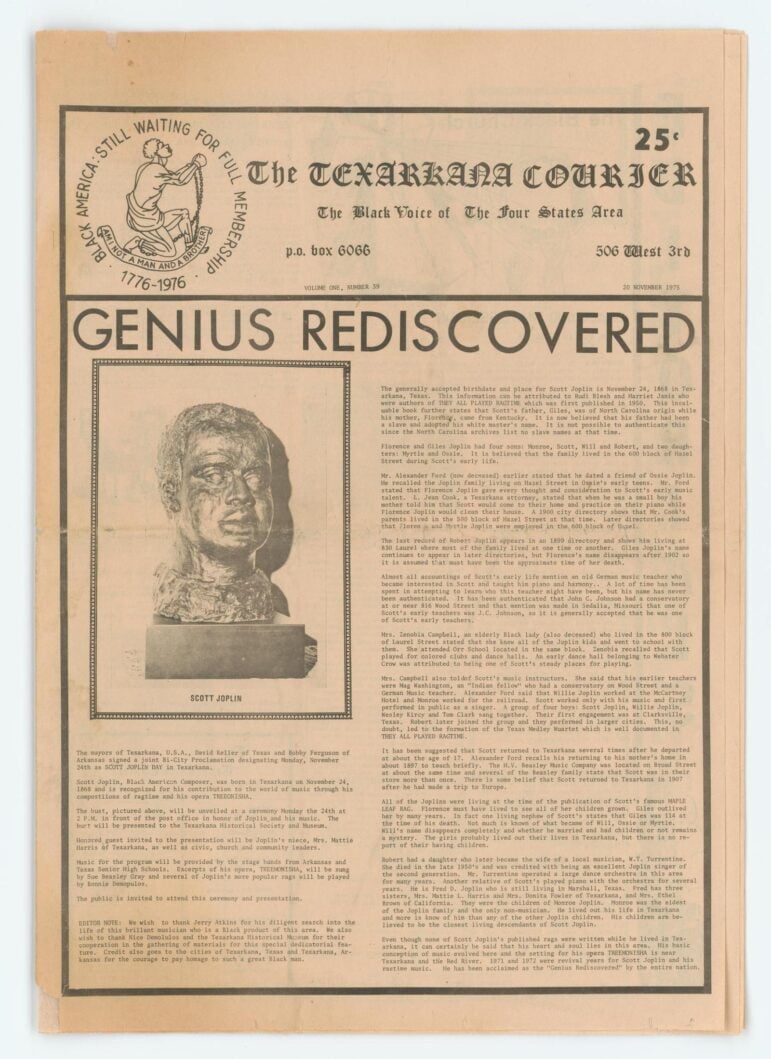
The program called for the bust to be unveiled at 2 p.m. in front of the post office and presented to the Texarkana Historical Society and Museum. Sue Beasley Gray would sing excerpts from Joplin’s opera “Treemonisha,” and Bonnie Demopulos would play his rags. The honored guest was Joplin’s niece, Mattie Harris of Texarkana.
An editor’s note thanked both cities “for the courage to pay homage to such a great Black man.”
“Nobody came forward to do it”
The Courier credited its research to one man: Jerry Atkins, a Texarkana jazz saxophonist and businessman who had promoted the 1973 concert.
Atkins wrote a column for the same issue. He described driving 500 miles in one day that July to a ragtime festival in Sedalia, Mo., where Joplin’s “Maple Leaf Rag” was published in 1899, and admitted he was an unlikely ragtime evangelist. “I dig Diz, Getz, Bird, and those whose music is built on improvisation,” he wrote. “Classical ragtime is far from improvised music.”
He also explained how the job fell to him. “It was inconceivable to not include Scott Joplin as a part of the Texarkana Historical Museum when it started. Yet nobody came forward to do it,” he wrote. “The legacy was mine and I had accepted it just because it was there.”
The work became an obsession, he wrote, and a frustrating one. Nobody, in his words, “cared to document the lives” of Black people “even after they gained their freedom.”
“Joplin lived in hard times for a Black musician,” Atkins wrote. “I have lived in far easier times as a white man, but Scott and I have something strong in common, we were both born in Texarkana, Texas.”
What he had assembled came from old city directories and elderly witnesses. Zenobia Campbell, who lived in the 800 block of Laurel Street, said she went to Orr School with the Joplin children. Alexander Ford remembered the family on Hazel Street. Attorney L. Jean Cook said his mother told him Scott practiced on the Cook family piano while Florence Joplin cleaned the house. Atkins counted six Joplin children and named the children of Scott’s older brother Monroe, including Mattie Harris, as the closest living relatives.
The page carried a clip-and-mail coupon headed “Information Wanted,” asking anyone who knew more about Joplin’s early life to send it to the Courier.
The trouble with Nov. 24, 1868
The proclamation stated as fact that “on November 24th, in the year 1868, there was born in Texarkana to Giles and Florence Joplin a son named Scott.”
Even in 1975, Atkins handled that carefully. He called it the “generally accepted” date and place and traced it to a single source, the 1950 book “They All Played Ragtime” by Rudi Blesh and Harriet Janis.
There are two problems. The first is that there was no Texarkana in 1868. The townsite was platted in 1873.
The second is the 1870 federal census, the earliest document that names Scott Joplin. It lists Giles Joplin, 28, born in North Carolina; his wife, Florence, 29, born in Kentucky; and three sons, Monroe, Scott and Robert. They were not in Bowie County. They were in Cass County, then temporarily called Davis County, on a farm in the Linden area almost 40 miles away, according to Joplin biographer Edward A. Berlin, author of “King of Ragtime.”
That census recorded Scott as already 2 years old on July 18, 1870, which rules out a birth in November 1868. Berlin places the birth between July 19, 1867 and mid-January 1868 and calls the Texarkana date “one tenacious myth.” The Handbook of Texas says Joplin was born about 1867, “possibly at Caves Spring, near Linden.”
Tax records fill in the move. Giles Joplin last appears on the Cass County rolls in 1878 and turns up on the Bowie County rolls the next year, Berlin and researcher Stephanie Caputo reported in The Syncopated Times. The 1880 census shows the family in Texarkana, Texas.
The confusion was not limited to Texarkana. Four days after Scott Joplin Day, a column in The Sedalia Democrat by Larry Melton, the Sedalia ragtime researcher who had been Texarkana’s guest at the 1973 concert, put the birth “in what is today Marshall, Tex.”
Atkins came around. In an essay for the Arkansas Jazz Hall of Fame years later, he wrote that the Nov. 24, 1868 date “is probably incorrect.”
Later research also corrected two family details from the 1975 Courier page. Atkins had guessed Florence Joplin died about 1902, when her name dropped out of the city directories. She had moved to Little Rock, where she died July 7, 1911, Berlin and Caputo found. And the story from a nephew that Giles Joplin lived to 114 traces to Giles himself, who gave that age to a wartime registration board in Texarkana in 1918. Census records put his birth around 1840.
The marker says both
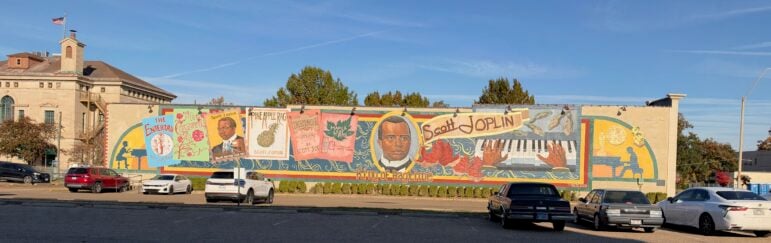
The Texas historical marker dedicated in 1976, which now sits near the Joplin mural at Third and Main, carries the contradiction in a single sentence. Atkins and Nick Demopulos are named on the back. Joplin, it says, “was born in Texarkana, Texas, five years before the townsite was platted in 1873.”
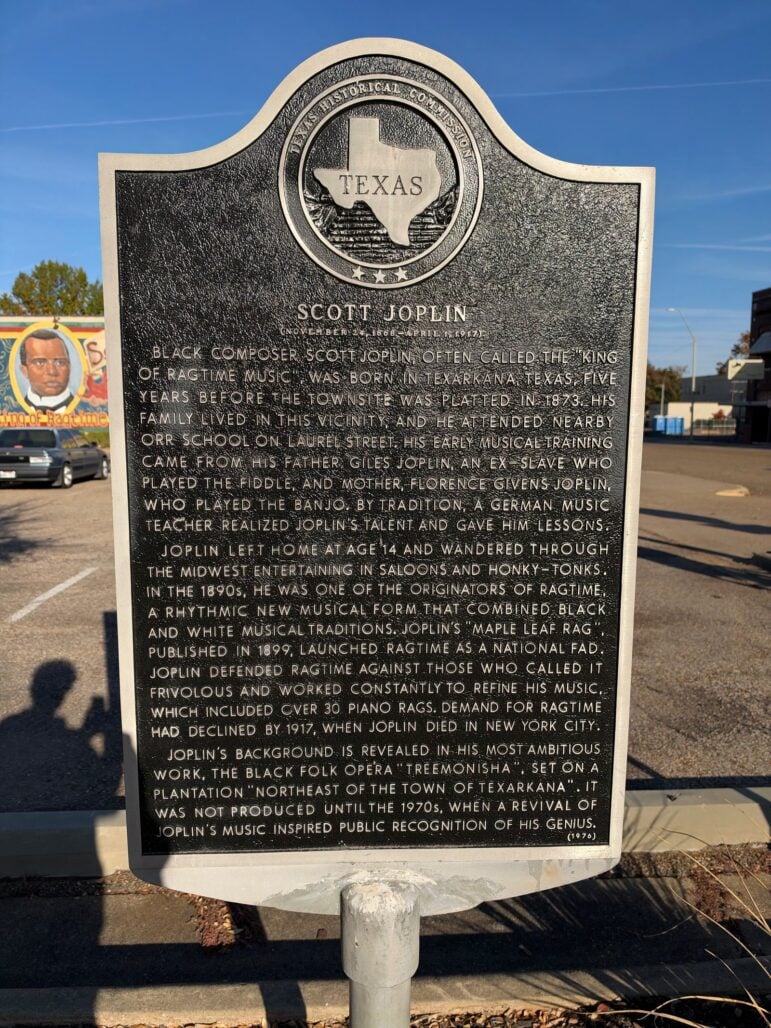
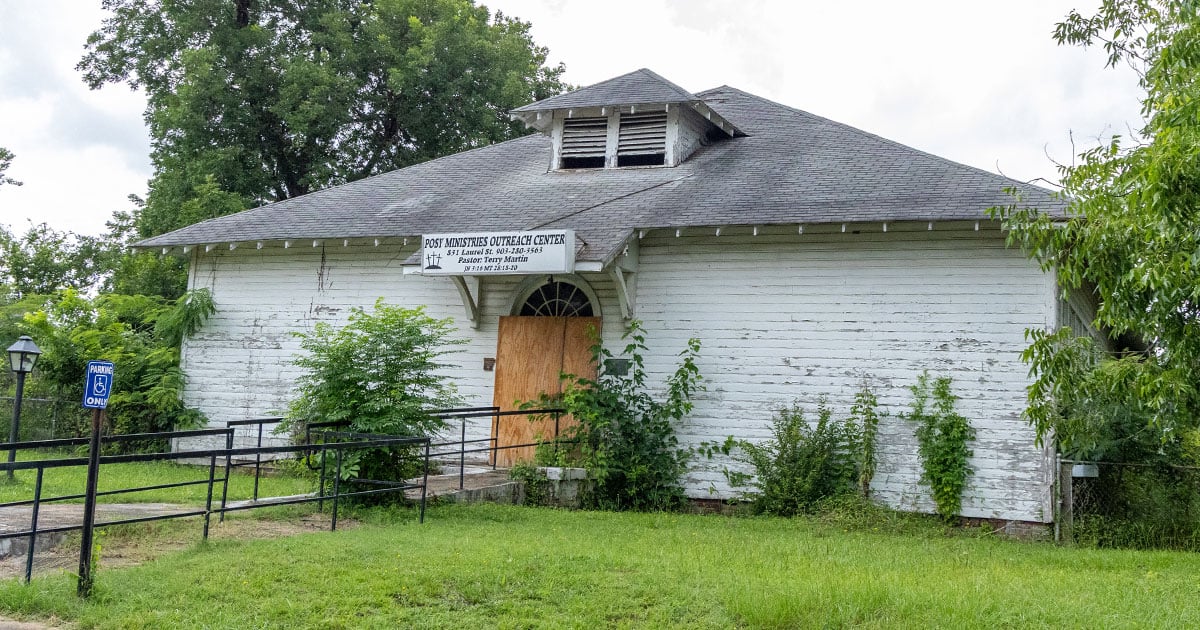
None of that touches what is documented. The family lived on Hazel and Laurel streets. Scott attended Orr School at 831 Laurel St., the only building still standing in Texarkana tied to his life. He took free lessons from Julius Weiss, a German-born music teacher whose name Atkins was still hunting in 1975. He left as a teenager, and when he wrote “Treemonisha,” he set it on a plantation “northeast of the town of Texarkana.”
The recognition that began in 1975 kept coming. Joplin received a posthumous Pulitzer Prize in 1976, the same year as the marker. A city park was named for him in 1975, according to Melton. The mural at Third and Main was painted in 1984. Carol Collins-Miles founded the Scott Joplin Support Group in 1997.
Atkins hosted a jazz radio show for 22 years and was inducted into the Arkansas Jazz Hall of Fame. He died June 10, 2010, at 81.
Texarkana’s claim on Scott Joplin is as a hometown, not a birthplace. The 1975 proclamation said both. The part that holds up is on the record because a saxophone player took on a job that, as he put it, nobody came forward to do.
TXKtoday has not been able to determine who sculpted the 1975 bust or where it is today. If you know, or if you were there that day, we would like to hear from you.
Sources: The Texarkana Courier, Nov. 20, 1975, via The Portal to Texas History; United Press International, Nov. 25, 1975; The Sedalia Democrat, Nov. 28, 1975; Edward A. Berlin’s biographical sketch of Joplin; Berlin and Stephanie Caputo, “Scott Joplin’s Parents: Truths, Fabrications, and Revelations,” The Syncopated Times; Handbook of Texas; Texas Historical Commission marker 9490; Arkansas Jazz Heritage Foundation; Larry Melton, The Syncopated Times, 2018.