
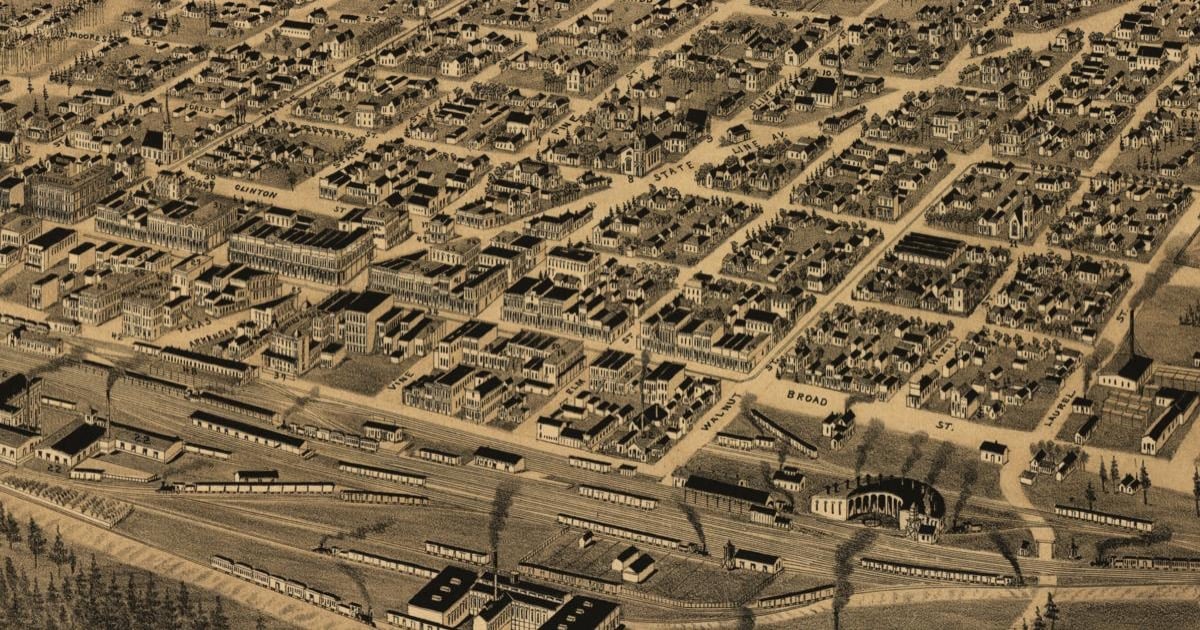
At noon on Thanksgiving Day 1892, Broad Street in Texarkana had a line.
“All was life and activity on Broad street about noon,” the Texarkana Daily Democrat reported that afternoon, especially around two storefronts where church and lodge women were serving Thanksgiving dinner to the public. So many people came “that large numbers were forced to await their turn before they could be served.” The Texarkana cornet band played on the street.
Texarkana’s newspapers from the 1890s, preserved on the Portal to Texas History and in the Library of Congress’ Chronicling America, show a holiday built around church services, fundraising dinners, turkey shopping and, for some, a duck hunt. By the end of the decade, the day also had bicycle races, saloon lunches and a parade that marched past a church at the wrong moment.
Dinner for a cause
For much of November 1892, the Democrat ran the same notice almost daily: the women of the Eastern Star, Texarkana Chapter No. 78, would serve a Thanksgiving dinner “on Broad street in the Plunkett building next to Lightfoot’s drug store” for the benefit of the Masonic State Line Cemetery. “It is the duty of every Mason, their wives and daughters to work to make it a grand success,” the paper added.
Three days before the holiday, the Democrat printed the Christian church women’s bill of fare and promised “the finest Thanksgiving dinner ever given in this city.” The list: oyster and vegetable soup; barbecued beef, mutton and pork; roast turkey, baked chicken and cold boiled ham; cranberries, celery, olives and sour pickle; corn, mashed potatoes, macaroni, French peas and hot slaw; lemon, mince and pumpkin pie; ambrosia, ice cream and “a variety of cake.”
Also on Broad Street, the women of the Christian church served their own dinner in a building recently vacated by Schuster and DePrato. Afterward, the Christian church women thanked the band and everyone who helped, reporting more than $250 raised. The Eastern Star took in about $125 at the door, which the paper called splendid “considering that they devoted so little time to it.”
The Christian church dinner became a tradition. In 1894, the women set up “next door to Chatfield & Buhrman’s on Broad street.” In 1895, they served a turkey dinner at noon and oysters that night in the old Texas Produce Co. building, at 50 cents a plate. Two days before the holiday, the women admitted in a notice: “Not many tickets sold as yet but we rely on our friends to come to our aid.”
Other churches made room. In 1893, the women of the Episcopal Guild announced they would serve their dinner on New Year’s Day instead of Thanksgiving “in order to help the ladies of the Christian church,” and promised a free Christmas dinner for the city’s poor children.
The 1893 dinner also drew an uninvited guest. The Democrat reported the next day that Officer Casey had caught a man entering the storeroom the church women were using as a dining hall, where the silverware was “in easy reach.” He was taken to the city lockup, which the paper called “Hotel Crenshaw.”
In 1896, the women of the Fourth Street Methodist church took over the Texas Produce building and charged the same 50 cents. The Texarkanian called the dinner “a success in every particular,” though “on account of the rain attendance was not as large as it otherwise would have been.”
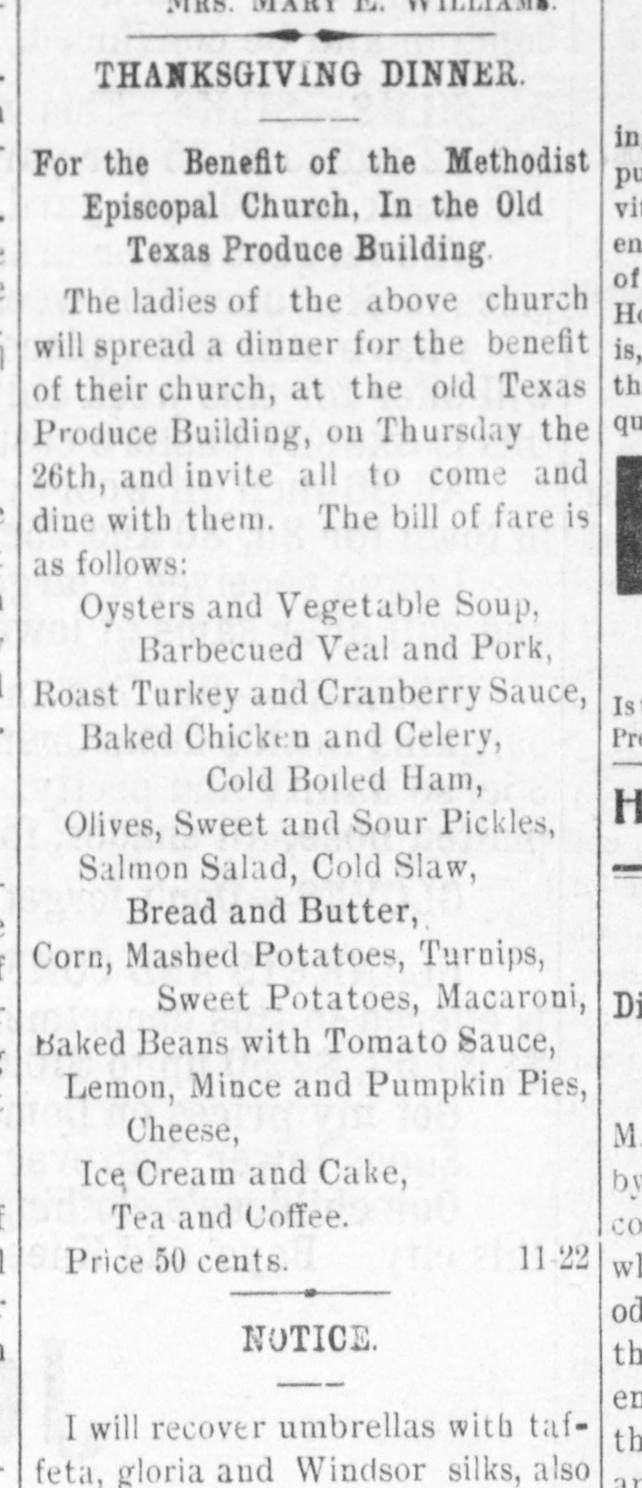
By 1899, the Christian church women were going door to door for supplies. One told the Texarkanian she had pledges for 12 turkeys, several chickens, 25 large cakes and $12 in cash.
Closing shop for church
Churches held joint services. In 1892, the union Thanksgiving service at the Presbyterian church was “full to overflowing,” the Democrat said, and 64 businesses, “comprising the leading firms,” closed during the service. Gov. James P. Eagle’s proclamation that year set aside Thursday, Nov. 24, as a day of thanks.
In 1893, the Democrat urged merchants “to close their places of business” for services at First Baptist and the 4th Street Methodist church, with a collection for the poor. At 4th Street Methodist, the Rev. A. W. Higby of St. James Episcopal preached a sermon the paper called “both eloquent and instructive,” and “a good collection was taken for the relief of the poor in the city.” In 1894, union services were held at both the First Presbyterian and State Line Methodist churches, and Clara Hoffman, a Missouri officer of the Woman’s Christian Temperance Union, lectured at the YMCA hall that night, admission free.
The custom held through the decade. At noon on Thanksgiving 1898, the Texarkanian wrote, the city “put on a sleepy look,” with many businesses “placarded with a ‘Gone to dinner will be back at 3 o’clock'” sign.
Turkeys, oysters and a gilded gobbler
The meat market of Huddleston Bros. advertised for the holiday. “We have just received several hundred turkeys and chickens and a hundred dozen fresh eggs for Thanksgiving. Come quick,” read its 1894 notice. The Texarkanian noted the market also had “fresh oysters, venison, celery, cranberries.”
In 1895, the Famous clothing store turned its big show window into a barnyard, with live turkeys strutting “just as if they were used to being stared at by passers by,” the Texarkanian reported on Thanksgiving Day. The biggest gobbler, standing in for the Famous itself, had gold bronze worked into its feathers and rubbed on its legs. The paper urged other merchants to compete on window displays so “our town would look more like a city.”
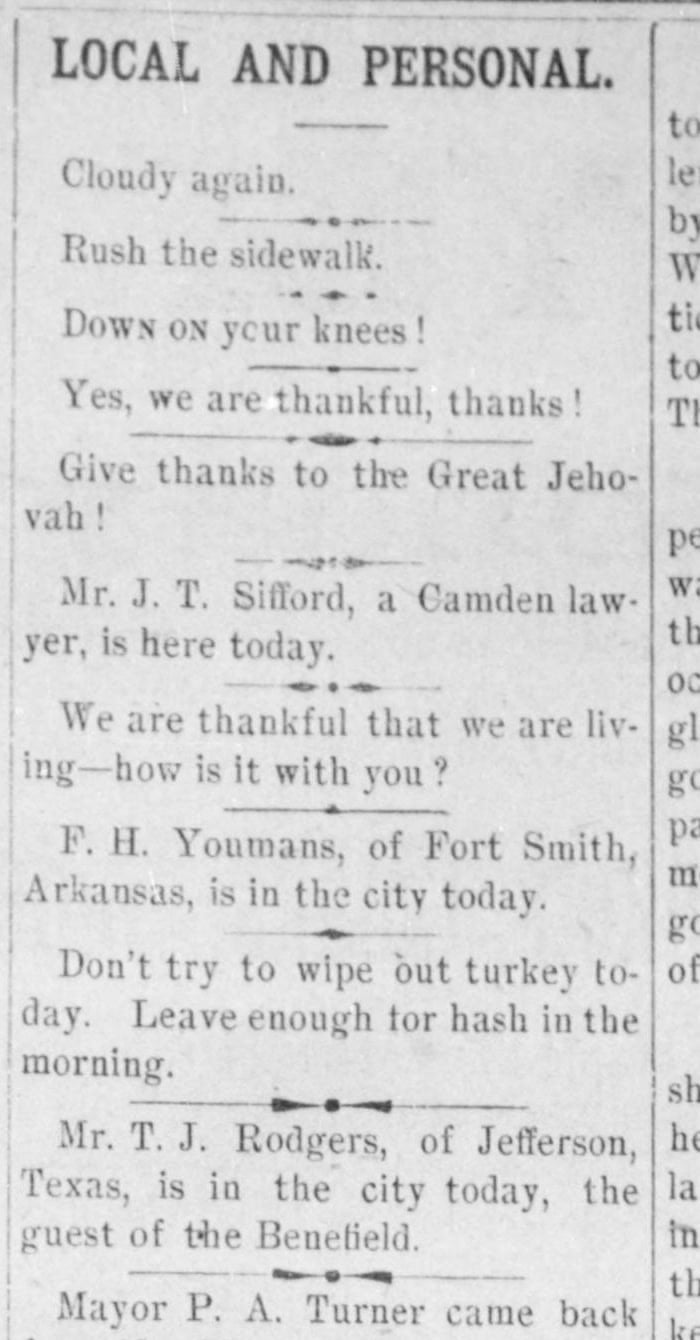
The Texarkanian’s 1895 Thanksgiving column was mostly one-liners. “Yes, we are thankful, thanks!” “Don’t try to wipe out turkey today. Leave enough for hash in the morning.” Mayor P. A. Turner, it reported, “will eat gobbler today in our city.” The editor said he “took turkey in his’n” at home with his wife and the city editor.
The paper also used the day to start a public subscription for a sidewalk on State Line Avenue from Langsdale’s meat market to the post office. In 1894, the same paper had joked that readers asking what they had to be thankful for should “thank the Lord for deliverance from Republican rule.”
A free turkey with every $10 purchase
Not every year was flush. “Next Thursday is Thanksgiving but there are few able to afford the luxury of a turkey,” the Texarkanian wrote in November 1896. “Nickels and dimes have to go for the necessaries of life.”
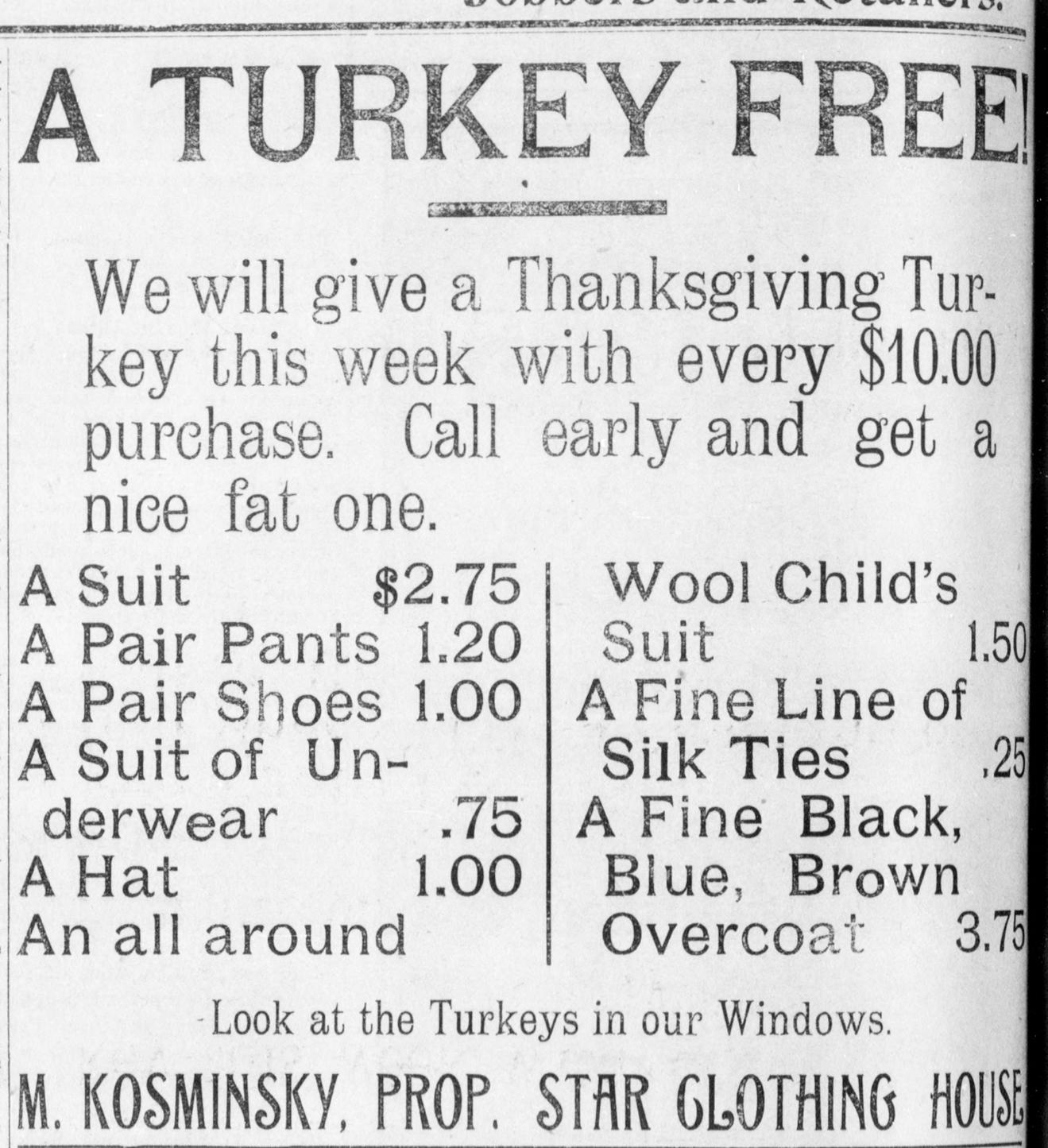
Merchants saw an opening. M. Kosminsky’s Star Clothing House advertised “A Turkey Free” with every $10 purchase that week, when a suit cost $2.75 and a pair of shoes $1. “Look at the Turkeys in our Windows,” the ad said. The store’s manager, a Mr. Salmson, also invited every newsboy in town to a turkey lunch at 11 a.m. on Thanksgiving Day. The bird sat in the show window beforehand, “baked to a turn with a carving knife and fork crossed over the wish-bone.”
Huddleston Bros. decked the front of the market with green trees that week and set coops of turkeys underneath.
In 1897, the paper reported, “the saloons all set up Thanksgiving lunch,” and John W. Mayher fed turkey to patrons of his Palace Bar. Two days before Thanksgiving 1898, “some enterprising individual had a drove of turkeys on the streets,” and more came in by wagon from the country.
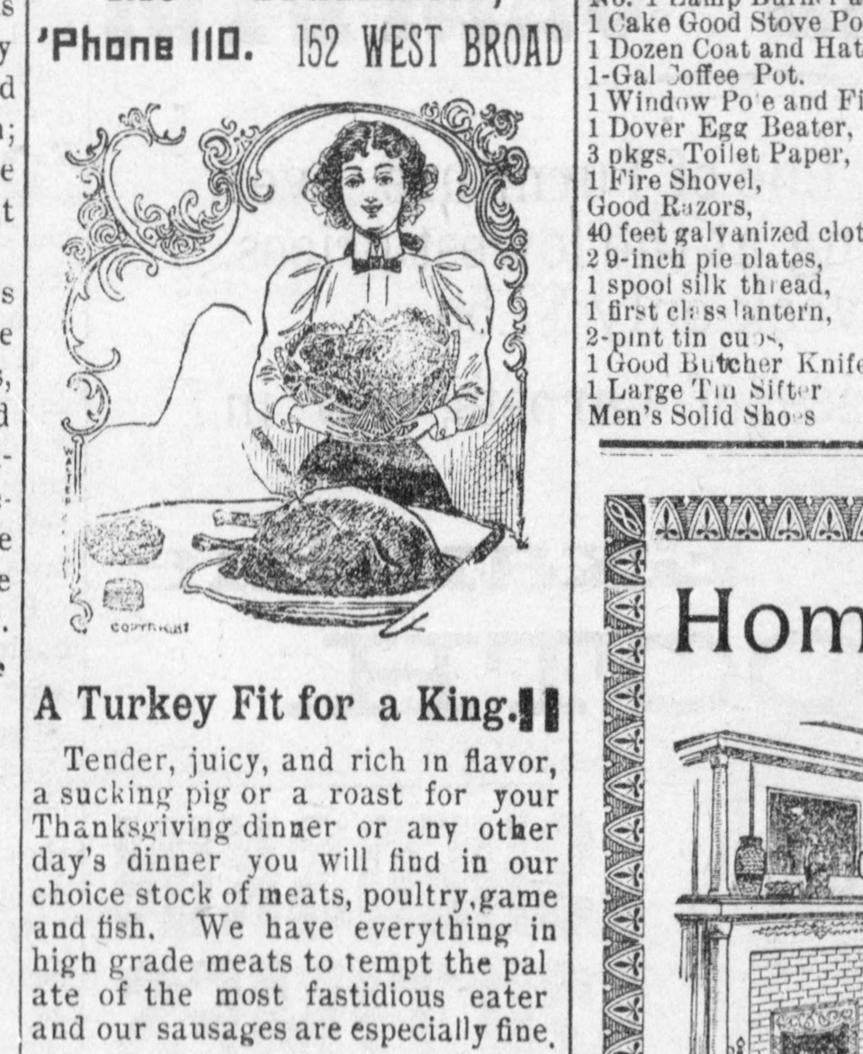
The supply outran the appetite in 1899. Butchers told the Texarkanian they sold fewer turkeys than on any Thanksgiving before. One of the largest dealers killed and dressed 100 and sold 15 or 20, though he figured he could keep the rest in cold storage a few days.
Bicycle races, living pictures and a parade
By the middle of the decade, Thanksgiving afternoon and evening belonged to entertainment. In 1896, the Mercury Wheel Club planned bicycle races at Spring Lake Park starting at 2:30 p.m., including one for boys under 16 and a final “slow” race for riders who failed to place. Rain spoiled the day, which the paper’s society editor called “the counterpart of Longfellow’s ‘Rainy Day,'” and the races were put off until December.
In 1898, months after the war with Spain, the women of St. James Episcopal Church staged “Living Pictures,” famous paintings posed by live models, with a chorus of 50 at the park auditorium. Admission was 35 cents, 20 cents for children. Their notices in the Texarkanian read: “Do you remember the Maine. Forget it and remember the Living Pictures.”
In 1899, a home-talent vaudeville troupe raising money for an opera house held a Thanksgiving morning parade of traps and fine horses. Its route passed the Presbyterian church during the union service. Three days later the Texarkanian printed “An Explanation”: the manager had not known a service was underway, could not turn back from the middle of the procession, and asked those offended to “forgive and forget the incident.”
The Sunday before, the Epworth League at State Line Methodist held its own Thanksgiving program. The opening talk, “Thanksgiving Historically Considered,” was given by the league’s president, Morris Sheppard, the young Texarkana lawyer who later represented Texas in the U.S. Senate.
Ducks on McKinney Bayou
Not everyone went to church. On Thanksgiving 1892, the Democrat reported, Messrs. McCorkle, Will Taylor, Homer Vaughan and Will Chance were “duck hunting on McKinney Bayou to-day.” The next morning, Pete DeArrigo and a relative left for Clear Lake to do the same, the paper said. A week earlier, three hacks full of men had headed out on a camp hunt “beyond McKinney bayou,” expecting “to bag lots of ducks.”
The Democrat also allowed itself a gloomier thought that day: “Sad thought: many who enjoy this Thanksgiving will never celebrate another. None of us have any lease on life.”
Does your church, lodge or family have a Thanksgiving tradition that goes back generations in Texarkana? We’d like to hear from you. Contact TXKtoday.
Sources: Texarkana Daily Democrat, Nov. 2, 1892, Nov. 8, 1892, Nov. 14, 1892, Nov. 17, 1892, Nov. 24, 1892 (also page 4), Nov. 25, 1892 (also page 4), Nov. 28, 1893 and Dec. 1, 1893; The Daily Texarkanian, Nov. 26, 1894, Nov. 27, 1894 (also page 2) and Nov. 28, 1895 (also page 3), all via the Portal to Texas History; page images: The Daily Texarkanian, Nov. 28, 1895, Library of Congress, Chronicling America; additional reporting from the Texarkana Daily Democrat, Nov. 21, 1892, Nov. 14, 1893 and Dec. 1, 1893, and The Daily Texarkanian, Nov. 28, 1894, Nov. 26, 1895, Nov. 20, 1896, Nov. 23, 1896, Nov. 25, 1896, Nov. 26, 1896, Nov. 27, 1896, Nov. 29, 1896, Nov. 26, 1897, Nov. 20, 1898, Nov. 22, 1898, Nov. 24, 1898, Nov. 16, 1899, Nov. 22, 1899, Nov. 30, 1899, Dec. 1, 1899 and Dec. 3, 1899; top image: Perspective map of Texarkana, Texas and Arkansas, Henry Wellge, 1888, Library of Congress.