

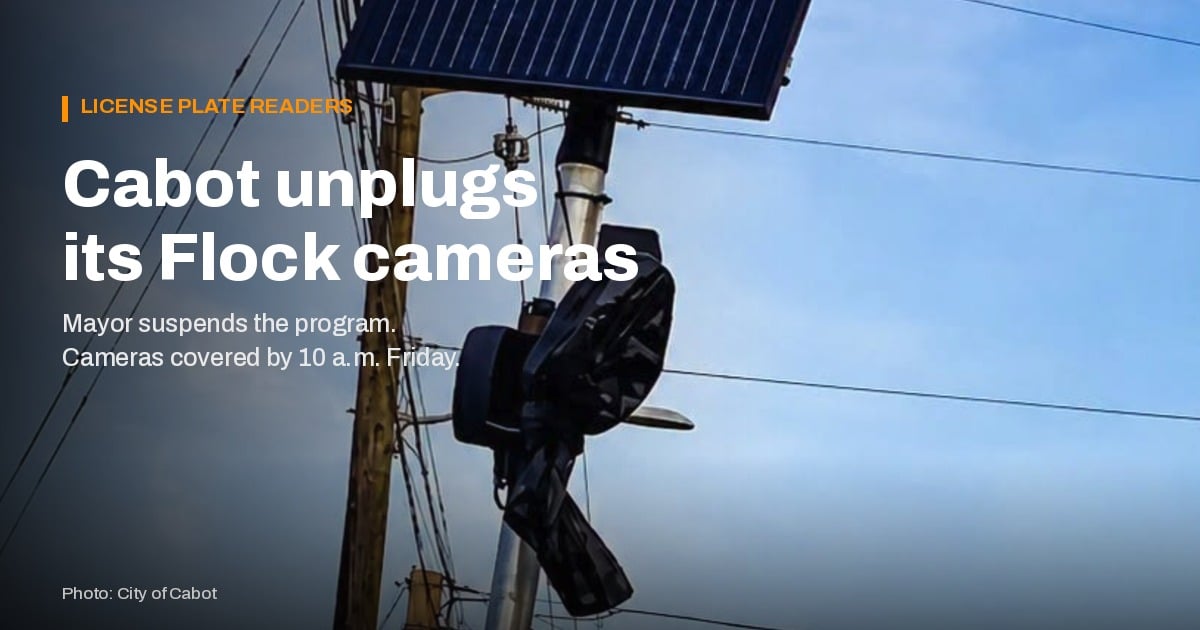
Cabot suspends its Flock camera program, the third Arkansas city to back away this summer

CABOT, Ark. – Cabot has suspended its Flock Safety automated license plate reader program, making it the third Arkansas city this summer to pull back from the surveillance technology and the first where the decision came from the mayor rather than the police chief.
Mayor Ken Kincade announced the suspension Thursday night.
“I have heard your concerns that these Flock Safety automated license plate reader cameras have raised about our privacy as citizens,” Kincade said. “Effective immediately, the City of Cabot is suspending our deployment of Flock Safety automated license plate reader cameras.”
Kincade said the city will conduct a comprehensive review during the suspension and invite input from residents and local leaders. He did not say how long the review will take, when a decision might come, or how the public can submit comments.
The mayor paired the announcement with support for his police department. He said that as the son of a police officer, his goal has been to give the Cabot Police Department as many resources as possible, and that the department has used the cameras to locate stolen vehicles and assist during critical public safety alerts.
“As your Mayor, I firmly believe that public safety and civil liberties must never conflict,” Kincade said. “Both must be protected equally.”
Cameras unplugged Friday morning
Kincade’s initial statement said the city was suspending its deployment of the cameras, wording that left open whether the existing readers had been switched off or whether Cabot had only stopped adding to the network.
The mayor answered that Friday morning. He said that by 10 a.m., all of the city’s Flock cameras had been covered and unplugged from their power source.
Cabot’s Flock transparency portal remained online Friday. The portal publishes a running count of unique plate reads over the last 30 days, a figure that should fall in the coming days if the cameras have stopped capturing.
Two other Arkansas cities stepped back first
Pea Ridge ended its participation in the Flock program on July 24. Police Chief Lynn Hahn announced the decision in a news release, emailing the mayor and City Council shortly beforehand.
Hahn cited the system’s return on investment, the concerns residents had raised, and the amount of time and energy the issue was consuming. He said he continues to believe license plate reader technology is a legitimate and valuable investigative tool.
Pea Ridge had approved the cameras in 2024 and operated seven readers on the outskirts of the city. Days before the announcement, resident Donivan Tarpley told City Council members the readers violated Fourth Amendment rights, describing them as a digital dragnet used to monitor and log residents.
In Greers Ferry, a retired couple spent months trying to get a camera moved from directly across the street from their Cleburne County home. Charlie and Angie Wolf said the camera photographed their driveway and front yard, along with anyone who visited them.
City officials repeatedly refused. Police Chief Kallen Lacy told Charlie Wolf the day after installation that the camera was not moving. Officials reversed course after the Institute for Justice sent the City Council a letter in July laying out the Fourth Amendment problems it saw with the placement. The town had contracted for five cameras.
The technology remains widespread in Arkansas
Crowdsourced tracking project DeFlock has identified 943 Flock cameras across Arkansas. Sherwood police have put the statewide figure higher, at 1,051.
Little Rock police operate 116 readers citywide. Conway police run 19 at eight intersections, approved by that city’s council in January 2025.
The cameras photograph passing vehicles and log the plate, along with the time, location, make, model, color and distinguishing features such as bumper stickers or damage. Agencies can search their own data and, depending on settings, data collected by other departments across the country.
Errors happen. A Sherwood Flock camera flagged a Black Chevrolet Tahoe as stolen in February after misreading a plate by one letter. An officer pulled the vehicle over in a parking lot and drew his weapon. A woman in the back seat, sitting next to a 1-month-old child, was also detained.
The American Civil Liberties Union has urged communities to reject the systems, saying the technology records every vehicle that comes into view and uploads the information to a nationwide database searchable by any agency with a Flock contract. Flock disputes that data sharing is automatic, saying each agency controls what it shares and with whom.
Flock operates in more than 6,000 communities nationwide. The ACLU says more than 50 municipalities have ended their contracts in the past year.
An unresolved question about state law
Arkansas agencies do not agree on how much of their Flock activity state law allows them to disclose.
The Texarkana, Arkansas Police Department removed its public search audit log earlier this year. Capt. Zach White said the department based that decision on Arkansas Code 12-12-1802 and 12-12-1804, arguing the statutory definition of captured plate data covers the search records themselves.
Cabot and Fort Smith read the same law differently and continued publishing theirs.
With Cabot’s program now suspended, Fort Smith stands as the primary Arkansas example of a department publishing the records Texarkana, Arkansas police say the law protects.