

Bowie County votes Tuesday on a 10-year tax break for Red Barn Solar

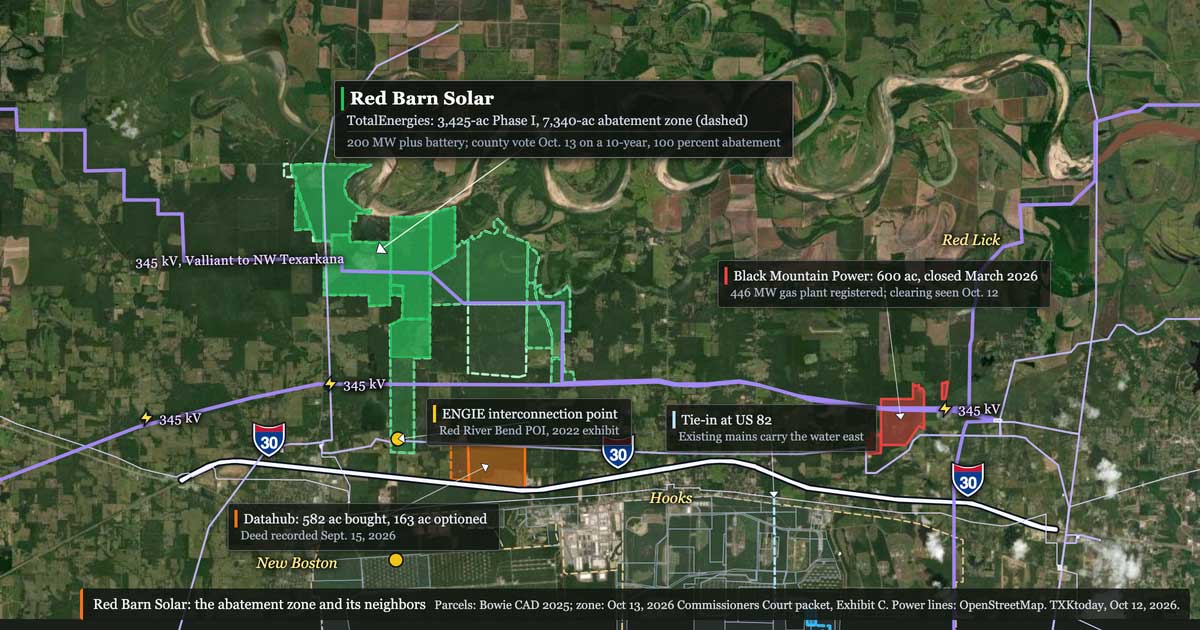
Bowie County commissioners will hold a public hearing Tuesday morning, then vote on a package for Red Barn Solar, a 200-megawatt solar and battery project TotalEnergies wants to build on about 3,400 acres of timber land between State Highway 8 and the Red River, north of New Boston and Hooks.
The meeting starts at 9 a.m. at the county courthouse in New Boston. Three items are on the agenda: creating a reinvestment zone for the project, approving a road use agreement and adopting a tax abatement agreement under Chapter 312 of the Texas Tax Code, according to the clerk’s notice stamped Oct. 6.
What Red Barn Solar is
Red Barn Solar LLC is owned by TotalEnergies, the French oil and gas company, through Core Solar Development of Austin, which TotalEnergies bought in 2022. The company registered with the Texas Secretary of State on Sept. 27, 2023. Its filings are signed by Greg Nelson, a vice president at TotalEnergies Renewables USA.
In October 2023 the company recorded options on roughly 4,900 acres owned by three timber companies: Cabe-Long Properties, MCM Timber and Loblolly Land Company. The project is named for Loblolly’s “Red Barn” tract. Loblolly’s general partner is managed by Michael Sandefur of Texarkana, who led the Bowie Landowners Protection Association’s 2013 fight against a SWEPCO transmission line. In March 2026, a Sandefur-run company, Barkman Creek Land Co., sold about 600 acres near Red Lick to Black Mountain Power.
The first phase covers about 3,425 acres, but the proposed reinvestment zone is much larger. Parcels listed in the packet total about 7,340 acres, using appraisal district figures. The zone’s southern edge comes within about 2.3 miles of the former county-owned tract sold to Datahub Developers in September, though the solar project does not touch that land.
The application calls for a 200-megawatt solar plant paired with a 100-megawatt, 200-megawatt-hour battery system. It puts the investment at $264.5 million, with construction expected to start in the third quarter of 2027 and full operation by the fourth quarter of 2028.
Where the power goes
The electricity is not for Bowie County, and it is not tied to any data center in the public record.
Red Barn’s interconnection agreement with Southwest Power Pool and SWEPCO, accepted by federal regulators Feb. 27, gives the project 201.6 megawatts of network resource interconnection service. In plain terms, the plant feeds the regional grid SWEPCO belongs to, and its output is sold on the wholesale market. It will connect at Orynth, a new SWEPCO substation on the Northwest Texarkana to Valliant 345-kilovolt line, just across the Red River in McCurtain County, Oklahoma.
That agreement sets a commercial operation target of Nov. 15, 2027, about a year earlier than the date in the county application.
No buyer for the power has been announced. By comparison, RWE announced in June that Meta will buy the output of its Rabbit’s Foot Solar project south of DeKalb.
The draft abatement agreement limits the site to solar generation and storage, along with the lines and equipment needed to deliver the power.
What the abatement does
Chapter 312 lets a county exempt new improvements in a reinvestment zone from county property taxes for up to 10 years. It applies only to county taxes. School district taxes are not part of this deal.
The draft agreement would waive 100% of county property taxes on the new improvements for 10 years, starting the January after the plant begins commercial operation.
Instead, the company would pay the county $1,500 per megawatt each year, or $300,000 annually at the 200-megawatt minimum. That payment would cover all county levies, including operations, debt service and road funds.
That is more than the company asked for. Its application, prepared by Rockwall tax consultant KEAndrews, proposed annual payments of $194,492, or about $1.94 million over 10 years. The draft’s $300,000 a year is about 54% higher, by TXKtoday’s calculation, and matches the figure the county reached with RWE for Rabbit’s Foot.
The county still gives up more than it gets. Using the tax rate and $264.5 million value in the company’s application, the project would owe about $1.05 million in county taxes in its first full year without an abatement. The abatement would cost the county roughly $750,000 that year, before the project’s value starts to depreciate. Those figures are TXKtoday’s math from the application, not the county’s.
The application projects the plant will still pay about $210,000 a year in county taxes after the abatement ends, on a depreciated value of $52.9 million. Over 30 years, it estimates $6.1 million in county taxes and $28.6 million in New Boston ISD taxes.
The jobs commitment is small. The company pledges a good-faith effort to create 125 or more temporary construction jobs and to keep at least two full-time jobs during the abatement, with no requirement that they go to county residents. It would offer up to $15,000 to an operations employee who moves to Bowie County for two years, and it agrees to keep the plant running for 10 years after the abatement ends.
The road use agreement sets approved routes for construction traffic and requires a $100,000 surety bond before heavy construction begins. It also allows the company to run power lines across county rights of way.
The county hired Austin firm Allison, Bass and Magee in November 2025 to help with the Red Barn deal. Red Barn presented to the court on Dec. 22, 2025, the same day commissioners approved Rabbit’s Foot’s second reinvestment zone.
Where the other projects stand
Red Barn is one of several power and data center projects that have landed in this corner of the county over the past two years. Here is where each stands as of Oct. 12, based on public records.
Rabbit’s Foot Solar (RWE). The 298-megawatt first phase south of DeKalb is under construction, with a Nov. 12, 2027, operation target and a Meta purchase agreement announced in June. The county approved its first zone and abatement in April 2025 and a second zone in December. On Sept. 30, SPP filed an interconnection agreement for Rabbit’s Foot 2, a 52-megawatt addition at the same substation.
Former county tract (Datahub Developers). The county, Hooks and New Boston signed the deed for the 582-acre tract between New Boston and Hooks on Sept. 11, and it was recorded Sept. 15. On Sept. 23, Hooks residents confronted the city council over the sale. The council kept the city’s industrial development board intact but agreed to seat two council members on it, KSLA reported. At least six Bowie County residents have since filed comments opposing data centers here with the Public Utility Commission of Texas in its large-load project. The Atlanta Journal-Constitution reported Sept. 29 that officials say the buyer now goes by Foundrie Hyperscale Data. Nothing has been filed with the state or SPP for a data center on the tract.
Project Big Pine (Potentia Development and TexAmericas Center). The roughly 490-acre site sits on TexAmericas Center’s East Campus at Bowie Parkway and FM 991. No tenant has been named, and nothing has been filed with state or federal regulators.
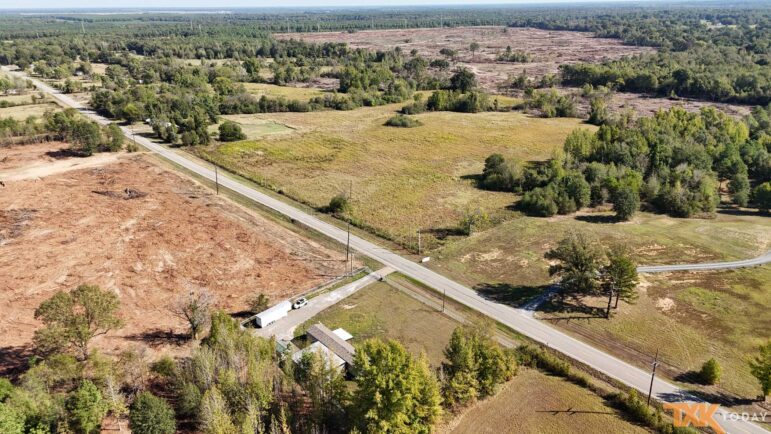
Black Mountain Power. The Fort Worth company bought about 600 acres near Red Lick in March. An affiliate, Fort Worth Power Core, holds a state air permit approved that month for a 446-megawatt natural gas plant on the land, intended to sell power. A TXKtoday check of state and federal filings Oct. 12 found nothing new since.
Red River Bend Solar (ENGIE). The project on TexAmericas Center’s West Campus has a tax agreement with New Boston ISD and a 2021 lease from TexAmericas Center but has not started construction. TexAmericas Center dropped it from its active prospect list in late 2024.
SWEPCO. Administrative law judges sent both of the utility’s pending Texas cases, its large-load contract and its base rate case, back to the PUC on Oct. 5 and Oct. 6 after the parties settled. Neither is on the commission’s Oct. 15 agenda. In Arkansas, regulators suspended SWEPCO’s proposed transmission cost rider on Sept. 24 for up to nine months.
Tuesday’s meeting allows up to three minutes of public comment per speaker on agenda items. Speakers must turn in a form at least 15 minutes before the meeting starts.