

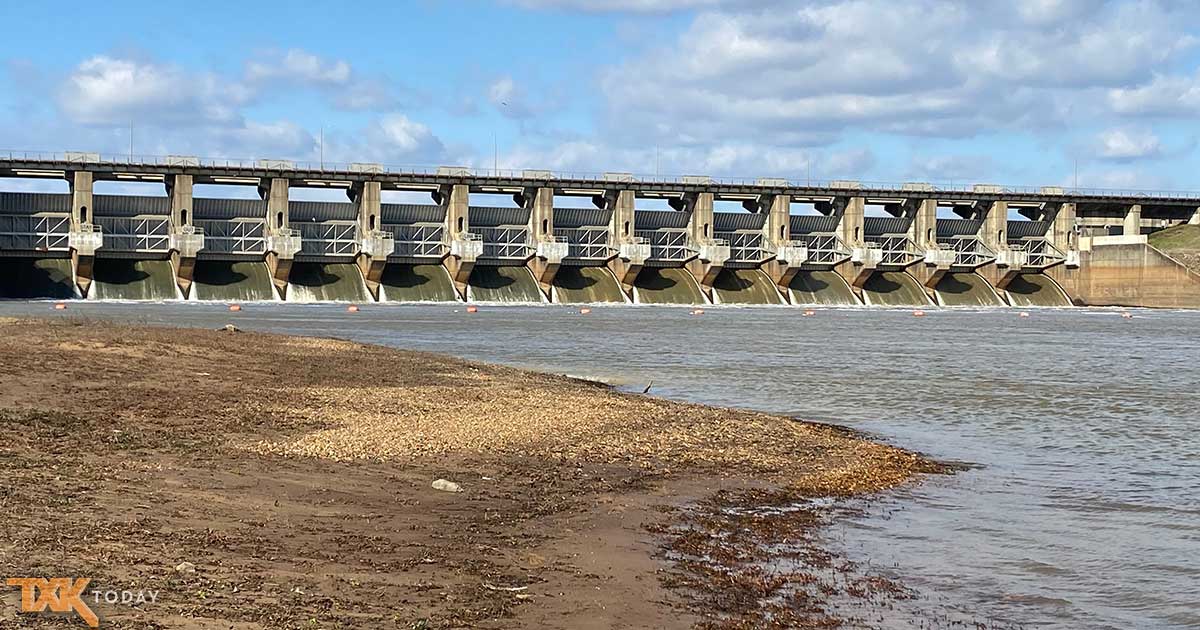
Texarkana, Arkansas, board votes 6-0 to seek state approval for Millwood Lake water sale to Texas

The Texarkana, Arkansas, Board of Directors voted 6-0 Tuesday night to let the Southwest Arkansas Water District ask the state for permission to move up to 110 million gallons a day of the city’s Millwood Lake water into Texas, and to deal only with Heartland Water Partners LLC while that application is pending.
The board read the ordinance three times, adopted it and attached an emergency clause in four separate roll calls, all unanimous, during a 48-minute special called meeting at City Hall. Mayor Allen Brown was absent. Assistant Mayor Ulysses Brewer presided, and Directors Danny Jewell, Steve Smith, Terry Roberts, Laney Harris and Steven Hollibush voted yes each time.
The vote came eight days after City Manager Tyler Richards first laid out the plan and one day after TXKtoday reported the terms of the draft exclusivity agreement in the meeting packet.
“It is not an agreement to sell any water. We are not bound to sell any water. We are solely exploring this further,” Richards told the board. “Any definitive sale agreement is going to have to come back before this board, and it’s a fairly lengthy process, so it’s not going to be soon.”
State Sen. Jimmy Hickey Jr., R-Texarkana, said afterward that he had texted Richards a statement opposing the deal and asked him to read it to the board before the vote. It was not read. Hickey’s name did not come up during the meeting.
What the city voted for
The ordinance authorizes Brown and Richards to sign the exclusivity agreement with Heartland, the water district and the cities of Hope and Ashdown and the town of Ogden, and lets the district file the out-of-state transfer application with the Arkansas Natural Resources Commission on the city’s behalf.
Richards called the step “simply to make application” and listed what the vote does not do: it does not obligate a sale even if the state approves, does not transfer title to any water rights, does not commit city money to construction and does not pledge the city’s credit.
In return for the exclusivity, Heartland would pay the city what Richards called reservation payments, “a good faith showing from Heartland that they are serious about this project.” Jewell asked him to confirm the amounts. Richards said each payment would be roughly $550,000, with the first due when the district files the application. Under the draft agreement, the second comes if the General Assembly approves the transfer and the third when a final sale agreement is signed.
Asked what happens to the first payment if the state denies the application, Richards said the city keeps it. “The only way we would have to pay that money back is if something happened, we were in breach of contract,” he said.
Richards said the city paid about $27 million for the 99.8 million gallons a day of storage it bought in 2016, in 50 annual installments of about $541,000 to the U.S. Army Corps of Engineers. “This water is just being released over the dam and flowing into the Gulf,” he said. “We’re going to continue paying for these water rights no matter whether we use them or not.”
The city holds rights to about 150 million gallons a day and would keep about 40 million after a sale, which Richards said is more than four times the state’s projected demand for the city in 2050.
The lake study and the timeline
Richards said a study by Spheros Environmental, an engineering firm, modeled the added withdrawal against 36 years of lake data and found Millwood could support about 190 million gallons a day of additional withdrawal, well above what the city proposes. He said the model showed no effect on the Corps’ minimum releases downstream and no longer low-water periods, and that in the 2011 drought, the worst on record for the lake, the district would still have held 25 percent of its conservation pool. Richards told the board last week that Heartland commissioned the study.
A director asked how long the state review would take. Richards said the commission has 120 days to review the application and make a recommendation to the General Assembly, and that it meets every other month, so its November meeting is the last chance to reach the legislative session that begins in January. He said the commission will announce the application in November and open a public comment period of about two weeks.
“This is a first for everyone,” Richards said. “This has never been done before. They had to create the application for this.”
If lawmakers approve, Richards said, engineering would take 12 to 18 months and pipeline construction about four years. He said water transfer contracts in this market typically pay the seller about half the sale price as a reservation payment from the day a final agreement is signed, including during construction. Jewell asked whether that meant half of the $15 million to $20 million a year Richards has projected. “Correct,” Richards said, adding that “these are all things that still have to be negotiated.”
Harris presses on who benefits
Harris, the Ward 2 director, questioned Richards for about seven minutes. He asked whether another buyer could still approach the city. Richards said anyone could call, but the city would have to tell them it could not negotiate. Harris asked whether the city would be shortchanging itself if a lithium industry in Miller County later wanted the water, how the city could get out of a contract if a better deal came along, and how water would be measured among the four cities on a single pipeline if one of them dropped out.
“All of those things will be covered in a definitive sale agreement,” Richards said. “We’re nowhere near that yet. This is just step two.”
Harris said he wanted it on the record that the money should go to residents through water bills, streets, sidewalks and neighborhoods, not salaries. “I don’t want none of this money to come where the next thing you know we’re the highest salary people in the state of Arkansas,” he said. He noted that three board seats turn over before any final contract would come back.
Richards said how the money is spent would be a separate board decision, and that he would present a financial plan. “What greater way to control water rates than sell water outside of our community,” he said. When Harris asked whether he would commission a study on the best use of the money, Richards said no.
Brewer said the city would need about $180 million to fix its roads and just passed a bond of about $30 million. “Instead of this being a pipe dream, we will actually have the funds to make a difference for our citizens,” he said.
Two former officials for, one resident against
Danny Gray, a Miller County member of the water district board and a former Texarkana, Arkansas, mayor and director, told the board the district is “there as a placeholder” in the agreement. He said the district has been charged since the 1950s with selling Millwood water to repay the Corps for the dam and that the city, not the district, is the seller.
Gray said that in 22 years on the board, including 10 as mayor, every industrial recruit required tax abatements, roads or water breaks. “This is one instance to where you don’t have to do that,” he said. He compared the deal to the Grimes County, Texas, agreement with Elon Musk’s Terafab chip plant, which he said pays the county $10 million up front and $20 million a year. “You have to do nothing but sell water and get the same thing,” he said. He added that the three lakes above Millwood in the same system still have about 60 million gallons a day of unsold water if the city ever needs more.
Dennis Young, who served on the city board from 1979 to 1986 and in the Arkansas House in the 1990s, read a statement he said he wrote at 1 a.m. He challenged anyone with a better proposal to speak up, “because we do not have the needed funds to properly take care of necessary expenses in our city, and there is no golden goose in sight.” He said the city has run “on a real shoestring budget for years” and suggested sharing about $5 million a year of the proceeds with neighboring cities and counties. “If we fail to grasp this opportunity, look for Shreveport or someone else to dam up more of the Red River and reap the benefit from it,” he said.
Shannon Rose, who said she lives on the Texas side, was the only speaker against. She said the laughter among directors showed “it’s already been decided,” that the board had dismissed Harris’s “very viable” questions, and that she was “mortified” no environmental study would be done. Richards answered that Harris had asked about a financial study. “I think it is ridiculous that water is sold and bought as if it is a stock exchange,” Rose said. “A lot of people are actually against this.”
Hickey says his objection went unread
“All, I am in Little Rock because we have state budget hearings going on. I had text the city manager and asked him to read this statement at the board meeting. For whatever reason, that was not done,” Hickey wrote on Facebook on Tuesday night, posting the text he said he sent Richards.
“I want to publicly state that I am not in favor of this proposal,” the statement says. “A similar situation involving the Red River as a regional project with multiple southwest Arkansas legislators in favor was not successful in the last regular session of 2025. I ask the board members to please consider your vote very carefully. I have already had multiple legislators telling me that this is a bad idea.”
“At the State Capitol, actions and legislation takes on many tentacles which may have adverse consequences,” Hickey wrote. He asked Richards to read the statement “since the General Assembly is being put in the spotlight with the water issue” and said he did not “want any more confusion.” Hickey told the Arkansas Democrat-Gazette last week that he opposes the plan. Any out-of-state transfer needs the General Assembly’s approval.
Hickey’s account: the governor, the Red River and a ‘red flag’
In a longer post Wednesday, Hickey described how he came to oppose the deal. He wrote that the Red River Commission, which has worked for years to open the river to barge navigation, had a tentative agreement before the 2025 regular session to sell water directly to Texas and asked him and other southwest Arkansas legislators to make it a regional project. “The funds would flow directly from Texas without any middlemen or private investor groups,” he wrote, and would have paid for locks and dams. “This project would be a huge economic boost for years to come.”
Hickey wrote that he, Rep. Carol Dalby of Texarkana, Rep. Lane Jean of Magnolia, Rep. DeAnn Vaught of Horatio and Sen. Steve Crowell of Magnolia met at the state Department of Commerce with commission representatives to begin negotiations between the two states and draft legislation. A few weeks later, he wrote, the department’s secretary told him and Jean “that the Governor did not want to sell Arkansas’s water to Texas.” Hickey said he and Jean pushed to keep talking and cited the minimum dollar amount under discussion, the secretary said he was unaware of the project’s size and would ask again, and then “once again told myself and Rep Jean that the Governor did not want to sell water to Texas.”
“Although we could have continued on with legislation ourselves, we dropped this because we needed the Dept of Commerce to help with the state to state negotiations and also would have liked to have the Governor’s support for the regional project,” Hickey wrote.
About 10 months later, Hickey wrote, Texarkana city officials asked to meet and told him the city wanted to sell Millwood Lake water to Texas. He said he told them what the governor had said and that he was not in favor. A second meeting, with him and Dalby, took place at the Rose Law Firm in Little Rock, which Richards has said is the city’s counsel on the deal, with city officials and “representatives of a private investor group.”
“They indicated that the Governor may be in support of selling water to Texas if Arkansas Natural Resources was in favor,” Hickey wrote. “Myself and Rep Dalby told them that this did not make any sense and that this was raising red flags for us.”
At a third meeting, Hickey wrote, the two learned that talks had continued with the investor group and lobbyists, and asked who the lobbyists were. “We were told that one of the lobbyists is Chris Caldwell who has very close connections with the Governor,” he wrote. “We stated that this was an absolute red flag and we would not be involved.”
Caldwell was Gov. Sarah Huckabee Sanders’ 2022 campaign manager and is a senior adviser to her 2026 campaign. A spokesman for Sanders told the Democrat-Gazette last week that it was too early for the governor “to weigh in on a proposal before the City of Texarkana has even submitted it to ANRC.”
No director asked who owns Heartland Water Partners. The draft agreement directs the company’s legal notices to the Dallas office of Grey Rock Investment Partners, a private equity firm, and state records show Heartland has hired Caldwell and a second lobbyist, Robert Moery, a former aide to Gov. Asa Hutchinson, as TXKtoday reported Monday.
Nobody raised the change from the resolution Richards described last week to an ordinance with an emergency clause, which makes the measure effective immediately. The ordinance says the clause is needed because the unused water “is currently being released to downstream riparian parties, including those in the State of Louisiana, at no charge.”
Under the agreement, the cities must tell the district and Heartland in writing by Nov. 1 how much water they are committing. The Natural Resources Commission meets Nov. 18 in Little Rock. The General Assembly convenes Jan. 11. If no application is filed by Jan. 31, any party can end the agreement on 30 days’ notice.
The board’s next regular meeting is at 6 p.m. Monday, Oct. 19. The full meeting is on the city’s YouTube channel, and the agenda packet with the draft agreement is here.