

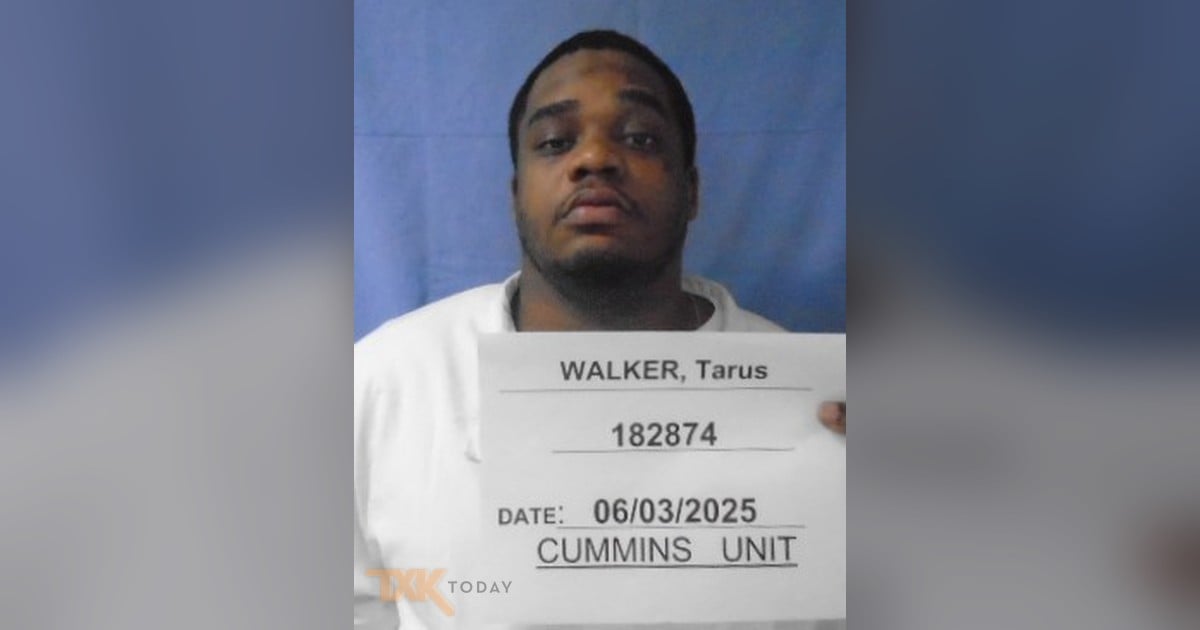
Arkansas Supreme Court revives Texarkana man’s challenge to Christmas Day murder conviction

TEXARKANA, Ark. – The Arkansas Supreme Court on Thursday revived a Texarkana man’s bid to challenge his capital murder conviction after the petition he mailed from prison was turned away because a corrections officer sent it without getting it notarized.
Tarus Walker is serving life without parole for the Dec. 25, 2022, shooting death of Aaron Bruce, 40, in the parking lot of the Brookhollow Apartments on East 24th Street. A Miller County jury convicted him in February 2024.
In an opinion written by Justice Rhonda Wood, the court reversed Circuit Judge Carlton Jones’ dismissal of Walker’s petition as untimely and sent the case back to Miller County for Jones to decide whether Walker did enough to meet his deadline.
After the Supreme Court upheld his conviction in September 2025, Walker had 60 days from the court’s Sept. 30 mandate to file a petition under Rule 37, the procedure that lets an inmate argue his trial lawyer was ineffective. Because the 60th day fell on a Saturday, the petition was due Monday, Dec. 1, 2025.
According to the opinion, Walker was in isolation while he prepared the petition. On Nov. 21, 10 days before the deadline, he handed the signed petition to a corrections sergeant with a request that it be notarized and mailed. The sergeant admits she dropped it in the mail “without being notarized accidently,” the opinion said.
Rule 37 requires a petition to carry the inmate’s sworn, notarized affidavit, and it bars circuit clerks from filing one without it. The Miller County circuit clerk received Walker’s petition but did not file it. The clerk also did not keep the envelope or stamp the petition as received, the court noted, even though the rules say clerks “shall” keep the envelope. The petition was mailed back to Walker on Dec. 3.
Walker says he learned on Dec. 18 that his petition had been returned. A notarized copy was filed Dec. 23, followed on Dec. 29 by a motion asking the court to accept it as timely and a sworn declaration about his lack of access to a notary. In January he filed an affidavit from the sergeant explaining what happened, according to the Miller County case file.
Jones dismissed the petition in February. His order said it was filed 24 days late and was “too late a filing for the Court to consider.”
The Supreme Court said the Rule 37 deadline is jurisdictional, but that it has recognized equitable tolling of a deadline when a litigant acts diligently and is not responsible for the late filing.
“Walker provides evidence that he acted diligently by handing the petition to Sergeant Washington for mailing on November 21, ten days before its due date on December 1,” Wood wrote. “Washington corroborates these factual assertions. But the circuit clerk did not retain the envelope from Walker’s first attempt to file the petition, which adds to our difficulty in determining the timing.”
The majority also pointed to a summary of Arkansas Division of Correction policy that Walker included in his own brief. It indicates that inmates in punitive isolation sign documents in the notary’s presence. That left open why Walker believed his petition would be notarized outside his presence and whether he was misled, Wood wrote.
“Because these factual questions remain unresolved, we reverse and remand this matter to the circuit court to determine whether Walker acted with reasonable diligence such that his belated petition should have been allowed,” the opinion said.
Justice Shawn Womack, joined by Justice Nicholas Bronni, agreed the dismissal was wrong but dissented from sending the case back for more fact-finding.
“The majority is right to conclude that the circuit court clearly erred in dismissing Tarus Walker’s Rule 37 petition as untimely. That, however, is the only thing the majority gets right,” Womack wrote. “With the record we have, what else was Walker supposed to do? We can determine that he acted diligently without the circuit court holding a hearing on the matter. To do anything more is a waste of time for the circuit court, the State, and Walker.”
Special Justice Cory Cox joined the majority. Justice Barbara Webb did not participate. Walker represented himself; Assistant Attorney General Jacob Jones represented the state.
Thursday’s ruling does not address the substance of Walker’s claims. His petition lists 11 grounds, most of them faulting his trial lawyer. Among them, Walker contends the lawyer failed to call an alibi witness, failed to develop information that Bruce was armed, did not get a juror removed who Walker says slept through critical parts of the trial, and agreed to a curative instruction instead of pressing for a mistrial after a detective told jurors about a felon-in-possession charge. He asks for a new trial “or a negotiated plea.”
In upholding the conviction last year, the Supreme Court recounted trial testimony that Walker confronted Bruce, who was dating the mother of Walker’s children, while armed with an AK-style rifle. Bruce’s cousin, Patrick Ross, testified that he pleaded with Walker not to shoot, but Walker said Bruce “was going to die today” and shot him multiple times. Walker’s only argument in that appeal was that the judge should have declared a mistrial over the detective’s testimony.
A second man charged in Bruce’s death, Nathaniel Fort, was convicted of capital murder by a Miller County jury on Feb. 29, 2024, and sentenced to life without parole. The Supreme Court affirmed his conviction in October 2025.
Walker is held at the Arkansas Division of Correction’s Cummins Unit.