

‘Your Home Away From Home’: The Texarkana businesses that guided Black travelers through the Jim Crow South

TEXARKANA — For 25 years, a slim green paperback told Black motorists where they could safely eat, sleep and buy gasoline in a country where choosing the wrong door could be dangerous. And for all 25 of those years, Texarkana was in it — on both sides of the state line.
“The Negro Motorist Green Book,” first published in 1936 by Victor Hugo Green, a Black postal carrier from Harlem, became the essential travel companion for African American families during the era of legal segregation. In much of the South, hotels, restaurants, restrooms and service stations were closed to Black customers. Some communities were “sundown towns,” where Black travelers faced the threat of violence if caught within city limits after dark. A guidebook listing the businesses that would welcome them was not a convenience. It could be a matter of survival.
A TXKtoday review of digitized Green Book editions held by the New York Public Library’s Schomburg Center for Research in Black Culture — 21 volumes spanning 1937 to 1964, all in the public domain — found Texarkana listed in every edition that covered the region, beginning with the guide’s first Arkansas and Texas listings in 1939 and continuing through the final surviving edition of 1963-64.
A city split by a state line — and mapped by necessity
Texarkana occupies an unusual place in the Green Book’s pages: the same city appears twice in every edition, once under Arkansas and once under Texas. A Black family driving Highway 67 — the old Bankhead Highway, one of the nation’s first transcontinental auto routes — had to navigate two states’ segregation laws without ever leaving town.
The earliest listings, in 1939, were modest. On the Arkansas side, travelers would find Mrs. Conner’s Hotel on West Broad Street and the G. C. Mackey Tourist Home at 102 E. Ninth St. On the Texas side, Brown’s Hotel at 312 W. Elm St. “Tourist homes” were private residences — often owned by Black families of some standing in the community — that opened spare rooms to travelers because no hotel would.
Article continues below
▼ Continue reading
By the following year the Texarkana section had grown to include Grant’s Cafe at 830 Laurel St. and Mrs. D. E. Kennedy’s tourist home at 710 Ash St., and over the next two decades the city’s listings expanded to include restaurants, barbershops, beauty parlors, service stations and a pharmacy.
Three names never left the book. Brown’s Hotel, the Mackey Tourist Home and Grant’s Cafe appear continuously from before World War II through the final edition — a quarter-century of quiet, steady hospitality spanning the entire published life of the guide’s regional coverage.
The advertisers
Most Green Book entries were bare listings: a name, a street address. But by the late 1950s, several Texarkana business owners were doing something notable — paying for display advertising to reach Black travelers directly. Their ads, reproduced with this story, put names and faces on an economy that segregation forced into existence.
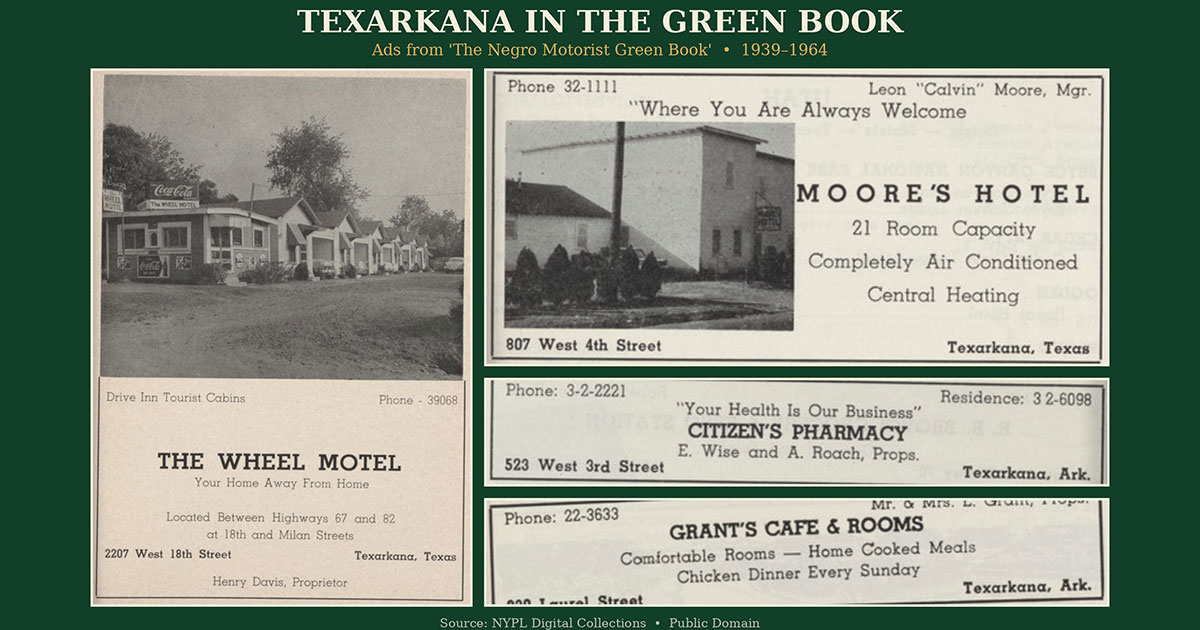
The most striking belongs to The Wheel Motel at 2207 W. 18th St. in Texarkana, Texas. Its ad, which ran in multiple editions around 1960 and 1961, features a photograph of the property — a neat row of drive-in tourist cabins beneath a Coca-Cola sign — with the slogan “Your Home Away From Home.” The proprietor listed his name plainly at the bottom: Henry Davis. The ad located the motel “between Highways 67 and 82 at 18th and Milan Streets,” positioning it for travelers on both major routes through the city.
On the Arkansas side, Mr. and Mrs. L. Grant advertised Grant’s Cafe & Rooms on Laurel Street with a promise that reads like an invitation to Sunday supper: “Comfortable Rooms — Home Cooked Meals — Chicken Dinner Every Sunday.”
Moore’s Hotel at 807 W. 4th St. in Texarkana, Texas, advertised in the 1962 edition under manager Leon “Calvin” Moore, touting a 21-room capacity, complete air conditioning and central heating beneath the greeting “Where You Are Always Welcome” — a phrase that carried weight in an era when most establishments’ message to Black travelers was precisely the opposite.
Citizen’s Pharmacy at 523 W. 3rd St. in Texarkana, Arkansas, run by proprietors E. Wise and A. Roach, advertised under the motto “Your Health Is Our Business.” And Smitty’s Service Station, Garage & Cafe, on King’s Highway a half-mile south of Route 67, told motorists simply: “Your car needs our Service.”
For a small business owner, buying an ad in a national guide for Black travelers was both a commercial decision and a public act. These proprietors were not merely tolerating Black customers; they were competing for them, investing in them and building institutions around them.
The full roster
Across the guide’s run, TXKtoday’s review identified more than 20 Texarkana establishments listed at various times. On the Arkansas side: Brown’s Hotel (which appears in later editions at 312 W. Elm St. under the Arkansas heading), Mrs. Conner’s Hotel, the G. C. Mackey and Mrs. D. E. Kennedy tourist homes, Grant’s Cafe, Citizen’s Pharmacy, Smith & Rand Service Station, the G. Powell and Williams barbershops, and the M. B. Randall beauty parlor on Laurel Street, among others. On the Texas side: the Lola Hotel at 214 Oak St., Moore’s Hotel, the Sunset Motel at 1508 North St., The Wheel Motel, the Casino Restaurant at 504 W. 3rd St., the Dutchess Tea Room on Capp Street, Carl Hill’s garage at 925 W. 20th St., a DX service station and garage, and Smitty’s.
The addresses trace the geography of Black commercial life in mid-century Texarkana — Laurel, Elm, Ninth and Ash streets on one side of the line; Oak, West 3rd, West 4th and West 18th on the other.
The end of the book — and the question of what remains
The Green Book’s final editions appeared in the mid-1960s. The Civil Rights Act of 1964 outlawed segregation in public accommodations, and the guide — whose founder had long expressed hope that it would one day be unnecessary — ceased publication soon after. The 1963-64 edition, the last held in the NYPL collection, still carried six Texarkana listings: Brown’s Hotel, the Mackey Tourist Home and Grant’s Cafe in Arkansas; the Casino Restaurant, The Wheel Motel and Moore’s Hotel in Texas.
Integration, urban renewal and time have not been kind to Green Book sites nationally; preservationists estimate that most have been demolished or sit unrecognized. The Texas Historical Commission has been surveying the state’s Green Book and other Black travel guide sites since 2019, documenting which buildings still stand.
Do you remember these places? If you or your family have memories, photographs or connections to any of the businesses named in this story — or to the people who ran them — TXKtoday wants to hear from you. Contact us..
Sources: “The Negro Motorist Green Book” editions 1939-1964, New York Public Library Digital Collections, Schomburg Center for Research in Black Culture (public domain); University of Virginia “Architecture of The Negro Travelers’ Green Book” project; Encyclopedia of Arkansas; Texas Historical Commission African American Travel Guide Survey Project. Page images accompanying this story are reproduced from the NYPL’s digitized editions.