

New Texas THC Ban Is Now in Effect; Marijuana Laws Did Not Change
Delta-8, delta-10 and similar manufactured THC products are now controlled substances in Texas. The state’s marijuana possession law did not change.

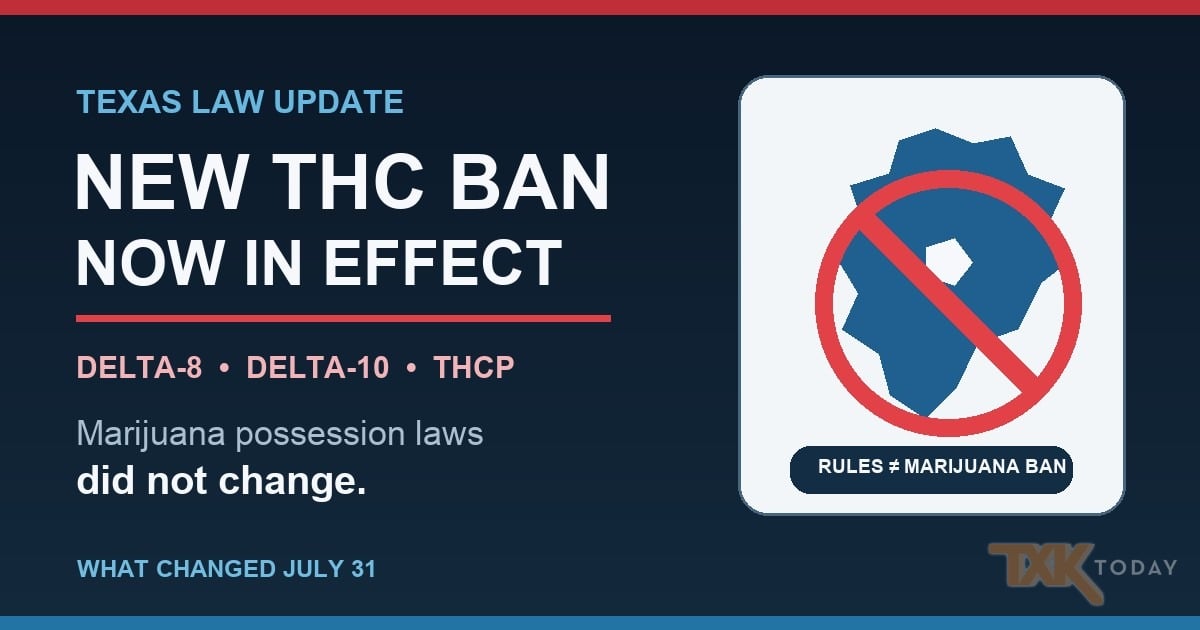
Delta-8, delta-10 and similar manufactured THC products became controlled substances in Texas on Friday. Possession can be a felony. The state’s marijuana possession statute was not changed.
A broad ban on hemp-derived THC products took effect in Texas on Friday, pulling delta-8, delta-10, THCP and other manufactured THC compounds off store shelves and placing them under the state’s Schedule I controlled-substance rules.
The change did not come from a new act of the Legislature. It came from a Texas Department of State Health Services definition first adopted in 2021 and reinstated after a Texas Supreme Court ruling this spring.
Here is what changed, what did not and what remains unsettled.
What is now illegal
DSHS reinstated its 2021 definitions of “tetrahydrocannabinols” and “marihuana extract.” The definitions sweep in THC isomers and variants beyond delta-9, while preserving the statutory exception for hemp containing no more than 0.3% delta-9 THC by dry weight.
Article continues below
▼ Continue reading
According to the official notice published in the July 10 Texas Register, the definition covers synthetic equivalents, derivatives and isomers with chemical structures and pharmacological activity similar to THC found in cannabis.
In practical terms, the rule covers many products smoke shops and hemp retailers have sold during the past five years, including delta-8 gummies, delta-10 edibles and THCP products. Many are manufactured by chemically converting CBD into other cannabinoids.
Possession of a controlled substance placed on the schedule by the commissioner but not assigned to another penalty group can be prosecuted as a state jail felony. A state jail felony carries 180 days to two years in a state jail and a fine of up to $10,000.
Businesses also face licensing, civil and potential criminal consequences for selling products covered by the reinstated definitions. DSHS has advised that products labeled as containing delta-8, or shown to contain more than naturally occurring trace amounts of THC isomers, may be detained and referred to law enforcement.
What is still legal
Delta-9 THC products remain legal under Texas hemp law when the finished product contains no more than 0.3% delta-9 THC by dry weight. That is the federal hemp threshold established by the 2018 Farm Bill and incorporated into Texas law.
That means qualifying delta-9 edibles, beverages and tinctures remain on the market, even though some can be intoxicating.
The DSHS Consumable Hemp Program says only trace amounts of delta-8 THC naturally produced by the hemp plant are permissible. Manufactured delta-8 and similar compounds are the target of the reinstated rule.
Sales of consumable hemp products to people younger than 21 are prohibited under rules adopted after Gov. Greg Abbott issued Executive Order GA-56 in September 2025.
Vapes are a separate issue. Senate Bill 2024 made it a Class A misdemeanor to market, sell or offer an e-cigarette product containing or marketed as containing cannabinoids. That law took effect Sept. 1, 2025.
Marijuana law did not change
None of the rule changes altered the way Texas law treats marijuana possession.
Texas Health and Safety Code 481.121 still governs possession, with penalties based on weight. Possession of two ounces or less is a Class B misdemeanor punishable by up to 180 days in county jail and a fine of up to $2,000. Possession of two to four ounces is a Class A misdemeanor. Possession of more than four ounces is a felony, with penalties increasing by weight.
A drug conviction can also trigger a six-month driver’s license suspension.
THC concentrates are treated more harshly than marijuana flower. They generally fall under Penalty Group 2, where possession of less than one gram is a state jail felony.
The legal line separating hemp from marijuana also remains unchanged: 0.3% delta-9 THC by dry weight.
The unsettled question: smokable hemp flower
Smokable flower remains the murkiest part of the legal picture.
A separate set of DSHS rules adopted this year changed how total THC is calculated. Under that formula, THCA counts toward the limit based on its potential conversion to delta-9 THC. THCA is not intoxicating on its own but converts to delta-9 when heated.
The calculation could remove most high-THCA smokable hemp flower and pre-rolls from the legal market. The rule took effect March 31, was blocked by a Travis County judge in May and was later allowed to take effect while litigation continued. Questions about enforcement and how particular products are tested and labeled remain.
Some coverage has treated THCA flower as part of Friday’s broader change. Other accounts have treated smokable flower as controlled primarily by the separate Travis County litigation. The proceedings overlap, and the legal answer for a specific product can depend on its composition, testing and labeling.
The same regulatory litigation involved sharply higher industry fees. The DSHS website currently lists consumable-hemp product licenses at $10,000 annually per location and retail registrations at $5,000 annually per location, plus online fees.
How Texas got here
The 2019 Texas hemp law legalized hemp and created the state’s consumable-hemp market. Retailers built businesses around delta-8 and other compounds the law did not specifically name.
In October 2021, DSHS expanded its controlled-substance definitions to capture those compounds. Austin retailer Hometown Hero and other plaintiffs sued and obtained an injunction that remained in place for years.
The Texas Register notice says the Texas Supreme Court reversed the injunction on May 1, 2026. The court issued its mandate dismissing the plaintiffs’ claims on June 5, allowing DSHS to reinstate the definitions.
Lawmakers separately tried to close the gap by statute. Senate Bill 3 would have banned hemp-derived THC products in 2025, but Abbott vetoed the legislation and called for regulation instead. Two special sessions followed without passage of a major hemp bill.
DSHS published the reinstatement notice July 10. The definitions took effect July 31.
What comes next
A federal deadline is close behind. Section 781 of H.R. 5371, signed in November 2025, rewrites the federal definition of hemp to exclude products with intoxicating levels of THC. That change is scheduled to take effect Nov. 12, 2026, and could reach some products that remain legal in Texas today.
The Texas Legislature returns Jan. 12. Lt. Gov. Dan Patrick has directed a Senate committee to study THC and its effects on health care costs, mental-health detentions and psychosis diagnoses.
Additional industry litigation is also expected, meaning the legal boundaries for some hemp products may continue changing.