

Flock Cameras in Texarkana, Explained

Flock Cameras in Texarkana,
Explained
License plate readers now watch roads on both sides of the state line. What they record, what police use them for, what they can’t do, and the questions still unanswered at City Hall — a plain-language guide.
Flock in Texarkana at a glance
What Flock cameras are
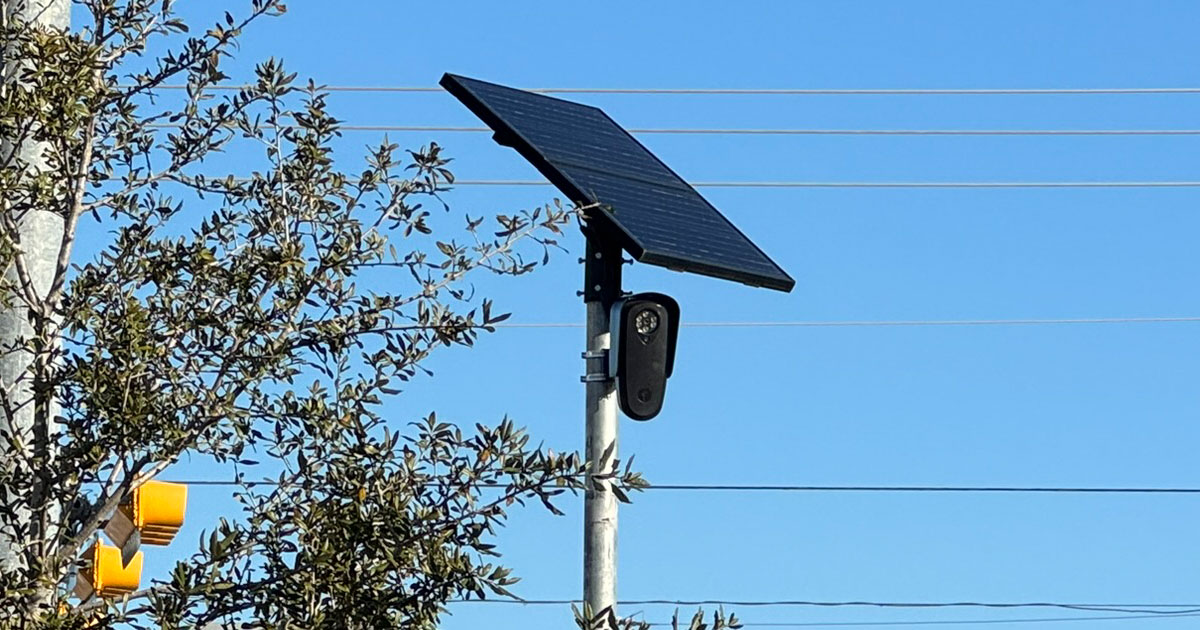
Flock Safety is an Atlanta-based company that sells automatic license plate reader (ALPR) cameras to police departments, homeowners associations and businesses across the country. The cameras are small, fixed units — usually solar-powered, mounted on poles along busy roads — that photograph every vehicle that passes.
Thousands of communities nationwide use Flock’s system, and Texarkana is one of them — on both sides of the state line. The Texarkana, Texas Police Department has operated Flock cameras since 2023, and the Texarkana, Arkansas Police Department runs its own, smaller network.
The short version
Flock cameras photograph the back of every passing vehicle, read the plate, and check it against databases of stolen cars and wanted people. A match sends an instant alert to police. Every read — match or not — is stored in Flock’s cloud for a limited time and can be searched by officers. They are not red-light or speed cameras, and they don’t send anyone a ticket.
How the system works
Each camera captures a rear image of a passing vehicle. Flock’s software then extracts more than the plate number — the company calls it a “vehicle fingerprint”: make, model, color, and identifying details such as bumper stickers, roof racks, toolboxes and visible damage, along with the time, location and direction of travel.
- Hotlist alerts. Every plate is checked in real time against databases including stolen-vehicle and wanted-person lists and AMBER and Silver alerts. A hit pings officers immediately.
- Searchable history. All reads — not just hits — go to Flock’s cloud, where authorized users can search by plate, vehicle description or location. Flock’s standard retention is 30 days, after which the data deletes automatically unless saved as evidence.
- Network sharing. Departments can opt in to statewide and national lookup networks, letting outside agencies search their cameras — and letting local officers search cameras elsewhere. This sharing is the source of much of the national controversy.
What they don’t do
Flock’s plate readers are not facial-recognition cameras — Texarkana, Texas police note the cameras shoot the rear of the vehicle and don’t identify drivers or passengers. They don’t measure speed and don’t issue citations. The privacy debate is about the records: weeks of time-stamped locations for every car on a road, searchable after the fact.
Flock in Texarkana
TXK Today was the first outlet to report on the local deployment, in April 2025. On the Texas side, about 20 cameras have operated around the city since June 2023 — one of them, on Richmond Road, was photographed by a resident in 2026. Texarkana, Texas police also run plate readers in patrol cars, which alert officers in real time to flagged vehicles they pass.
According to Texarkana, Texas Police public information officer Shawn Vaughn, access to the system is limited — searches and alerts are largely handled by detectives and crime analysts, with entries logged for accountability.
On the Arkansas side, the Texarkana, Arkansas Police Department operates eight Flock cameras, making it one of roughly 40 Arkansas law enforcement agencies using the company’s system.
What the Texas contract shows
A City of Texarkana, Texas council packet reviewed by TXK Today answers several of the questions raised at City Hall. On December 11, 2023, the City Council voted in regular public session to approve Resolution No. 2023-161, authorizing the city manager to sign a five-year contract with Flock Safety of Atlanta, Georgia for an amount not to exceed $141,950, paid from the city’s General Fund. The item was brought by the police department — with Capt. Michael Henry as action officer — and approved under Mayor Bob Bruggeman.
The deal did two things: it locked in pricing for five years ahead of an announced Flock price increase, and it expanded the city’s fixed cameras from eight to 11. The original eight had cost about $21,500 a year; the new contract raised the recurring cost to $28,000 a year. The order form lists ten Flock Safety Falcon cameras plus one Falcon Flex unit, a 60-month initial term with 24-month renewals, and Flock’s standard 30-day data retention.
The 2023 contract authorized 11 fixed cameras; TXK Today’s later reporting has put the number around the city at roughly 20, suggesting the network has grown since — another detail the city has not detailed publicly.
Which features the city bought
The order form shows Texarkana, Texas purchased Flock’s “Essentials” FlockOS package. Among the capabilities it includes:
- State and nationwide lookup networks — the ability to search license plates across cameras that other Texas and out-of-state agencies have opted into the Flock network.
- Direct Share with surrounding jurisdictions — full access to share cameras with neighboring departments.
- Vehicle Fingerprint search — searching by make, color and features such as bumper stickers and roof racks, not just the plate number.
- Real-time NCIC alerts — automatic pings when a plate listed in the national crime database passes a camera.
- Unlimited custom hot lists and an analytics dashboard that includes search and audit logs.
The contract shows what the city purchased; which features are actually switched on, and how searches are audited day to day, is a separate question the department has not addressed publicly.
Where the cameras are
The map below shows license plate reader locations in the Texarkana area as reported to DeFlock, a crowdsourced project that maps ALPR cameras nationwide. Locations are submitted by volunteers who spot the cameras in the field.
Because the map is community-reported, it may be incomplete or include cameras operated by agencies other than the two city police departments — neither city has published an official map of its camera locations.
What police say they’ve gotten out of it
By the department’s account, the cameras have worked. In the system’s first 18 months on the Texas side, police credited it with recovering stolen vehicles — many from outside the area, including one taken in Arlington — and with arrests of people with outstanding warrants. In one case, a wanted suspect traveling between Little Rock and Dallas was caught after his plate triggered an alert.
“Locally the success that we’ve had in terms of being able to arrest people with warrants as well as recover stolen vehicles has been quite exceptional,” Vaughn told TXK Today in 2025.
A 2026 case shows how detectives use the system to build a case. After a Texarkana man allegedly staged the theft of his own Ford F-250 and camper to collect an insurance payout — then had the camper burned — Detective Lauren Freeman used the area’s Flock cameras to track a black Ford dually seen near the scene, following it across multiple camera locations to a family property where the stolen vehicles were hidden. Three men were charged with engaging in organized criminal activity. Read the full story.
What the Arkansas department’s search log shows
One of the open questions in this guide has been whether the public can see how local police actually use the system. On the Arkansas side, at least, part of the answer is now available. The Texarkana, Arkansas Police Department publishes a search-audit log through Flock’s public transparency portal, and TXK Today reviewed 30 days of it, covering May 24 to June 22, 2026.
It is a revealing snapshot. In that single month, the department ran 226 license-plate searches, an average of about eight a day. And although the Arkansas department operates only eight cameras of its own, the great majority of those searches reached far beyond Texarkana.
30 days of searches, by the numbers
- 226 searches in 30 days, about eight per day.
- 83% scanned 500 or more separate camera networks at once. The typical search reached 833 networks; the largest single search queried 6,177.
- Drugs and narcotics was the most common stated purpose (50 searches, about 22%), followed by stolen vehicles (32) and wanted persons (23).
- The box where an officer types the reason for a search was left blank in 69% of cases. The most common entry in the rest was “Investigstive,” a misspelling logged 16 times.
The network figures are the most striking part. Those eight Arkansas cameras are a small local footprint, but the searches run through them are not local at all. By opting into Flock’s nationwide lookup, an officer running a single plate search is simultaneously querying cameras on hundreds or thousands of other Flock networks across the country, networks operated by other police departments, businesses and neighborhoods. A typical Texarkana, Arkansas search swept more than 800 of them. The biggest reached more than 6,000.
The stated reasons run from the most serious crimes to routine matters. Homicide, robbery, kidnapping and weapons offenses all appear in the log. So do six searches logged as “Traffic Infraction,” one as “City Planning/Traffic Analysis” and one as “Prostitution,” several of which still scanned 800 or more networks nationwide.
None of this means a given search was improper. The log records an offense category for every entry, and plate readers are routinely used for exactly the kinds of cases that dominate the list. But the blank reason field on more than two-thirds of searches speaks directly to the accountability question raised at City Hall. The log shows that a search happened and what broad category it fell under, but usually not why a specific vehicle was run, or by whom: the officer identities are redacted.
Source: Texarkana, Arkansas Police Department public search-audit log via Flock Safety, covering May 24 to June 22, 2026 (226 records), reviewed by TXK Today. The log lists each search’s date, the number of camera networks queried, an offense category and an optional free-text reason.
Found what you were looking for?
Get trusted local news, helpful guides, event recommendations and community stories delivered to your inbox for free.
The concerns
Nationally, Flock has become one of the most debated technologies in policing, and the concerns raised elsewhere have now been raised in Texarkana too:
- A record of everyone’s movements. Because every read is stored, the system builds a searchable history of where ordinary drivers — not just suspects — have been. Civil-liberties groups, including the ACLU, argue that weeks of location data on every passing car amounts to warrantless tracking.
- Who else can search it. Reporting around the country in 2025 and 2026 documented outside agencies — including federal ones — running searches through local departments’ shared Flock networks. In June 2026, Dayton, Ohio physically covered its cameras after an audit found searches that violated city policy on immigration enforcement.
- Misuse by individual officers. Documented cases elsewhere include officers using plate readers to track former partners and other private citizens.
- Mistakes. A misread plate can trigger a high-risk stop of an innocent driver — in Sherwood, Arkansas, a camera that misread a plate by one letter led police to stop a driver whose car wasn’t stolen.
- Feature creep. Flock can add capabilities — including video — to existing cameras with an over-the-air software update, without new hardware or a new public vote.
At the Texarkana, Texas City Council’s June 8, 2026 meeting, a resident raised many of these points during open forum and pressed the council on how the city’s system is governed.
What’s answered — and what isn’t
Four questions were put to the Texarkana, Texas council during the June 2026 open forum. The 2023 contract packet answers the first three, at least on the Texas side:
- Does the city have a contract, and when was it approved? Yes — Resolution 2023-161, approved December 11, 2023.
- Was it voted on in public? Yes — the council approved it by vote in a regular public session, not administratively.
- Which features are included? The order form spells out the “Essentials” package and its capabilities (above), though it doesn’t show which are actively used.
That leaves the question the paperwork doesn’t settle:
- Has the police department adopted a written policy on who may search the database, what counts as a legitimate search, and how misuse is investigated — and is there an audit trail the public can review?
The Arkansas side’s contract and written policy still have not been published, though its search-audit log is now public through Flock’s transparency portal (see The audit log above). TXK Today is continuing to request the ALPR policies and the Texas side’s search logs from both departments, and will update this guide as answers emerge.
Two states, two sets of rules
Texarkana’s state line means the same technology operates under two different legal regimes — sometimes on the same street:
| Texas side | Arkansas side | |
|---|---|---|
| State law on ALPR data | No statewide retention law — local contract and department policy govern | State law requires government entities to purge LPR data after 150 days |
| In practice | Flock’s 30-day default applies unless the city changes it | Flock’s 30-day default is well inside the state cap; state rules for agency LPR policies are still being finalized |
| Public records law | Texas Public Information Act | Arkansas Freedom of Information Act |
One wrinkle noted by Arkansas journalists: the state’s 150-day purge requirement binds government entities — not necessarily the private vendor holding the data.
Your rights and the paper trail
The contracts, policies and audit logs behind these systems are public records. If you want to see them:
- Texas side: file a Texas Public Information Act request with the City of Texarkana, Texas for the Flock contract, the police department’s ALPR policy, and search-audit logs. The city generally has 10 business days to respond.
- Arkansas side: file an Arkansas FOIA request with the City of Texarkana, Arkansas — Arkansas’s FOIA clock is faster, generally three business days.
- Flock transparency portals: some departments publish a public dashboard of their camera counts, search totals and audit logs through Flock itself. The Texarkana, Arkansas department has one enabled, which is the source of the search-log findings above; whether the Texas department has activated its own is still an open question.
TXK Today’s Flock coverage
TXK Today first reported the cameras’ local success record in April 2025 and covered the June 2026 council meeting where the system’s governance was challenged. For the latest, see our News section.
Sources: TXK Today archival reporting; City of Texarkana, Texas council packet and Resolution No. 2023-161 (approved Dec. 11, 2023); Texarkana, Texas Police Department statements; Texarkana, Arkansas Police Department public search-audit log via Flock Safety (May 24–June 22, 2026, 226 records); Flock Safety data-privacy policy; Arkansas license plate reader statutes and proposed state rules; regional reporting on Arkansas Flock deployments. Camera counts are as reported and may change as contracts are renewed or expanded.
This guide is part of the TXK Today Guides series — plain-language explainers on the institutions and systems that shape life in the Texarkana region. Spot an error or an update we should make? Email [email protected].