

The Rocket Docket, Explained: How East Texas Became the Patent Capital of America
The U.S. District Court for the Eastern District of Texas is the busiest patent court in America, and the historic state-line courthouse in Texarkana is one of its seven divisions. A guide to the rocket docket, patent trolls and the cases landing here now.

The “Rocket Docket,”
Explained
For more than 20 years, the U.S. District Court for the Eastern District of Texas has been the single most popular place in America to file a patent lawsuit – and Texarkana’s historic courthouse on the state line is one of its six divisions. Here is how a stretch of East Texas became the patent capital of the country, and why fresh suits against companies like Synology and Shake Shack keep landing here.
At a glance
The local landmark: the courthouse on the line
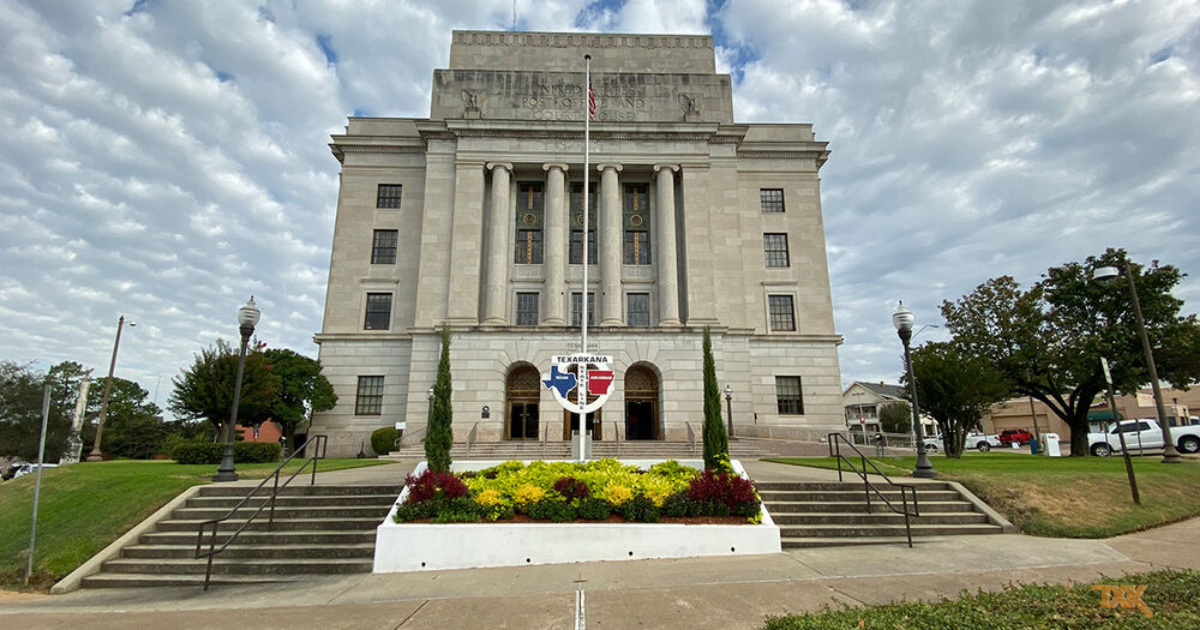
Drive to 500 N. State Line Avenue in downtown Texarkana and you are looking at one of the most unusual federal buildings in the United States. The U.S. Post Office and Courthouse, completed in 1933, is the only federal building in the country that sits in two states at once. The state line runs straight through it.
The building was designed to show off that split. Its base is pink granite from Texas. Its walls are limestone from Arkansas. The style is Beaux-Arts with Art Deco touches, and it was added to the National Register of Historic Places in 2000. Federal law itself acknowledges the oddity: the statute governing the court allows proceedings to be held anywhere in “the Federal courthouse in Texarkana that is located astride the State line between Texas and Arkansas.”
Out front sits “Photographer’s Island,” the little plaza, redone by both cities in 2021, where visitors plant one foot in Texas and the other in Arkansas for a photo. Local boosters like to call it the second-most-photographed courthouse in America, behind only the U.S. Supreme Court.
One building, two courts
That single building houses two separate federal trial courts. On the Texas side is the U.S. District Court for the Eastern District of Texas, Texarkana Division. On the Arkansas side is the U.S. District Court for the Western District of Arkansas, Texarkana Division. An appeal from the Texas courtroom travels to the Fifth Circuit in New Orleans. An appeal from the Arkansas courtroom goes to the Eighth Circuit in St. Louis. Same building, two judicial worlds.
The Texas-side court here covers four counties: Bowie, Franklin, Red River and Titus. And it is one slice of a much larger and much more famous court.
What is the Eastern District of Texas?
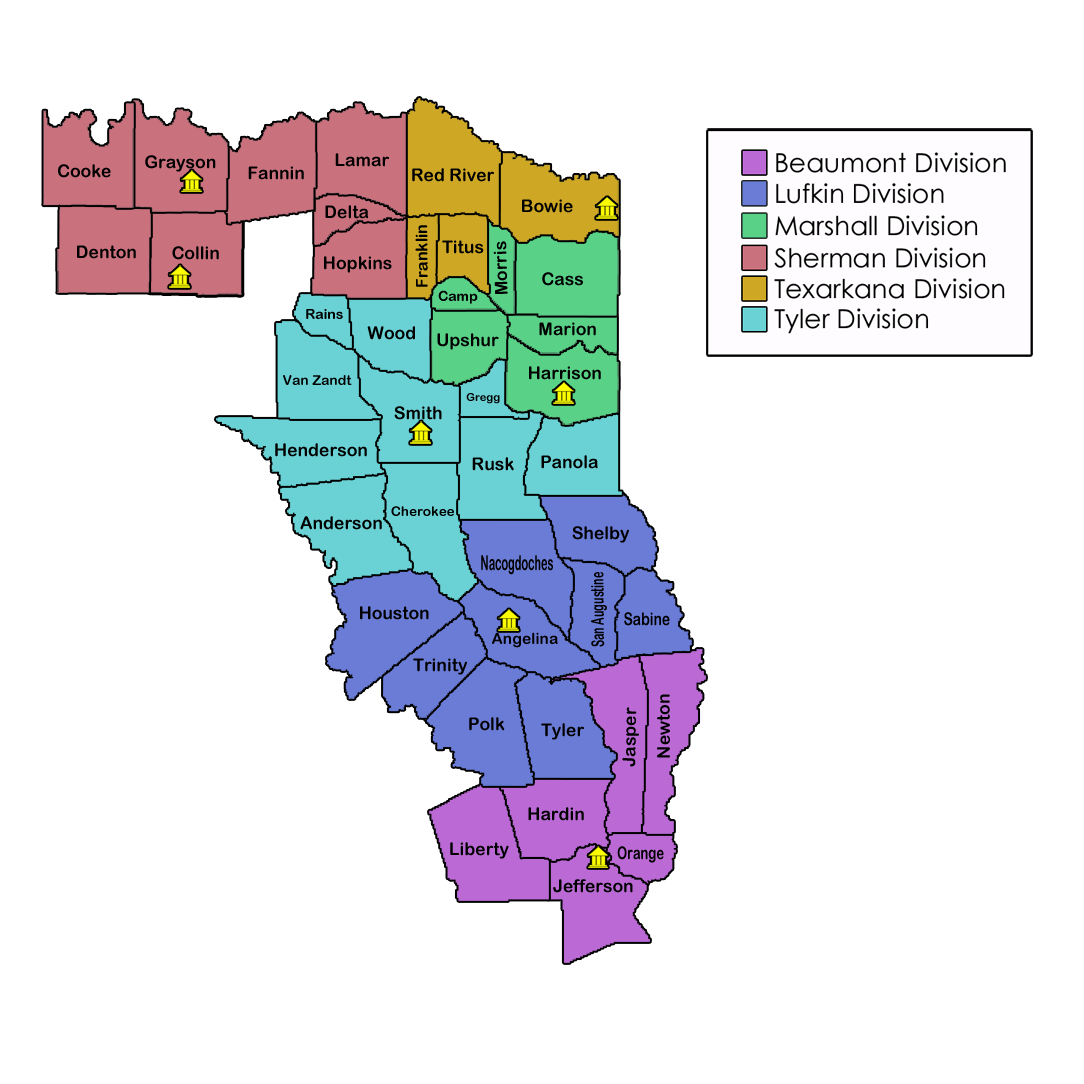
The federal court system divides each state into districts. Texas has four. The Eastern District, created back in 1857, runs across the eastern third of the state and is split into six divisions: Beaumont, Lufkin, Marshall, Sherman, Texarkana and Tyler, with an additional courthouse in Plano. Its headquarters is the William M. Steger Federal Building in Tyler. The district has eight active judgeships, plus senior and magistrate judges who help carry the load.
On paper, it is an ordinary federal court that hears the usual mix of criminal cases, civil disputes and government matters. In practice, one category of case made it world-famous: patents.
How East Texas became the “rocket docket”
Patent fights are won and lost on procedure, money and time, and in the late 1990s a federal judge in Marshall figured out how to control all three.
Judge T. John Ward took the bench in Marshall in 1999. The district barely had a patent docket then. It saw just 14 patent cases that year. Ward studied the patent rules used in the tech-heavy Northern District of California, adapted them, and rolled out his own fast, strict local rules around 2000. He set hard deadlines. He sanctioned lawyers who dragged their feet. He famously used a chess clock to ration each side’s time at trial, giving lawyers a fixed budget of hours instead of letting cases sprawl for weeks.
That speed earned the nickname “rocket docket.” East Texas did not invent the phrase. The original rocket docket was the U.S. District Court for the Eastern District of Virginia in Alexandria, which lawyers nicknamed back in the 1970s for the breakneck pace set by Judge Albert V. Bryan Jr., who was known to rule from the bench on the spot and try entire cases in a single afternoon. Marshall earned the same label for the same trait, and it drew patent owners like a magnet, for three reasons:
- Speed. Fast trials put pressure on defendants. The sooner a company faces a jury, the more tempting it is to settle.
- Friendly juries. East Texas juries built a reputation for siding with patent holders, winning the large majority of trials, well above the national average.
- Predictable rules. The local patent rules and the judges’ deep experience made the district familiar and reliable for the lawyers who filed there again and again.
The short version
The Eastern District of Texas went from 14 patent cases in 1999 to roughly 2,540 in 2015. At the peak, close to half of all patent lawsuits filed in the entire United States were filed here, and a huge share landed in Marshall, a town of about 25,000 people.
Found what you were looking for?
Get trusted local news, helpful guides, event recommendations and community stories delivered to your inbox for free.
The busiest patent judge in America
When Ward retired, the mantle passed to Judge J. Rodney Gilstrap, who still sits in Marshall and is regularly described as the busiest patent judge in the country. The label is earned. In recent years a remarkable share of every patent case in America has been assigned to his courtroom alone. In 2024, he was handed roughly 795 new patent lawsuits, several times more than any other federal judge in the nation.
That concentration has drawn both business and criticism. Supporters say Gilstrap and his colleagues are simply efficient experts who know patent law cold. Critics have accused the court of bending the rules on where a case can be filed to keep cases in East Texas, and some of those rule changes have been struck down on appeal. Either way, the gravity of the place is real: if you want a patent trial, the odds say it happens here.
The Supreme Court hit the brakes, then the cases came back
The district’s dominance hit a wall in 2017. In a case called TC Heartland v. Kraft Foods, the U.S. Supreme Court tightened the rules for where a patent suit can be filed. The justices ruled that, for venue purposes, a company “resides” only in the state where it is incorporated. A few months later, a federal appeals court added more limits, making clear that a lone sales employee working from a home office was not enough to anchor a big company in East Texas.
The effect was immediate. Patent filings in the Eastern District of Texas dropped sharply, and Delaware, where huge numbers of companies are incorporated, became the new hot spot.
But the district did not stay down. By 2024 and 2025 it had clawed its way back to the top, once again ranking as the number one venue for patent litigation in the country, and especially for suits brought by patent-licensing companies. Part of that rebound came from next door: a rival rocket docket had sprung up in Waco, in the Western District of Texas, under Judge Alan Albright, who at one point was drawing close to a fifth of all U.S. patent cases to his single courtroom. In 2022, the Western District changed its rules to spread those Waco cases randomly among a dozen judges, and much of that business flowed back east.
What is a “patent troll”?
You cannot understand this court without understanding the kind of plaintiff that fuels much of its docket.
A patent does not require you to actually build or sell anything. It is a legal right to stop others from using your invention, and that right can be bought, sold and enforced like any other asset. A company that owns patents but makes no product of its own is called a non-practicing entity, or NPE. Its business is licensing and litigation: it acquires patents and then sues, or threatens to sue, companies that do make things, collecting settlements and royalties along the way.
Critics call the most aggressive of these companies “patent trolls.” The complaint is that some assert broad or shaky patents mainly to extract quick settlements, betting that a defendant will pay to make the case disappear because fighting it in court costs even more. Defenders counter that NPEs let independent inventors and small companies actually enforce patents they could never afford to defend alone.
These plaintiffs are often small limited-liability companies, frequently organized in Delaware or Texas, sometimes operating out of little more than a mailing address. For years, a modest brick office building in downtown Marshall, steps from the federal courthouse, served as the listed address for dozens of them. A whole local economy of hotels, caterers, jury consultants and local lawyers grew up around the trials.
The cases on the docket right now
Three patent suits filed in the district in just the past few weeks show exactly how this looks in practice.
| Case | Filed | What it is about |
|---|---|---|
| Lone Star Document Management v. Vitrium Systems Marshall Division | June 8, 2026 | A Delaware company with an Austin address accuses Vitrium, a Vancouver software firm, of infringing a patent on an “electronic document proofing system.” Jury trial demanded. |
| Lone Star Document Management v. Synology Marshall Division | June 17, 2026 | Nine days later, the same plaintiff filed the same patent against a different target: Synology, the Taiwanese maker of network storage devices. One patent, one plaintiff, multiple defendants, filed in waves. |
| Near Field Electronics v. Shake Shack Sherman Division | June 12, 2026 | A Plano company sues the burger chain over older patents covering USB and near-field communication chips. The alleged infringement? The contactless “tap to pay” terminals at Shake Shack’s registers. The patents have expired, so the suit seeks damages only for past use. |
The Texarkana connection
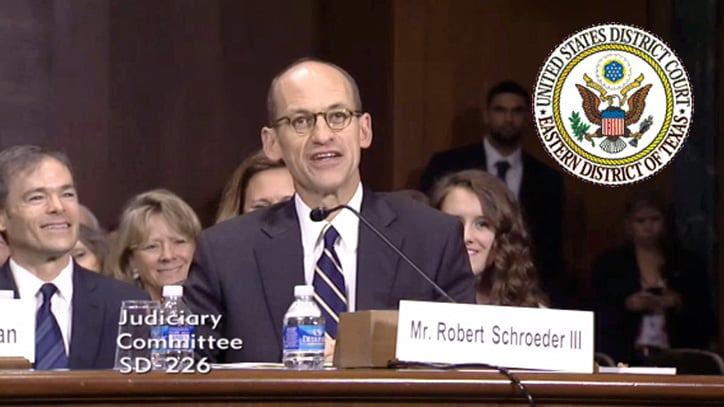
That last case closes the loop back to State Line Avenue. Its docket number carries the initials RWS, for Judge Robert W. Schroeder III, the district’s Texarkana-based judge. Judge Schroeder, a Texarkana native and former local attorney who was confirmed to the federal bench in 2014, took over the seat long held by Judge David Folsom and has presided over some of the biggest patent trials in the district, including the long-running fight between VirnetX and Apple that produced a jury verdict of more than $500 million in 2018.
Why the verdicts get so big
Patent damages are meant to compensate an inventor for what the infringement was worth, and in a market the size of the smartphone or pharmaceutical industries, that number can be enormous. East Texas juries have delivered some of the largest patent awards in American history.
A Marshall jury once handed Johnson & Johnson’s Centocor unit a $1.67 billion verdict against Abbott Laboratories over the arthritis drug Humira, in 2009. An important footnote: a higher court threw that verdict out two years later. More recently, in 2025, a Marshall jury awarded roughly $445 million against Samsung in Judge Gilstrap’s court. Year after year, a large share of the nation’s biggest patent verdicts come out of this one district.
The bottom line for Texarkana
The patent capital of America is not in Washington or Silicon Valley. It runs through a string of East Texas courthouses, and Texarkana’s historic building on the state line is one of them. The next time you tap your card at a checkout, stream a video or open a document in an app, there is a real chance the technology behind it has been, or will be, argued over in a courtroom a short drive from here.
Sources for this guide include the U.S. District Court for the Eastern District of Texas, the General Services Administration, federal law (28 U.S.C. Section 124), the National Register of Historic Places, the court filings in the cases named above, and reporting from Texas Monthly, Vice, the Texas Lawbook, RPX, the ABA Journal and IPWatchdog.