
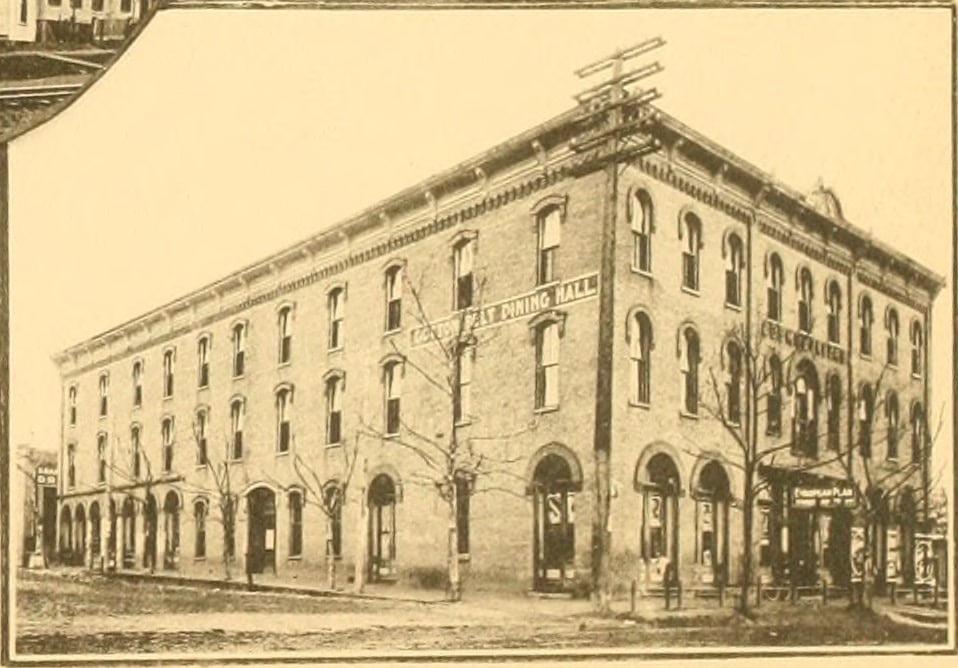
On the afternoon of Tuesday, Nov. 25, 1902, the staff at the Cosmopolitan Hotel in downtown Texarkana started to worry about two guests who had not left their room in more than a day.
The couple had checked in Monday, newlyweds just back from Alabama. They did not come down for supper Monday night or for breakfast or the noon meal Tuesday. When repeated calls at the door went unanswered, the hotel sent for police, and officers broke the door down, according to a special report in the St. Louis Republic.
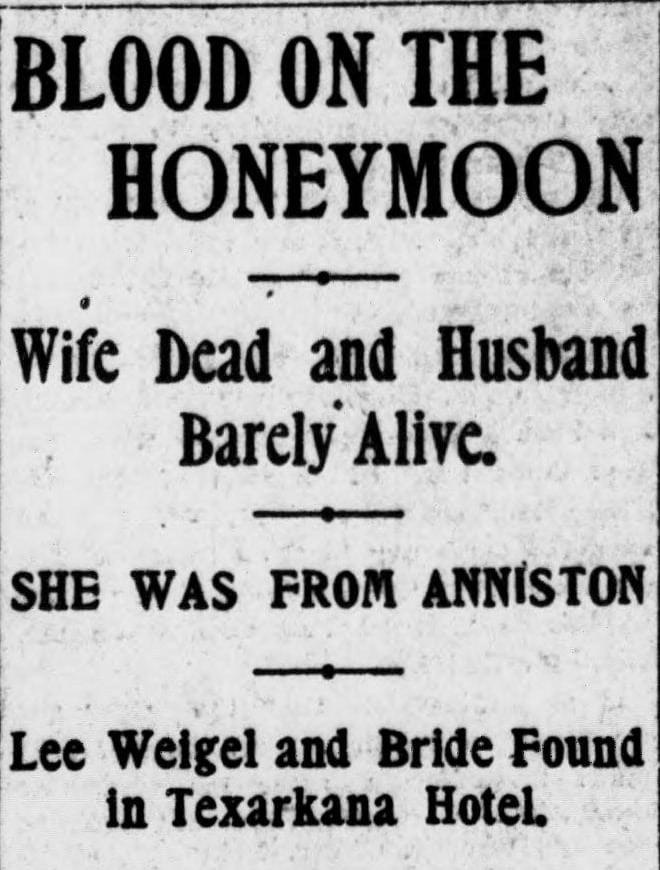
Inside were Lee Weigel of Texarkana and his bride, the former Marie Quinn of Anniston, Ala. Both had their throats cut. She was dead. He was alive but too weak from loss of blood to move. A razor lay near the bed.
They had been married four days.
A wartime romance
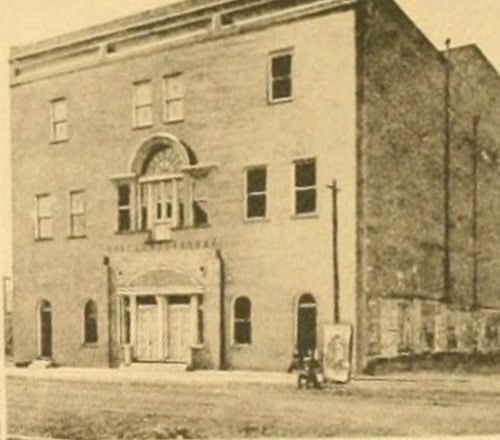
Weigel, about 26, had been partly raised in Texarkana, the Republic reported. He had worked in the Texas and Pacific Railway’s local car department and more recently at the opera house. The paper said he was well liked but “regarded as somewhat erratic at times.” His mother lived in Little Rock. A sister was a professional equestrienne traveling with the Ringling Brothers circus, and a brother had once managed the Western Union office in Texarkana.
He met Marie Quinn during the Spanish-American War, when he served with an Arkansas regiment stationed at Anniston, according to an Associated Press report from Birmingham. Her family was well known there. Her brother A.H. Quinn held a responsible position with the Woodstock Iron Works, and another brother, C.L. Quinn, was Anniston’s city tax collector. A third brother, W.E. Quinn, was a railroad purchasing agent in Shreveport.
About a week before the deaths, Weigel left Texarkana saying he was going to get married. The wedding took place in Anniston on Friday, Nov. 21. The couple reached Texarkana early Monday and went straight to the Cosmopolitan.
The Republic also printed a story, credited to people who would not give details, that the two had married two or three years earlier, quarreled and separated, then reconciled by letter. TXKtoday found no other account that confirms it.
“Deep mystery”
From the start, Weigel would say nothing. He was taken to a local sanitarium, where his wounds were dressed and officers stood guard.
The first reports leaned toward a suicide pact. The room showed no sign of a struggle, and no one at the hotel heard an outcry, the Republic reported. Physicians said Weigel had cut his own throat several times and slashed his wrists but not deeply enough to die, and they believed hours passed after his wife’s death before he turned the razor on himself.
According to the Republic, Weigel sent a bellboy out the first night for morphine and chloroform. A later Texarkana dispatch said he had also bought poison in Montgomery on the trip west and that doctors found him suffering from morphine poisoning. The autopsy found no trace of poison in his wife.
It did find a small knife wound in her left side that had pierced the heart, The Associated Press reported. On Nov. 26, as he lay in bed at the sanitarium, Weigel was served with a warrant charging him with her murder.
W.E. Quinn arrived from Shreveport that day. “How could he have the heart to harm my poor sister?” he said, according to a Texarkana dispatch printed in the Tucson Citizen. He took her body home to Anniston for burial.
Feeling in Texarkana ran “very bitter” against Weigel, the Republic reported.
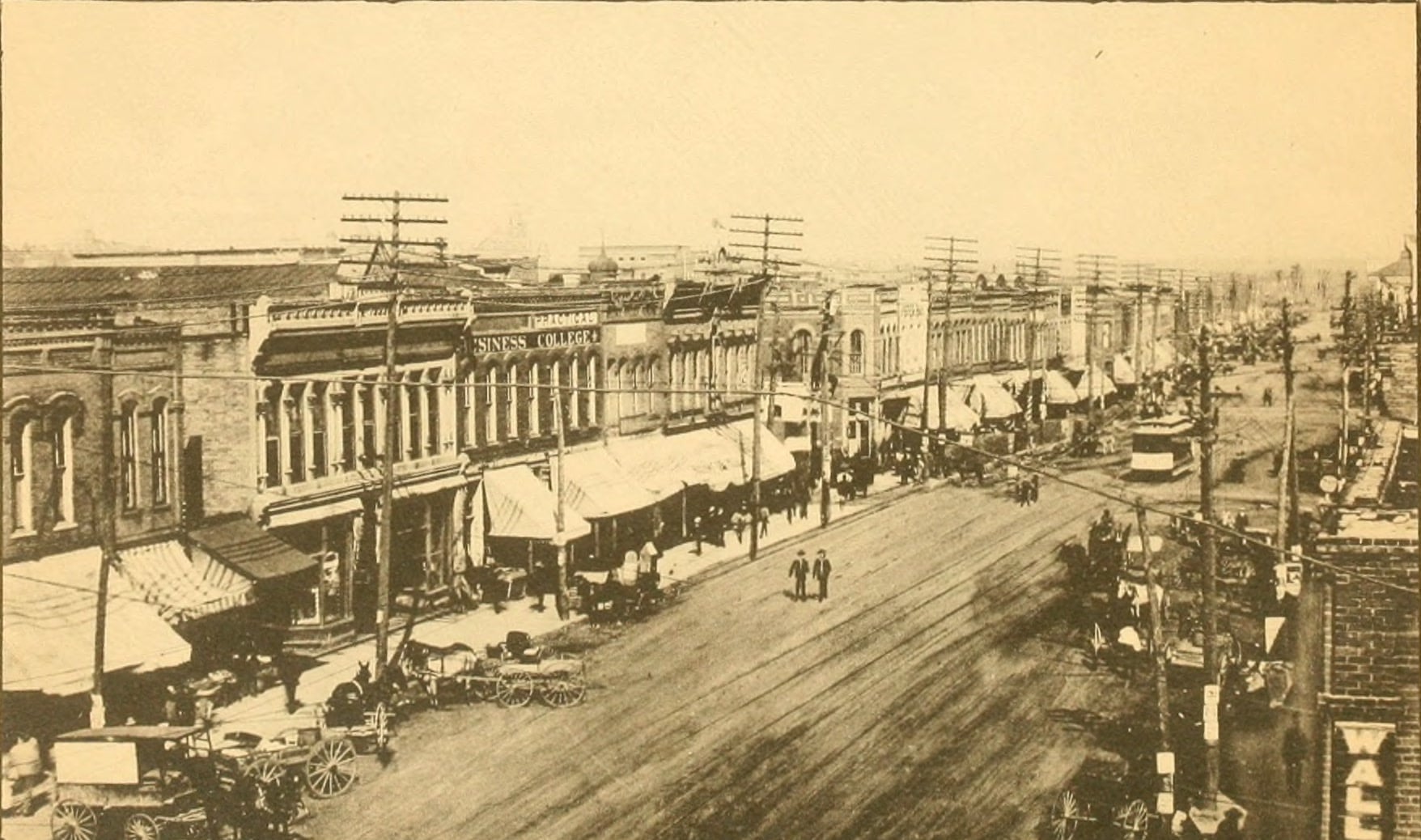
The trial at Boston
On Dec. 3, Weigel was brought from the sanitarium for a preliminary hearing. He waived examination and was ordered held without bail for the grand jury that would meet in March, the Republic reported. He had hired defense lawyers. Her family brought in a leading criminal lawyer from Anniston to help the prosecution.
In March 1903, Arkansas papers reported that Weigel had made what they called a sensational attempt to escape from jail several weeks earlier. They gave no details.
He was indicted and tried in Bowie County District Court at Boston, then the county seat. His lawyers entered a plea of insanity, according to a statewide Arkansas news digest. At the end of March 1903 the jury found him guilty of murder and fixed his punishment at life in prison rather than death.
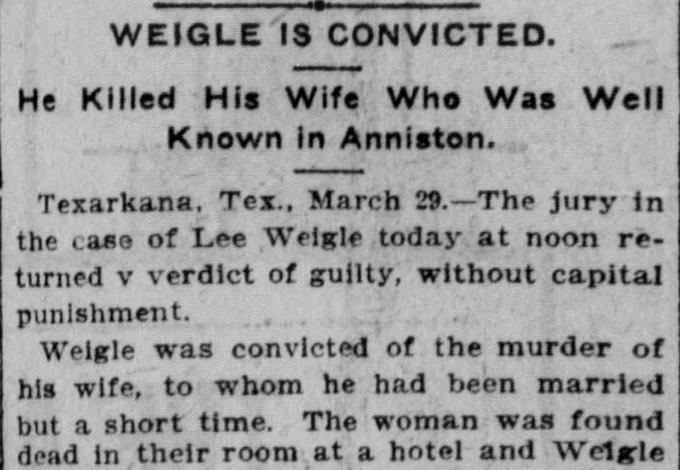
What became of him
What became of him
Weigel served a little more than 10 years. TXKtoday found no published appeal of the conviction.
On May 6, 1913, Gov. O.B. Colquitt granted him a conditional pardon. The Houston Post and the Austin Statesman reported that he was the first prisoner freed on the recommendation of a legislative committee then investigating the state penitentiary. His sister had worked for his release and made her case to the committee in person. The Arkansas Gazette identified her as Lillian Weigel of Texarkana.
The pardon came with conditions. Weigel had to stay sober and “support his aged mother during the remainder of her life and his unmarried sister until such time as she may marry.” The Statesman said his mother was widowed and blind, and that his sister left Austin for Huntsville carrying the document.
A Lee Wiegel born Aug. 1, 1876, in Arkansas died Feb. 2, 1933, at the Veterans’ Administration hospital in Kansas City, Mo., according to his Missouri death certificate. He is buried at Leavenworth National Cemetery in Kansas. Census and soldiers’ home records gathered by family researchers identify him as the same man and show that he remarried and raised sons in Texas after his release.
Nothing in the published record shows that he ever explained what happened in that room.
Marion Quinn Weigel was buried at Hillside Cemetery in Anniston on Nov. 28, 1902, the Anniston Star reported.
The hotel by the depot
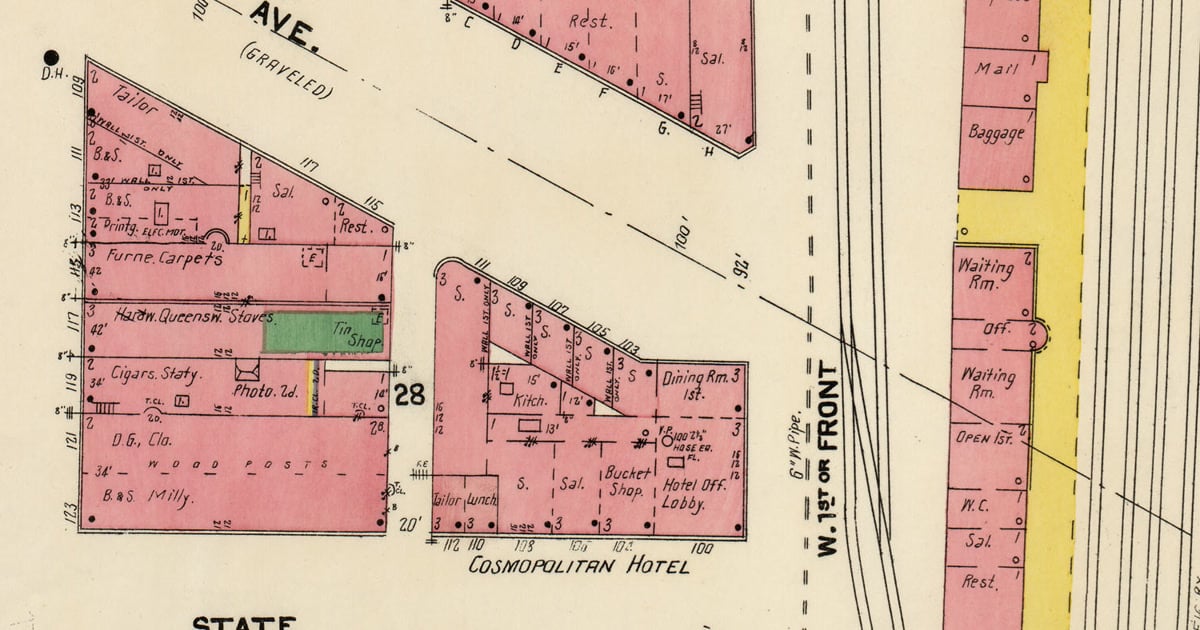
The Cosmopolitan stood on the Texas side of State Line Avenue, at State and Front streets, facing the railroad depot across Front. For anyone stepping off a train, it was the closest bed in town.
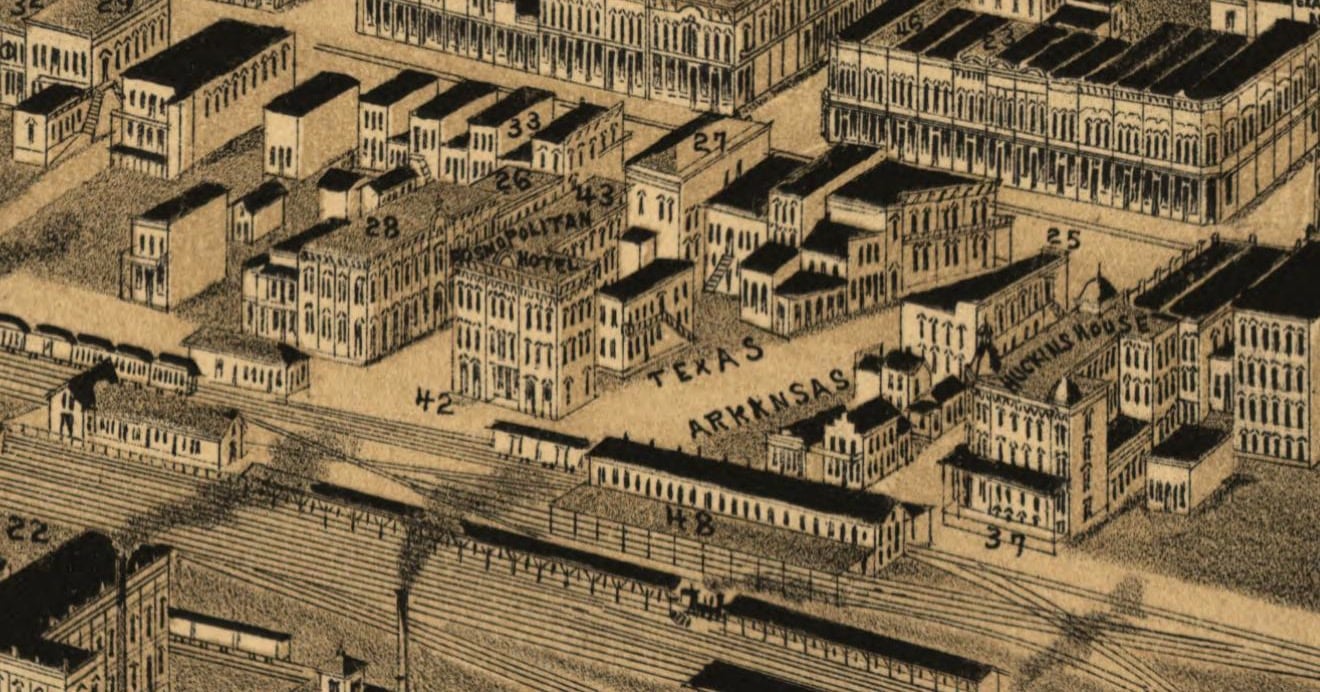
The hotel was operating by 1875 under a proprietor named Davis. It was a plank building when Hank McCartney, a locomotive engineer who came to Texarkana with the Iron Mountain railroad, bought it from a Mrs. Davis and replaced it with a three-story brick hotel, according to his 1896 obituary in the Daily Texarkanian. Outlaws Rube and Jim Burrow and an accomplice registered there in December 1887, days before a train robbery, according to an 1890 book on Rube Burrow. In 1895, prizefighter Bob Fitzsimmons ate supper there, as TXKtoday reported last month.
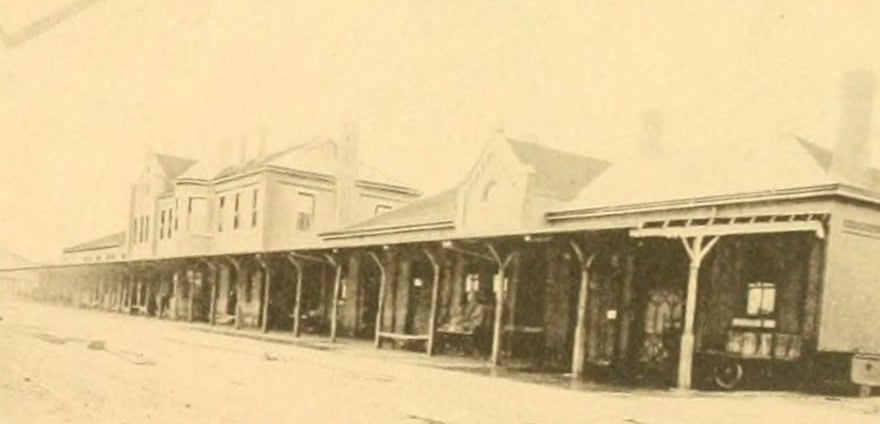
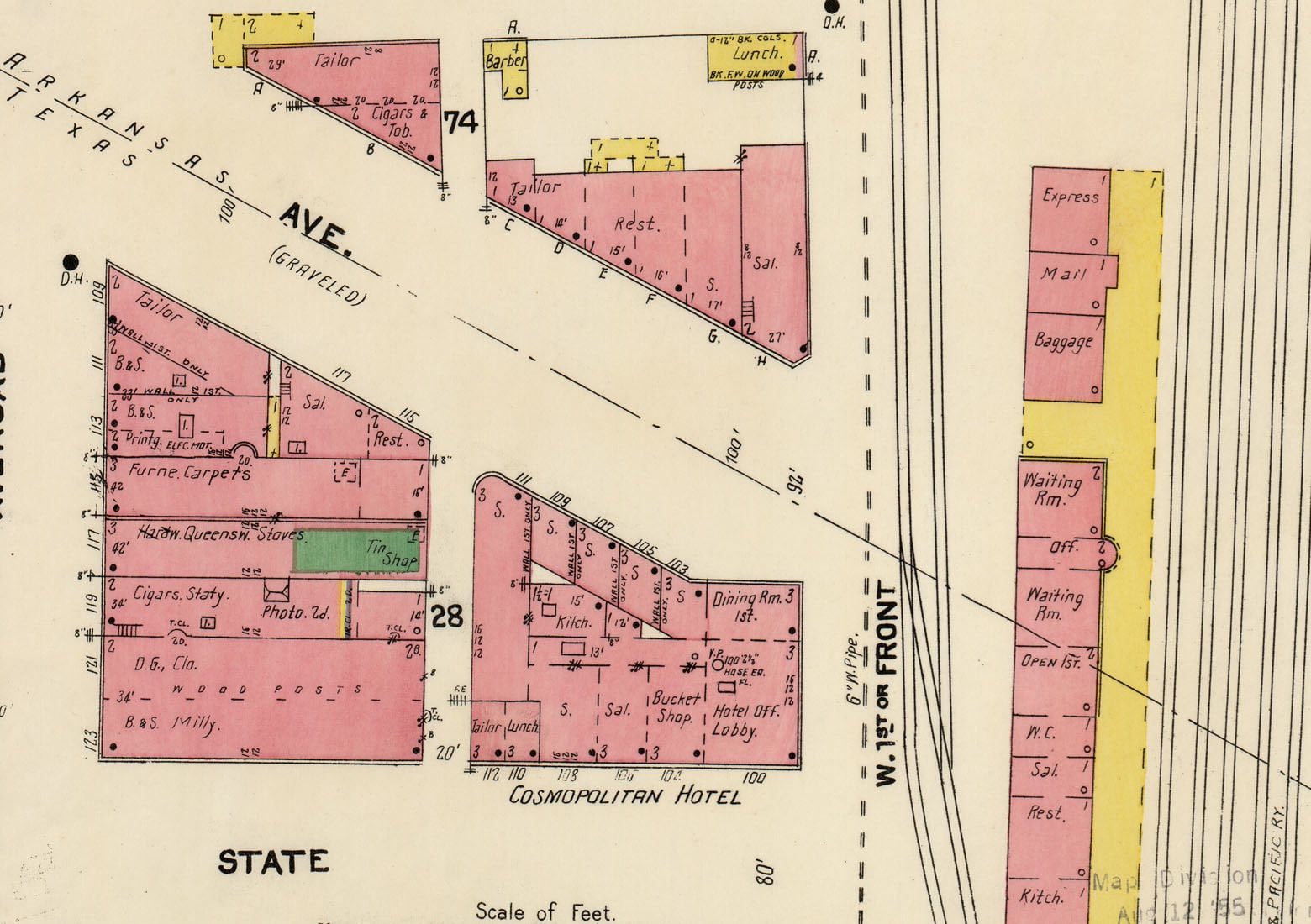
After McCartney died in 1896, his son, Will A. McCartney, ran the hotel into the 1910s. A fire insurance map drawn in 1905 shows a saloon, a “bucket shop” where customers bet on market prices, a lunch counter and a tailor on the ground floor, with the hotel office and lobby on the corner and the dining room behind.
The Hotel McCartney
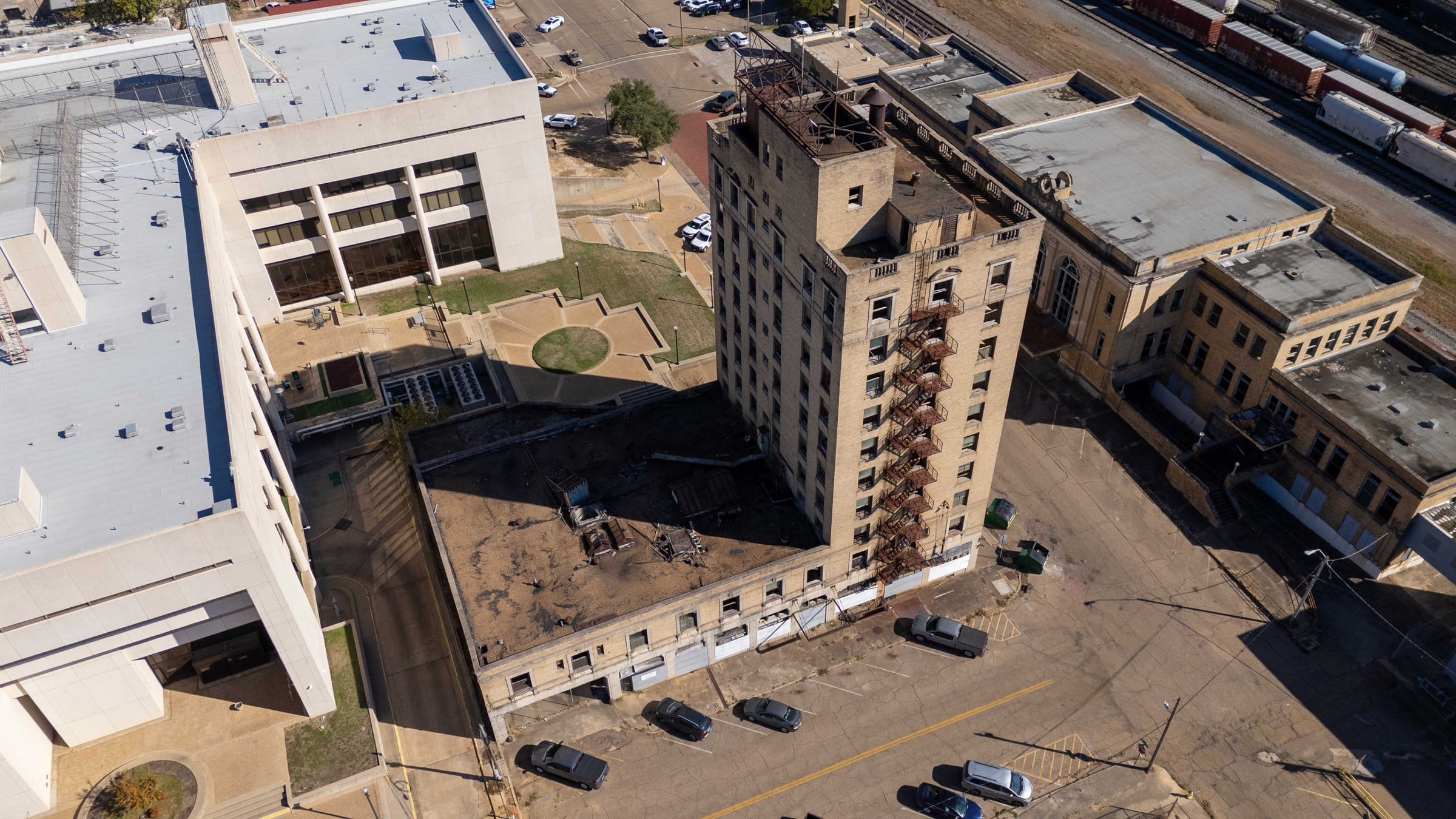
W.A. McCartney razed the Cosmopolitan in 1929 to build the 10-story Hotel McCartney on the lot, according to the building’s 1979 National Register of Historic Places nomination. That October, the Cass County Sun in Linden reported that the contract had been let for a hotel to replace “the ancient Cosmopolitan,” which it said had served Texarkana for more than 40 years. The new building was to cost close to $400,000 and be ready by July 15, 1930.
Houston architect Joseph Finger designed it. A 1939 county history put the finished cost at about $500,000 and counted 120 guest rooms, banquet halls and a ground-floor grill. It also had a bus terminal under its own roof, run by the Tri-State Transit Co. of Shreveport and serving four motor coach lines. The front door faced the new Union Station across Front Street. Inside, the nomination describes an Art Deco lobby and mezzanine trimmed in gold and silver, a curved marble staircase and a second-floor ballroom that opened onto a roof deck.
For four decades it was a place for banquets and receptions. Newspapers in neighboring counties recorded a Bloomburg junior-senior banquet there in 1940, a Southwestern Gas & Electric Co. employee banquet in December 1942, and wedding receptions and bridal luncheons in its Mirror Room in the 1950s. The Texarkana, Texas, housing authority was organized at the hotel on March 1, 1940, according to a National Park Service history of the Stevens Courts housing project.
W.A. McCartney Sr. became known as the city’s “unofficial historian” and published a pamphlet of recollections, “Now I Am 80,” in 1950. The nomination credits gatherings he hosted at the hotel with helping bring four U.S. highways through Texarkana. He died in April 1952 at 81, according to a 1961 collection of pioneer family histories.
The highways he pushed for helped undo the hotel. As passenger trains dwindled and travelers took to the road, a hotel across from the depot lost its advantage. The nomination says it stopped operating as a hotel in the early 1970s. TXKtoday could not find the exact closing date, and later accounts give years from 1970 to 1975.
In 1976 the building was used as a movie set, then sold and used for storage, the nomination says. Portions of “The Town That Dreaded Sundown,” released that year, were shot at the hotel and Union Station, as TXKtoday has reported.
The hotel was listed on the National Register on Sept. 6, 1979. The nomination shows it was then being sold by Twin State Corp. of Texarkana to American Development Corp. of Dallas, and said the plan was to restore the exterior and convert the building to retail and office space. That did not happen. A 2019 guide to Texas architecture described the hotel as “deserted and crumbling.” It still stands empty at Front and Main streets, on the lot where the Cosmopolitan stood.
Do you have family stories about the Weigel or Quinn families, or photos of the Cosmopolitan Hotel? We would like to see them. Get in touch with TXKtoday through our contact page.
Sources
Newspapers via Library of Congress, Chronicling America:
- The Birmingham Age-Herald, Nov. 26, 1902, p. 1: Arkansas Gazette special from Texarkana; the Quinn family
- The Montgomery Advertiser, Nov. 26, 1902, p. 1: “Blood on the Honeymoon”
- The St. Louis Republic, Nov. 26, 1902, p. 11: the discovery, Weigel’s background, the morphine and chloroform
- The Birmingham Age-Herald, Nov. 27, 1902, p. 3 (AP): arrest and autopsy
- The Tucson Citizen, Dec. 2, 1902, p. 1: the Montgomery poison, W.E. Quinn’s words
- The St. Louis Republic, Dec. 4, 1902, p. 16: preliminary hearing, held without bail
- The Forrest City Times, March 13, 1903, p. 1: indictment and escape attempt
- The Birmingham Age-Herald, March 30, 1903, p. 1: verdict
- The Pine Bluff Daily Graphic, March 31, 1903, p. 5: life sentence at Boston
- The Forrest City Times, April 3, 1903, p. 1: insanity plea
- The Daily Texarkanian, Aug. 3, 1896, p. 1: Hank McCartney obituary and the hotel’s origin
Other sources:
- Sanborn Map Co., Texarkana, Texas and Arkansas, October 1905, Sheet 5 (University of Texas Libraries)
- “Souvenir of Texarkana, Arkansas and Texas” (1904), photographs by Gus J. Ghio (Library of Congress, via Internet Archive)
- Henry Wellge & Co., “Perspective Map of Texarkana, Texas and Arkansas” (1888) (Library of Congress)
- National Register nomination, Hotel McCartney (1979) (Texas Historical Commission)
- Agee, “Rube Burrow, King of Outlaws” (1890) (Internet Archive)
- Public Ledger, Memphis, April 1, 1875: Davis as proprietor (Library of Congress)
- The Cass County Sun, Linden, Oct. 29, 1929, p. 1: contract let for the Hotel McCartney (Portal to Texas History)
- The Citizens Journal, Atlanta, May 16, 1940, and Dec. 10, 1942; The Clarksville Times, Nov. 2, 1956; The Naples Monitor, June 18, 1959: events at the hotel (Portal to Texas History)
- Chandler and Howe, “History of Texarkana and Bowie and Miller Counties” (1939): the hotel’s cost, rooms and bus terminal
- “Texarkana Pioneer Family Histories” (1961): W.A. McCartney Sr.
- Historic American Buildings Survey, Stevens Courts Housing Project (National Park Service, via Library of Congress)
- Moorhead et al., “Buildings of Texas” (2019), Old Hotel McCartney (SAH Archipedia)
