

131 years ago tonight: Texarkana’s night with the heavyweight champ
In October 1895, a title fight chased out of Texas landed Bob Fitzsimmons in handcuffs at Texarkana, then at supper with a pet lion outside.

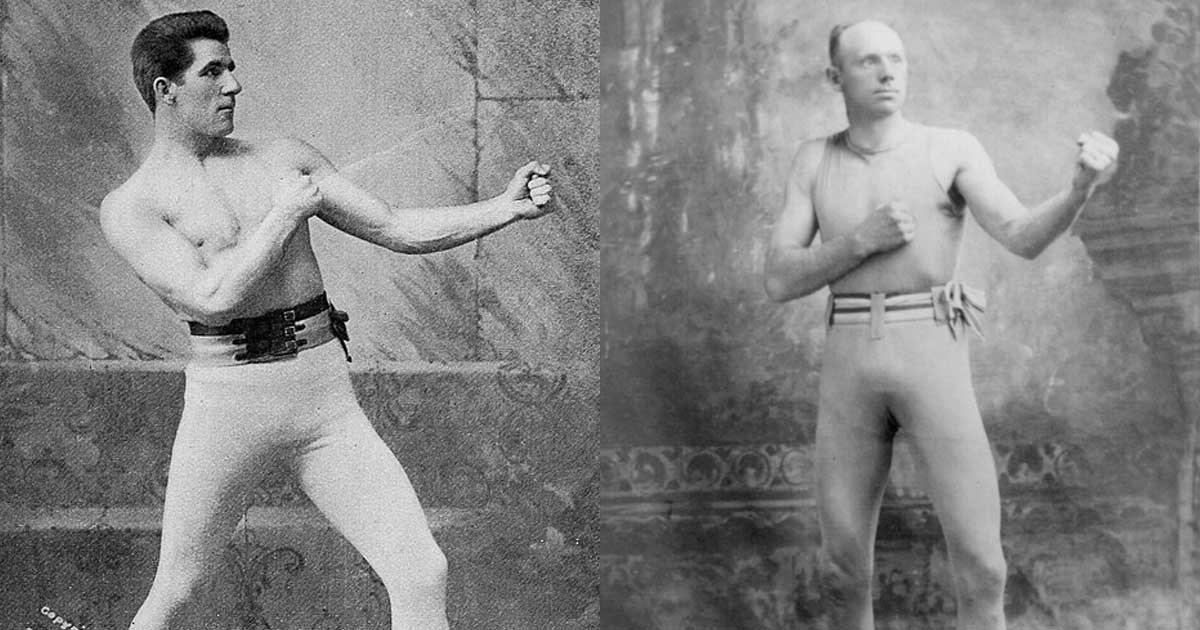
On the night of Oct. 30, 1895, the most talked-about athlete in America sat down to supper at a Texarkana hotel as a prisoner of the state of Arkansas.
Bob Fitzsimmons, who was supposed to be fighting for the heavyweight championship of the world, had been pulled off a train at Fulton by officers working for Arkansas Gov. James P. Clarke and brought back to Texarkana under arrest. Two sets of Arkansas lawmen spent the night arguing over who got to keep him. The Daily Texarkanian said they were fighting over him “like dogs over a bone.”
A week later he was back in Texarkana as a celebrity, going bird hunting with local businessmen and keeping a pet lion chained in front of the Cosmopolitan Hotel.
The story survives in the pages of the Daily Texarkanian from October and November 1895, preserved by the University of North Texas on the Portal to Texas History. Links throughout this story go to the original newspaper pages.
The biggest fight in America
The champion was James J. “Gentleman Jim” Corbett, 29, a former San Francisco bank clerk. In 1892 he knocked out John L. Sullivan, the most famous athlete in the country, in 21 rounds in New Orleans to win the heavyweight title. Corbett beat bigger men by outboxing them instead of slugging, and between fights he worked as a stage actor.
Article continues below
▼ Continue reading
The challenger, Fitzsimmons, was 32. Born in England and raised in New Zealand, he had worked in his family’s blacksmith shop before he took up boxing. He won the world middleweight title in 1891. He was much lighter than Corbett but was known as the hardest puncher in the sport.
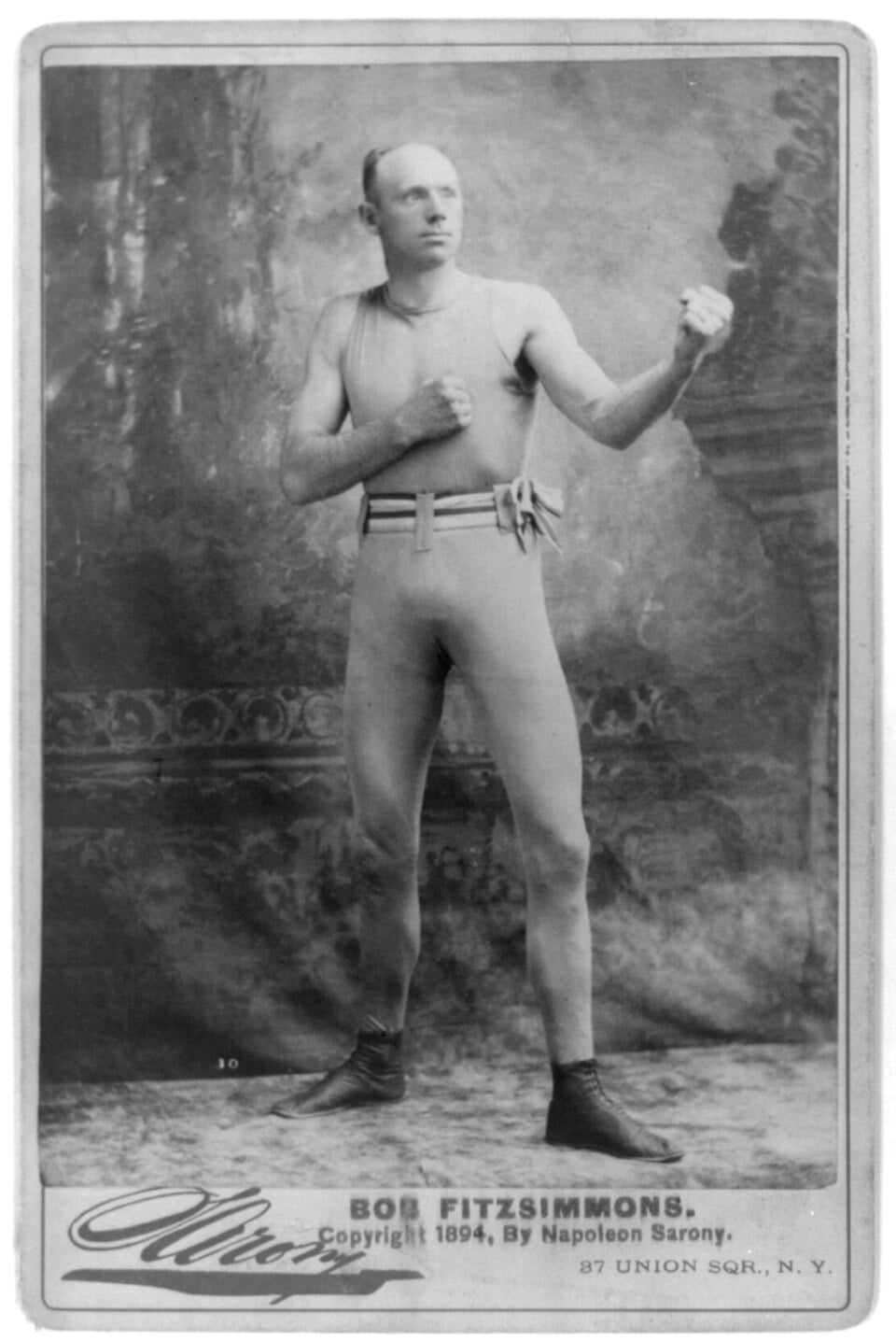
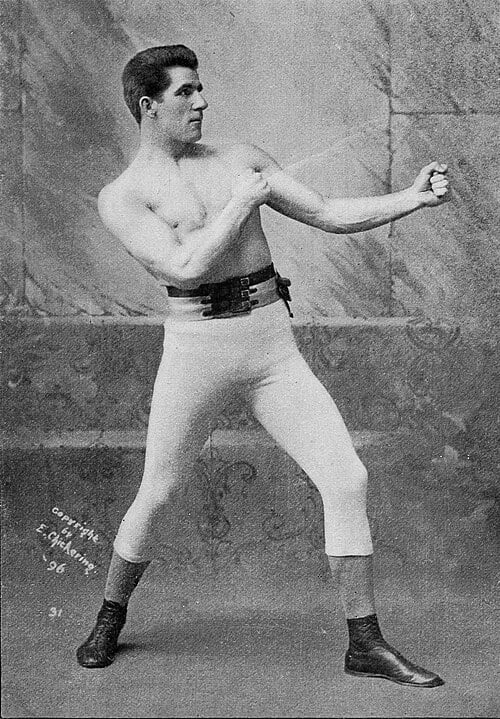
Dallas promoter Dan Stuart booked the two for Oct. 31, 1895, in Dallas. It was the biggest sporting event in the country. It was also a crime in most of it.
Why the governors wanted to stop it
In the 1890s, prize fighting, or boxing for money, was illegal in most states. Preachers and many newspapers put it in the same class as saloons and gambling halls: brutal and disgraceful. Dallas ministers came out against the fight.
Texas had a law against prize fighting, but it was so poorly written that many lawyers doubted it would hold up in court. Gov. Charles Culberson called the Legislature into special session to pass one that would.
Arkansas Gov. Clarke felt the same way. He said he “will not have his state disgraced by this fight,” the Texarkanian reported.
“Texarkana wanted everything in sight”
Texarkana saw an opening anyway. State Sen. Ben Whitaker telegraphed Texarkana attorney Paul Jones that “Dallas was doomed and that the fight could be pulled off in Texarkana,” and asked if the city wanted it.
Jones was out of town, so Sam Solinsky of his law firm answered. His reply, as printed in the Daily Texarkanian on Oct. 2: “prize fighting was a misdemeanor only in Arkansas and that Texarkana wanted everything in sight.” In other words, on the Arkansas side of town a fight would cost only a fine. The paper wasn’t entirely sure the exchange wasn’t a joke.
Texas closed the door the next day. On Oct. 3, the paper reported lawmakers had made prize fighting a felony, passing it 110-5 in the House and 27-1 in the Senate. The penalty was two to five years in the penitentiary. The paper’s advice to Stuart was to “get himself a monkey cage and put Corbett and Fitzsimmons in it.”
Why Hot Springs wanted it
The fight moved to Hot Springs. The resort town lived on visitors, and a championship fight promised trainloads of them. Garland County officers and residents, the Texarkanian said, were “almost a unit for the scrap.”
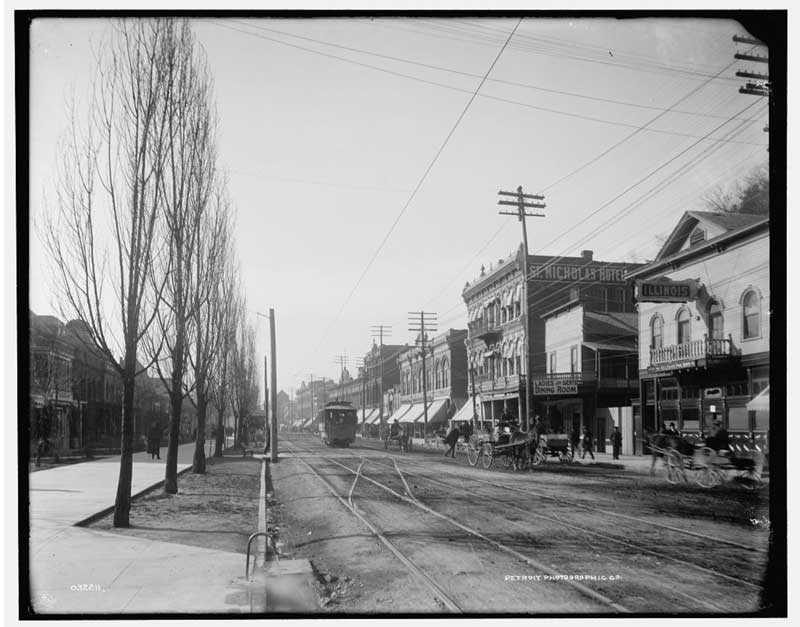
Corbett came to town and was arrested. But on Oct. 19, a Hot Springs judge, Chancellor Leatherman, threw out Arkansas’s prize-fight law, ruling that the Legislature had not passed it properly. He called the bout a legal “glove contest,” less dangerous than football, and set Corbett free, the San Francisco Call reported. Gov. Clarke answered by putting the state militia on alert.
Hot Springs kept building. On Oct. 29, the Texarkanian reported that “wagon loads of lumber have been quietly hauled to Whittington Park and a ring is now being constructed,” and that Corbett would be in it Oct. 31 “rain or shine.” If Fitzsimmons and his manager, Martin Julian, came “nosing around those Springs,” Corbett said, he would “punch them in a scientific manner,” the paper had reported Oct. 27.
“Where is Fitz?”
Texarkana spent the night of Oct. 29 watching every train out of Texas. When word spread that Fitzsimmons was aboard the Galveston flyer, the crowd under the Union Depot shed was “immense,” the paper reported. “All shades of life were represented in the crowd.”
Arkansas officers searched the coaches but ran into a locked sleeping car they had no authority to force open on the Texas side. They came back empty-handed.
Fitzsimmons was not hiding his plans. From San Antonio, he told the Associated Press: “I leave for Hot Springs tonight. I don’t care if I am arrested. I am going up there to fight.”
Arrested at Fulton
Hot Springs wanted to make the arrest itself, and everyone knew why. The Texarkanian reported Oct. 30 that Julian had been warned that if officers working for Gov. Clarke arrested Fitzsimmons, “all prospects of a fight” were gone. If Garland County Sheriff Houpt’s men made the arrest, he had been told, “the fight can be pulled off.”
Houpt and a deputy traveled to Marshall, Texas, to meet Fitzsimmons. They offered him a special train to Malvern, the rail stop for Hot Springs, and a small bond if he would let them arrest him.
He turned them down. “No, I am a free American citizen and expect to travel as one without molestation.”
The governor’s officers got to him first. Carrying a court order against the fight, they took him off the train at Fulton on the night of Oct. 30 and brought him back to Texarkana. Their plan was to get him to Little Rock “any way except Malvern,” keeping him away from Hot Springs, the Oct. 31 paper reported.
“The two sets of officers with different writs were fighting over the prisoner like dogs over a bone,” the paper wrote.
Not everyone in the Fitzsimmons party was upset. When he was taken off the train, the paper said, Mrs. Fitzsimmons and two others “clapped their hands for joy,” figuring the governor would keep “Lanky Bob” safely away from Corbett.
Supper at the Cosmopolitan
The Oct. 31 paper caught the scene around town. Hotel man Hank McCartney, told that Fitzsimmons was being brought back, said, “I will bet a cool fifty he is not.” Ten minutes later, “Fitz was eating supper at Hank’s hotel, the Cosmopolitan.” The paper added that McCartney never actually bets.
The Hot Springs lawmen were not gracious losers. Under the headline “WHITE FEATHER BOB,” the paper reported that Sheriff Houpt and his deputies “pronounced Fitz a coward from his feet up to his red head.” Houpt said that if he ever caught Fitzsimmons in Hot Springs, he would give him a whipping himself.
Delivered to the governor
Texarkana officers finished the job. Sheriff Dillard, City Marshal James Crenshaw, Deputy Marshal Casey and Sam Solinsky, the same man who had wired that Texarkana “wanted everything in sight,” escorted Fitzsimmons to Little Rock.
Gov. Clarke told them they “had saved the State many dollars and perhaps bloodshed,” the Texarkanian reported Nov. 1.
Fitzsimmons seemed to take it in stride. He and Julian “called on Governor Clarke yesterday in an open carriage and had a pleasant confab with the executive,” the paper reported.
The Texarkanian grumbled that the fighters were being kept in Little Rock “at a three dollar a day hotel at the state’s expense.” Its advice: “Let them fight or make them leave the state.” That is about how it ended. The charges were dropped on the condition that the men leave Arkansas.
A lion at the Cosmopolitan
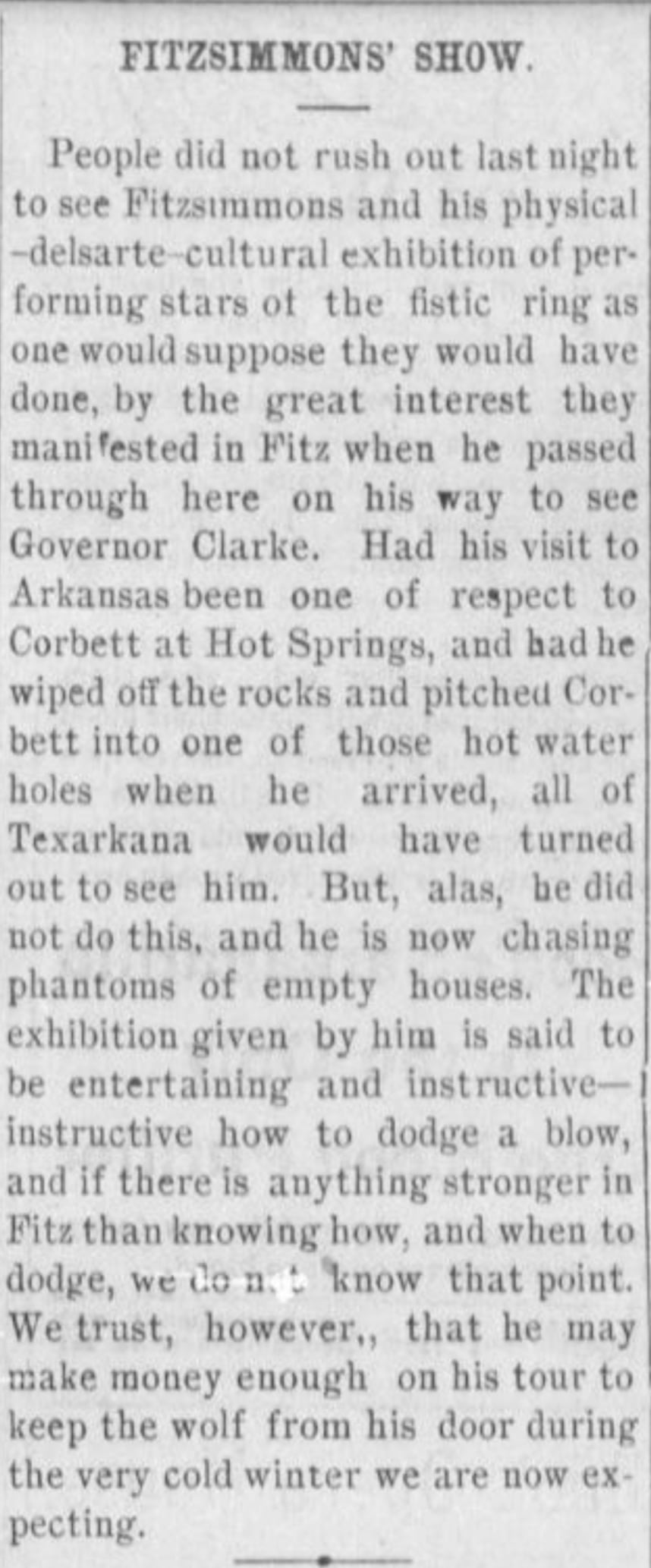
The fight never happened. By the first week of November, Fitzsimmons was free and on tour. On Nov. 5 his company played Ghio’s Opera House in Texarkana: a sparring match with his trainer, plus a wrestler. It was advertised as “a refined exhibition for ladies and children.”
Turnout was thin. The paper figured that if he had “pitched Corbett into one of those hot water holes, all of Texarkana would have turned out to see him.”
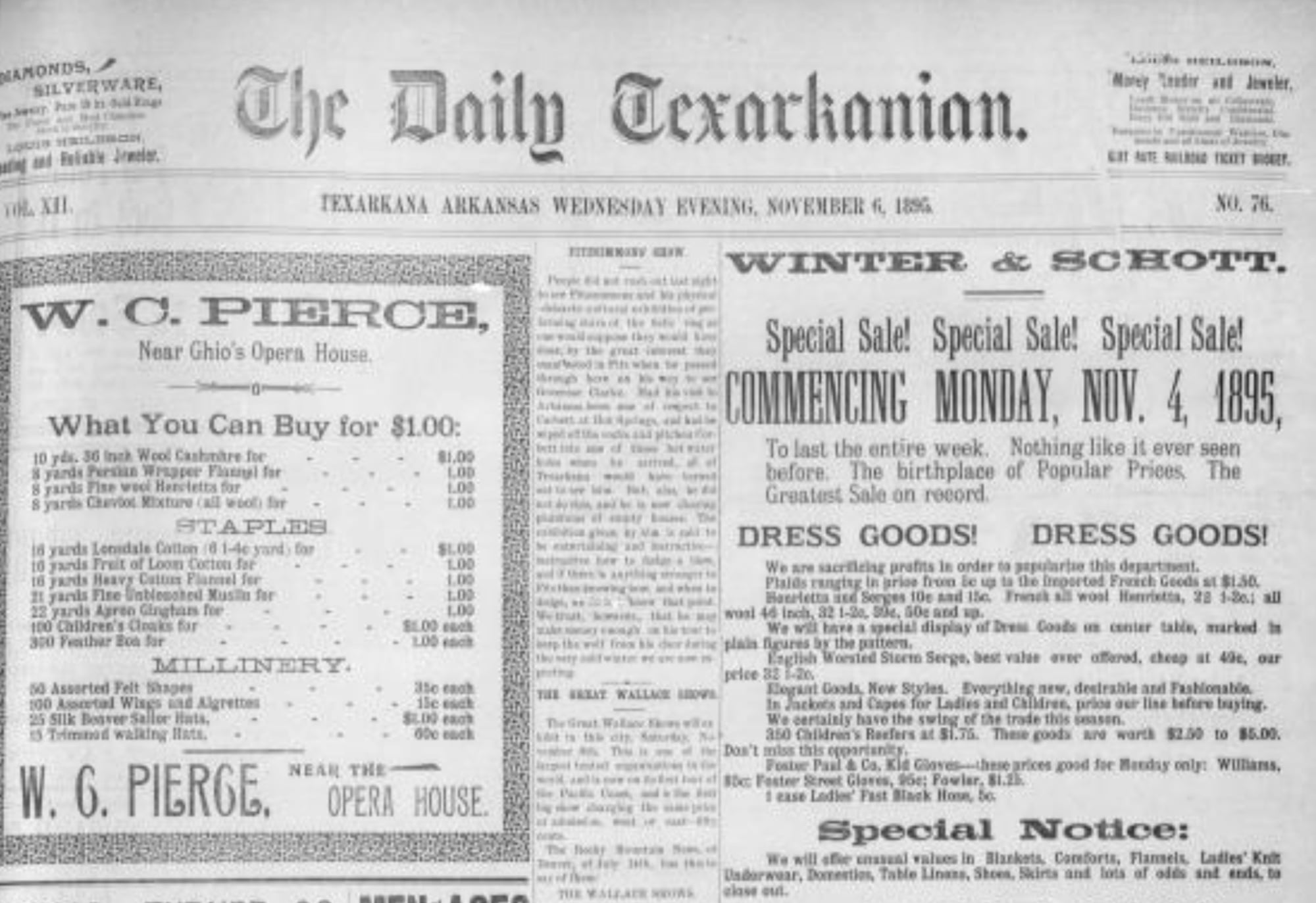
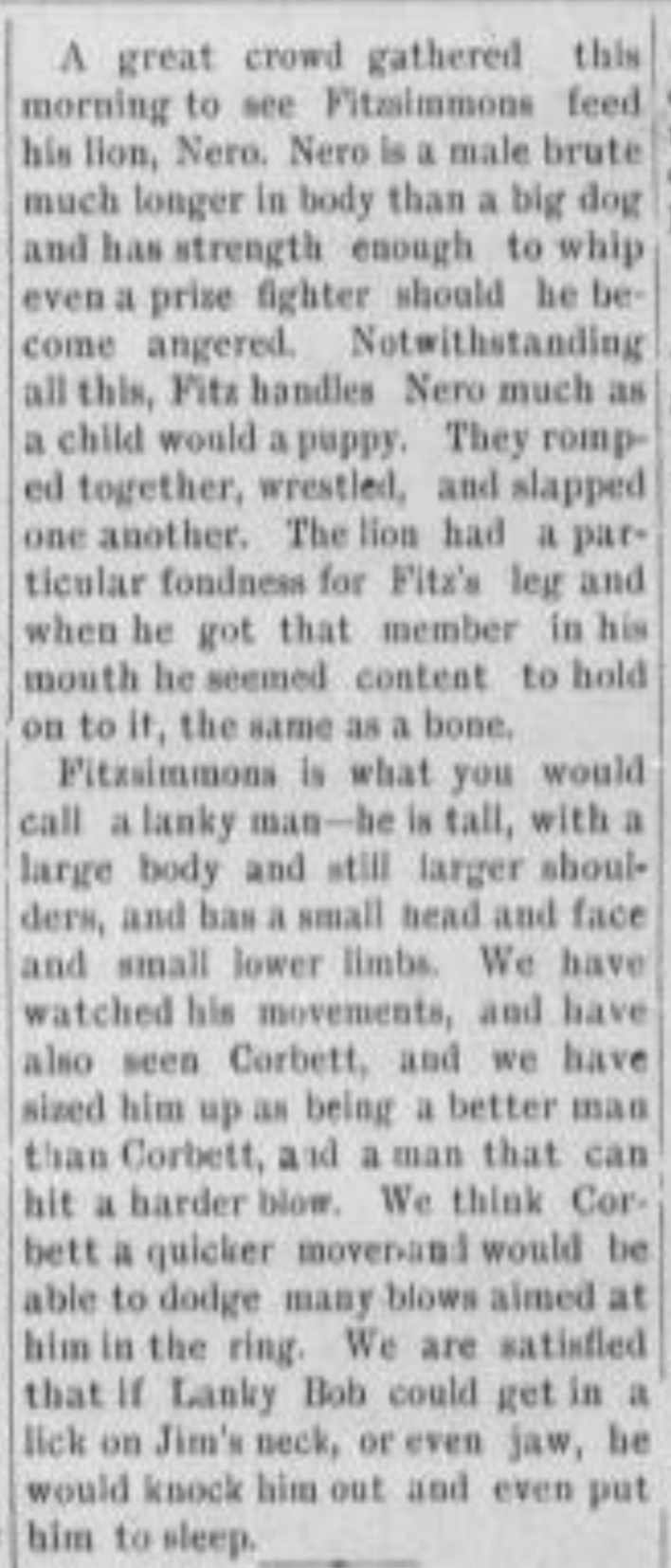
The bigger draw was Nero. Fitzsimmons traveled with a pet lion, and he kept it chained in front of the Cosmopolitan Hotel. One boy kept running up to whistle at it until Nero “made a lunge and broke away and started after the kid.” The paper reported that “the kid proved to be quite a runner and got out of the way.”
A crowd gathered to watch Fitzsimmons feed the animal. “They romped together, wrestled and slapped one another,” the paper wrote. “The lion had a particular fondness for Fitz’s leg.”
After seeing both fighters up close that fall, the Texarkanian’s reporter gave his verdict: Fitzsimmons was the harder hitter, and “if Lanky Bob could get in a lick on Jim’s neck or even jaw he would knock him out.”
Horseshoes for the sheriff
Fitzsimmons spent several days in town. Harry Ehrlich took him and Nero for a buggy ride, and “Fitz liked the town.” He went bird hunting with Ehrlich, Fee Kennett, Ed Rutter, J. F. Arnold and Edgar Kirby.
The old blacksmith hadn’t forgotten his trade. Before leaving for Denison on Nov. 8, he “made several horse shoes while here and presented one each to Harry and Simon Ehrlich and gave the rest to Sheriff Dillard,” the same sheriff who had helped arrest him nine days earlier. The Cosmopolitan reported that the party “behaved well and paid for everything promptly.”
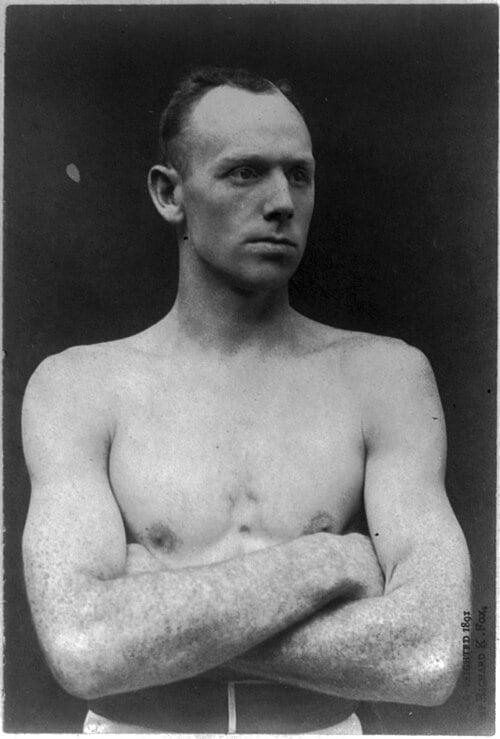
He finally got his shot at Corbett on March 17, 1897, in Carson City, Nev., after Nevada made prize fighting legal to host the bout. He knocked Corbett out in the 14th round with a punch to the stomach and took the heavyweight title. Gov. Clarke, the man who kept the fight out of Arkansas, went on to serve in the U.S. Senate.
Sources
Quotations from the Daily Texarkanian are from the Portal to Texas History at the University of North Texas. OCR text was lightly cleaned.
- Oct. 2, 1895: Texarkana bids for the fight, Clarke vows to stop it, p. 2
- Oct. 3, 1895: Texas makes prize fighting a felony, p. 1
- Oct. 27, 1895: Corbett in Hot Springs, p. 1
- Oct. 29, 1895: the ring at Whittington Park, p. 1
- Oct. 30, 1895: crowds at the depot, the Hot Springs arrest plan, p. 2
- Oct. 31, 1895: the arrest at Fulton, p. 1; supper at the Cosmopolitan, p. 3
- Nov. 1, 1895: delivered to the governor, p. 3, p. 4
- Nov. 3, 1895: held in Little Rock, p. 4
- Nov. 4-5, 1895: the Opera House show, Nov. 4, p. 3, Nov. 5, p. 2
- Nov. 6, 1895: Nero and the turnout, p. 1, p. 3
- Nov. 7-8, 1895: buggy ride, bird hunt and horseshoes, Nov. 7, p. 3, Nov. 8, p. 3, p. 4
Other sources:
- San Francisco Call, Oct. 20, 1895: the Hot Springs court ruling (Library of Congress, Chronicling America)
- Ann Arbor Argus, July 1895: doubts about the 1891 Texas law (Ann Arbor District Library)
- Sydney Morning Herald, Dec. 12, 1895: charges dropped in Little Rock (National Library of Australia)
- Texas State Library and Archives: Culberson’s special session
- American Heritage: the Dallas promotion