

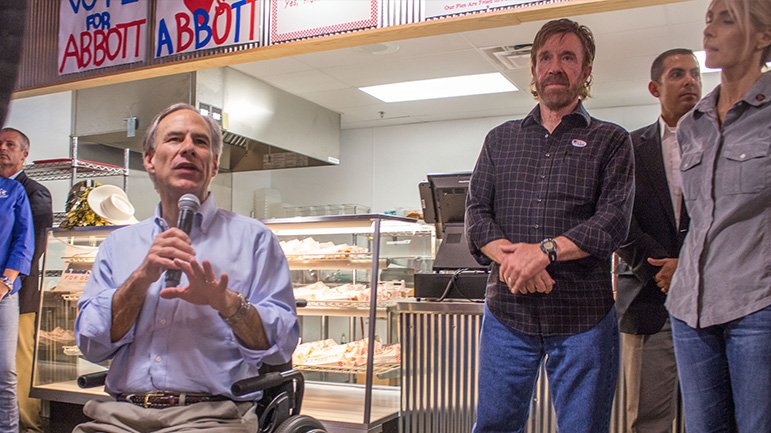
Abbott spent a decade courting data centers. Now he wants to rein them in. Here’s what that means for Bowie County.

TEXARKANA, Texas — Gov. Greg Abbott says Texas should prohibit AI data centers from being built in rural neighborhoods, a sharp turn for a governor who spent the past decade recruiting the industry to the state. The shift lands as two large data center projects take shape in Bowie County, one of them already drawing organized opposition.
“We must prohibit them from building AI data centers in rural Texas neighborhoods,” Abbott said last week at a campaign stop in Bullard, southeast of Tyler, according to The Texas Tribune.
He went further: “I made clear already: Any AI data center even thinking about coming here, they got to bring their own money, bring their own power, reuse their own water and do it in a way that reduces the cost of electricity for residents across our state,” the Tribune reported.
Abbott also repeated his call to end the industry’s state tax break. “We must eliminate the tax break they are getting. They must be responsible for funding their own projects here in Texas. We will get that done,” he said, according to The Associated Press.
Three weeks of tightening
The Bullard remarks capped a month of escalating moves from the governor’s office.
On June 10, Abbott sent a formal directive letter to the Public Utility Commission of Texas and ERCOT, the state’s grid operator. The letter orders the PUC “to take action to require data centers to pay for all of their electric infrastructure costs to ensure that no residential ratepayer is burdened by those costs” and directs both agencies to review their existing authority “to safeguard Texans, their property, and resources.”
The letter sets hard deadlines. The PUC and ERCOT must deliver a joint memorandum to the governor’s office by July 17 identifying actions taken and legislation needed, and the PUC “shall initiate action to reduce residential ratepayer transmission costs by July 31, 2026.”
Abbott also pledged in the letter to push legislation next session that would require new data centers to use “water-efficient technologies such as closed-loop cooling systems,” require large data centers to report their electricity and water usage to the PUC annually, mandate “setbacks, noise-reduction technology, and other measures that take into account the concerns of neighbors,” and “repeal sales tax exemptions and other outdated or unnecessary incentives for data centers.”
“Data centers must operate in ways that reduce costs for residential electricity customers, do not drain water needed for our communities, and take into consideration the needs of our neighborhoods,” Abbott said in the accompanying press release.
A decade of open doors
The original sales tax exemption for qualifying data centers became law in 2013, under Gov. Rick Perry. Two years later, Abbott signed House Bill 2712, which expanded the break to cover large data center projects, and in a 2016 op-ed he touted that Texas had “exempted hosting and data center companies from sales and use taxes” as part of the state becoming “the new tech mecca.”
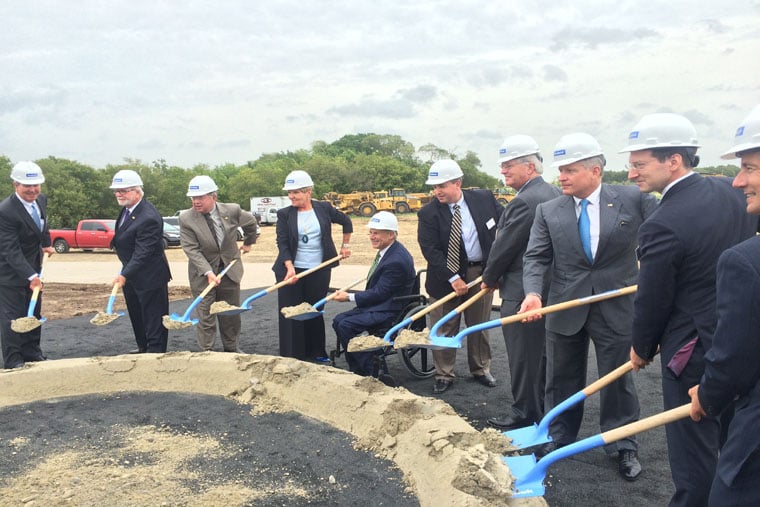
The recruitment record runs long. In 2015 he broke ground on Facebook’s Fort Worth data center, saying “there really is no place like Texas.” In 2021 he declared “Texas is open for Crypto business” and signed a slate of blockchain-friendly bills, and in 2024 he said Texas “should become the crypto capital.” In August 2025 he celebrated Vantage Data Centers’ $25 billion campus near Abilene as one that “will help create thousands of good-paying jobs for Texans.”
As recently as November 14, 2025, less than seven months before the directive letter, Abbott stood with Google’s CEO to announce a $40 billion investment in three new Texas data center campuses. “This is a Texas-sized investment in the future of our great state,” he said then. “Texas is the epicenter of AI development, where companies can pair innovation with expanding energy.”
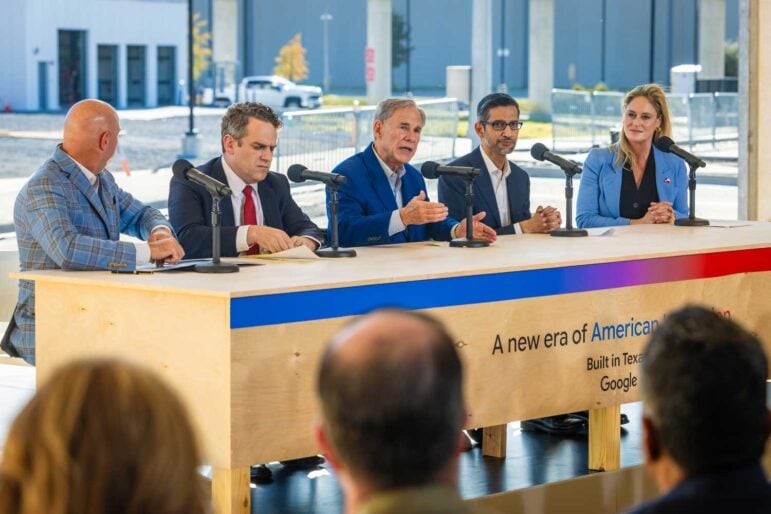
Gov. Greg Abbott and Google CEO Sundar Pichai announce Google’s $40 billion Texas investment in November 2025, the company’s largest in any state. (Press photo from the Office of Texas Governor)
The money and the politics
The industry’s political spending in Texas has grown alongside its footprint.
Abbott has received more than $2 million from people and companies linked to the tech and AI industries since 2025, E&E News by Politico reported in April, citing data compiled by the nonprofit Transparency USA. That includes a $1 million donation from Airbnb co-founder Joe Gebbia and $600,000 from Alpha School co-founder MacKenzie Price, both in 2025. The AP noted the donation figure in its coverage of Abbott’s rural ban proposal this week.
More broadly, AI-aligned super PACs spent $4.2 million in Texas during this year’s primary cycle, all but $150,000 of it backing Republicans, and data center companies added at least 15 lobbyists in Austin between the 2023 and 2025 legislative sessions, The Texas Tribune reported in May.
The politics behind the reversal are not hard to read. Nearly two-thirds of rural Texans oppose data center construction in their own communities, according to University of Texas polling cited by the Tribune, and the Tribune found that nearly half of planned Texas data centers are slated for unincorporated areas, where counties have little zoning authority, compared with about 12 percent of existing ones.
The grid math driving it
The numbers behind the pressure are in ERCOT’s own filings. In testimony to the Texas Senate on April 1, ERCOT CEO Pablo Vegas reported the grid operator was “tracking approximately 410 GW of Large Loads seeking interconnection of which ~87% are data centers.” For scale, ERCOT’s all-time peak demand, set in August 2023, is about 85.5 gigawatts. The requests in the queue are nearly five times the size of the entire grid’s record load.
Lawmakers took a first step last year with Senate Bill 6, signed by Abbott in June 2025, which requires large power users to help fund their own interconnection costs and gives ERCOT authority to curtail new large loads during grid emergencies. Abbott’s June letter said SB 6 “took meaningful steps” but that “more must be done to protect Texans.”
There is a wrinkle in all of this for Texarkana readers: Bowie County is not on the ERCOT grid. Most of Texas runs on ERCOT, but the state’s northeastern corner is served by SWEPCO, an American Electric Power subsidiary, and by rural cooperatives such as Bowie-Cass Electric, and their transmission is managed by a different grid operator entirely, the Southwest Power Pool.
SPP is a Little Rock-based regional transmission organization that coordinates the grid and runs the wholesale power market across all or part of 17 states, from northeast Texas and Louisiana up through the Dakotas and Montana. It is a much smaller system than ERCOT: SPP’s all-time record demand is 56,184 megawatts, set August 21, 2023, roughly two-thirds of ERCOT’s peak. And it is riding the same wave. Driven largely by data center requests, SPP projects its peak demand could nearly double, from about 56 gigawatts to more than 100 gigawatts, within 10 years, and it has approved an accelerated 90-day study process for plugging in large loads like data centers.
That distinction matters for what Abbott’s grid orders can actually reach. His directives went to the PUC and ERCOT, so interconnection cost rules or emergency curtailment authority written for ERCOT would not govern projects that connect through SWEPCO to SPP’s grid, as the Bowie County sites would. The Public Utility Commission does still regulate SWEPCO’s Texas rates, and the legislation Abbott has pledged on water use, setbacks, usage reporting and tax incentives would apply statewide, no matter which grid a data center sits on.
What data centers actually use, and why it is hard to find out
Residents asking what a project would actually consume run into a problem that is national in scope: the industry usually does not say. Texas does not require data centers to disclose projected or actual water use, and when state lawmakers directed the PUC to survey the industry this year, most companies simply did not answer; responses came from just 28 companies covering 92 data centers. Nationally, projects are assembled under code names and nondisclosure agreements, and usage figures often stay secret until long after a facility is running, if they come out at all.
Sometimes getting the numbers takes a court fight. When The Oregonian asked how much water Google’s data centers were drawing in The Dalles, Oregon, the city sued the newspaper to keep the records secret, with Google contributing more than $100,000 to the city’s legal effort. After a 13-month fight the records came out: the data centers used 355 million gallons in 2021, 29 percent of the city’s entire water supply, nearly triple what they used in 2017. To its credit, Google reversed course afterward and is now the only major operator that publishes water numbers for every site.
Those disclosures show why blanket claims in either direction miss the mark: usage varies enormously with cooling design. Google consumed 8.1 billion gallons across its data centers in 2024, up 28 percent in a single year, but the site-level range ran from about a billion gallons for the year in Council Bluffs, Iowa, to 10,000 gallons at an air-cooled site in Pflugerville, Texas. A campus using conventional evaporative cooling towers consumes on the order of 6.75 million gallons per megawatt per year, which for a 100-megawatt facility works out to roughly 1.8 million gallons a day.
That is where the closed-loop systems Abbott wants to mandate come in, and where the fine print matters. A closed loop stops evaporating water on site, but the heat still has to go somewhere: into dry coolers and chillers that consume more electricity instead. Google’s own engineers put the penalty at about 10 percent more energy for air-cooled designs, and every added kilowatt-hour carries hidden water of its own; federal researchers at Lawrence Berkeley National Laboratory estimate electricity consumption drives about 1.15 gallons of water use per kilowatt-hour upstream at power plants. So “zero water” claims tend to be true on site and incomplete overall. At the Stargate campus in Abilene, the closed-loop system is marketed as zero-evaporation, but it still took an initial fill of 8 million gallons of city water, in a city that uses about 22 million gallons a day.
The electricity side is better documented. Federal researchers found data centers used 4.7 percent of all U.S. electricity in 2024 and project roughly 12 percent by 2030, accounting for about a third of all growth in American power demand between now and then. For scale: a 500-megawatt AI campus running around the clock uses about as much electricity in a year as 400,000 homes.
And when a developer brings its own generation rather than waiting years in an interconnection queue, the tradeoff moves into the air. Developers have announced roughly 101 gigawatts of on-site natural gas generation nationally, with Texas leading at about 38 gigawatts. The cautionary example is xAI’s Colossus facility in Memphis, which ran about 35 mobile gas turbines, roughly 420 megawatts, without air permits, with the potential to emit 1,200 to 2,000 tons of smog-forming nitrogen oxides a year; the county later permitted 15 turbines, and civil rights groups are now suing over 27 more unpermitted turbines at a second site across the state line in Mississippi. The turbine type matters: quick-deploy simple-cycle units burn about 46 percent more gas per kilowatt-hour than a modern combined-cycle power plant, and mobile units typically lack the emissions controls permanent plants carry. What Black Mountain Power has proposed for Bowie County, has yet to be answered.
What it means here
The policy fight is not abstract in Bowie County. Two large-scale projects are in motion in the Texarkana region, and both would be touched by parts of what Abbott is proposing.
In April, TexAmericas Center announced Project Big Pine, a 500-acre campus in Bowie County designed to attract data centers and AI infrastructure, with an estimated $3.5 billion in investment at full buildout and roughly 120 permanent jobs. Weeks later, a standing-room-only crowd packed a Texarkana, Texas City Council meeting to oppose the project, citing concerns over water use, electricity costs, pollution and the project’s long-term viability. Those are, nearly point for point, the concerns Abbott’s directive letter now instructs state regulators to address.
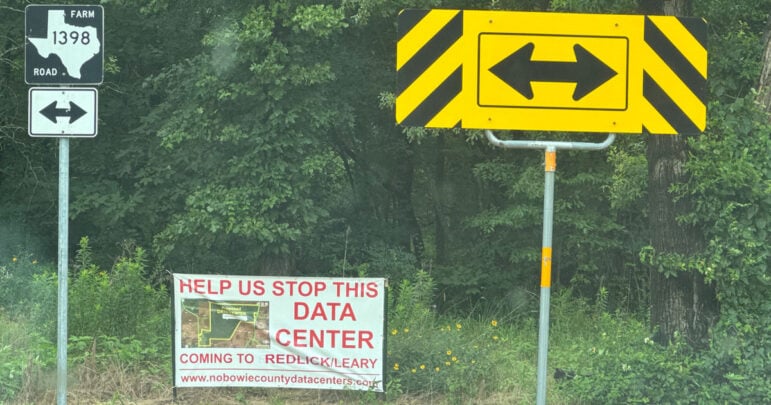
Separately, TXK Today reported in June that Fort Worth-based Black Mountain Power LLC quietly purchased nearly 600 acres in western Bowie County, and days later that the company has applied to build a gas-fired power plant on the land. That project has already drawn yard-sign opposition in the Redlick and Leary area, and it sits in exactly the kind of unincorporated, rural setting Abbott now says should be off limits for AI data centers. At the same time, a developer bringing its own generation is doing precisely what Abbott demanded in Bullard: “bring their own power.”
Whether Abbott’s proposals would slow, reshape or barely graze the Bowie County projects depends on details that do not exist yet. A “prohibition” on data centers in rural neighborhoods is so far a campaign-stop pledge, not a bill, and the Legislature does not convene in regular session until January 2027.
What happens next
Two near-term dates will show how much force is behind the governor’s words. The PUC and ERCOT owe Abbott their joint memorandum by July 17, and the PUC faces his July 31 deadline to begin acting on residential transmission costs. TXK Today will report on both, and on what they mean for the projects already on the ground in Bowie County.