

What Does a Mobile App Maintenance Plan Actually Cover?
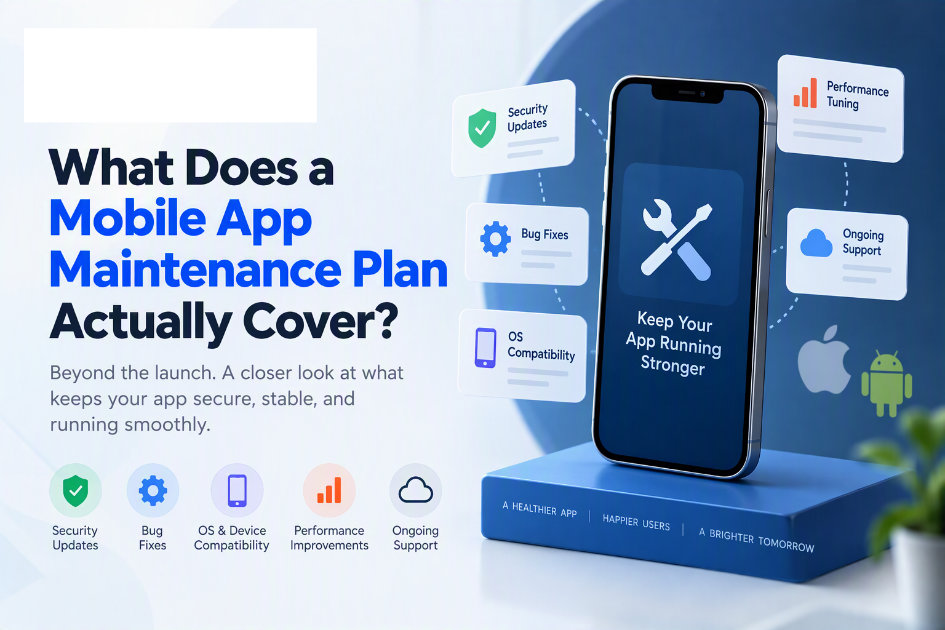
A mobile app maintenance plan pays for keeping an application usable after launch. That includes bug fixes, security patches, checks after phone updates and performance optimization. The awkward question is what happens when a problem crosses the boundary between the app and somebody else’s system.
Picture a fictional Texarkana restaurant on Friday evening. Customers can browse the menu, yet payment confirmations never arrive. Some try again. The kitchen receives no orders. The app looks available, although the part that earns revenue has stopped working.
Businesses comparing mobile app maintenance services should ask a provider to work through that example. Who checks whether payments went through? Who stops duplicate attempts? Who tells staff what to say to customers? Those answers reveal more than a promise of “complete support”.
Start with what the provider actually maintains
A mobile app may rely on a server, databases, cloud services and connections to business systems. The restaurant’s problem could sit in any of them. A contract covering only the phone software leaves a gap.
Ask for a list of components and the person responsible for each. Third party services need contacts too. The maintenance partner cannot repair a payment company’s infrastructure. It should still know how to identify that dependency and coordinate the response within its agreed scope.
When comparing mobile app maintenance services, use questions tied to work rather than package labels.
| Situation | What the plan should explain |
| A customer is charged twice | Who checks the transaction records and investigates the cause |
| Checkout fails on newer phones | Which operating systems and devices are supported |
| A library has a known vulnerability | Who assesses exposure and schedules the patch |
| Ordering becomes slow | What gets measured and what improvement is expected |
| A release introduces a fault | Who can pause distribution and approve recovery work |
| The monthly hours run out | Who authorizes further spending and at what rate |
Hosting bills, store fees and redesigns may be separate. Get the exclusions in writing.
Article continues below
▼ Continue reading
Bug fixes should restore an agreed behavior
Corrective maintenance restores the agreed behavior of existing features. Repairing a checkout that charges twice belongs in that category. Adding a loyalty program does not.
Another example is a booking app that accepts overlapping appointments. If preventing overlaps was an agreed requirement, it is a defect. If the business has just introduced shared rooms and equipment, the new scheduling rules may be feature improvements. The original requirements should settle that question.
Mobile app maintenance should include time to reproduce the fault and implement targeted fixes. Fixing bugs also means checking the result. A changed line of code is not proof that duplicate bookings have stopped.
When users report a problem, in app support forms should capture the app version and what happened immediately beforehand. They should not request passwords or unnecessary sensitive data. User feedback often supplies the missing clue, such as “it happens only after changing the pickup time”.
Mobile app support also needs a route from user support to engineering. A customer asking where an order went should not have to diagnose the fault before receiving help.
Compatibility work continues after launch
Mobile applications depend on operating systems that change after launch. A permissions change might affect notifications even though the business has not requested any development.
Android’s quality guidance includes platform, stability and functionality checks. A mobile app maintenance company should turn that guidance into a supported device list and a testing schedule. Compatibility testing needs to cover the operating systems customers actually use, alongside evaluation of upcoming changes.
Ask for a task to be tested from beginning to end. For a booking service, that means receiving a reminder and opening the correct appointment rather than just launching the app.
Mobile app development companies may sell ongoing support separately. The mobile app maintenance plan should say whether compatibility work and app updates use the monthly hours. An upcoming release is a poor time to discover that nobody budgeted for them.
Security work needs priorities and ownership
Imagine a former contractor still has a working administrator account. Installing the latest library will not remove that access. Security management needs to cover accounts and access controls as well as software.
Outdated dependencies can create security risks when known weaknesses affect the application. Application maintenance services should identify who reviews security vulnerabilities and applies security patches. The report should explain which problems were addressed and which remain open.
OWASP MASVS provides requirements for app security on the mobile client. It does not cover the entire backend. Protecting business and user data therefore needs an agreed scope across the connected system.
Security testing should check relevant controls after changes. Security updates do not establish that every weakness has disappeared. If security vulnerabilities require security upgrades, the app maintenance service should explain the work and obtain approval rather than silently leave the issue unresolved.
Monitoring is useful only when someone responds
Performance monitoring should include successful transactions. An app can stay open while every payment fails. Reports of app crashes alone miss that distinction.
Firebase Crashlytics supports alerts and notification integrations. Continuous monitoring still needs someone to act on the signal. Continuous support from engineers is a separate staffing commitment, so a restaurant should check whether Friday evenings are covered.
Firebase’s Doodle case study illustrates this approach. The scheduling company first used crash reporting to improve stability. It then tested changes to registration and poll creation. Firebase reports that one flow produced over 42% more polls.
That figure belongs to a specific product experiment. It is not evidence that maintenance alone increases engagement by 42%. The useful lesson is the sequence. Establish reliability, then test improvements against the task customers came to complete.
Mobile app maintenance services should connect alerts to named responders. Proactive monitoring helps teams investigate early without guaranteeing advance warning of every fault.
Performance optimization needs the same discipline. Compare app performance under similar conditions to verify performance improvements. If a catalog takes eight seconds to open on a weak connection, investigate images, network requests and server delays before proposing a rebuild. This is a diagnostic example rather than a measured client result.
Response time is not repair time
Suppose a provider promises a 30-minute response. That does not mean ordering will work again within 30 minutes. The service provider may only be committing to acknowledge the ticket or start investigating, depending on the wording.
A mobile app maintenance plan should distinguish that response from restoring service and delivering a permanent repair. External services may need to participate. A temporary workaround might restore orders while engineers continue investigating.
Support services should also define severity and communication. A wrong icon can wait. A failed checkout needs a different route. For a Texarkana business, specify the support hours in Central Time and explain weekend coverage.
An update saying “payments remain affected; the next update is in 30 minutes” is more useful to staff than silence. That interval is an example to agree with the provider rather than an industry standard.
A fix is not finished when the code is saved
Mobile application maintenance does not end when code is changed. Automated testing can check repeatable workflows, while device checks and accessibility testing address other aspects of quality. Testing reduces the chance of releasing defects; it does not eliminate that possibility.
A release plan should identify approval, distribution and recovery steps. Apple offers phased releases that distribute automatic updates over seven days, with an option to pause. Customers can still download the update manually during that period.
Pausing distribution does not remove versions already installed. The team needs a documented recovery plan rather than an unsupported promise to reverse every update instantly.
Routine maintenance should also keep build instructions and deployment access usable. Consistent maintenance makes handover easier when personnel change. The evidence is practical, such as whether another authorized engineer can build and release the supported version.
What changes the monthly price?
Mobile app maintenance costs depend on scope, coverage and the state of mobile applications. The original development cost alone is an unreliable basis for estimating future work.
A technical assessment should identify technical debt, unsupported components and missing tests. Outdated systems may need stabilization before a predictable monthly arrangement makes sense. More integrations and demanding response commitments can increase maintenance costs.
Ask how the app maintenance service allocates time. Does investigation count? What happens to unused hours? Are releases included? Flexible engagement models only help when the purchasing rules are clear.
Feature enhancements should have their own approval path. Small changes may fit an allowance, while new features require separate estimation. Mixing feature enhancements into an undefined support budget makes spending difficult to explain.
For cost efficiency, compare identical scopes across providers. A lower fee that excludes the backend or testing may shift work back to the business. Maintenance costs should show those exclusions before a purchasing decision.
Ask what changed for customers this month
An application maintenance report should show completed work, unresolved problems and upcoming decisions. Request bug fixes linked to closed incidents and performance improvements supported by measurements. “Checkout retries no longer create duplicate orders” says more than “eight hours of maintenance”.
Track app performance alongside business outcomes. User retention, user engagement and user satisfaction provide context. Promotions and product changes influence them too. Mobile app maintenance should not be credited with every improvement or blamed for every decline.
For mobile applications, regular maintenance is most useful when priorities follow business requirements. Technical assistance should help the owner understand those choices without turning the report into a software development lecture.
Before signing, ask for a worked example
Return to the Friday payment failure. Ask the proposed maintenance partner to walk through detection, investigation, communication and recovery. Include what happens when the monthly allowance is exhausted.
The answer should connect mobile app maintenance to a named team and an agreed process. Ongoing monitoring without an escalation route leaves a gap. Software development capacity without release access leaves another.
For mobile applications, long term app success depends partly on that continuity. Dependable service can contribute to a competitive edge. The owner should leave knowing who takes the call, what happens next and which work the monthly payment covers.