

90 years ago, Texarkana women built a monument to the men who didn’t come home
In November 1936, a women's group called the Texarkana Memorial Unit put up a World War I monument in Sheppard Park honoring the dead of Bowie and Miller counties. Here is what it says, who is on it and what is still unknown.

Part 9 of 11 for 11, a TXK Today series remembering Texarkana-area veterans through America’s wars. A new story every day through Veterans Day.
Eighteen years after the guns went quiet in France, a group of Texarkana women gave the World War I dead of two counties and two states a monument in the middle of downtown.
In November 1936 the Texarkana Memorial Unit, which described itself as “an organization of women,” put up a monument in Sheppard Park, at Sixth and Olive streets on the Texas side of downtown. It honors the men of Bowie County, Texas, and Miller County, Arkansas, who died in World War I.
It stands just west of the federal courthouse and post office. This month marks 90 years since it was dedicated.
Article continues below
▼ Continue reading
What the stone says
The inscription, as recorded by the Texas Historical Commission, reads in part:
“In memory of the men from Bowie County, Texas and Miller County, Arkansas, who made the supreme sacrifice in the service of their country in the World War 1917-1918. They and their comrades fought not for selfish gain nor for one foot of added territory, but for the highest ideal ever upheld by man, the peace of the world.”
It ends with the builders’ own line: “Erected by the Texarkana Memorial Unit, an organization of women banded together to honor their loyalty, their service and the devotion. November 1936.”
An eagle stands on top of a column carved with the words “Patriotism, Fidelity, Courage,” according to a description posted to the USGenWeb Archives. The same account says seven park benches were inscribed with the names of major American battles: Meuse-Argonne, St. Mihiel, Oise-Aisne, Aisne-Marne, Champagne-Marne, Montdidier-Noyon and the Somme Offensive.
The names
According to that transcription, the monument lists 61 men: 24 from Miller County and 37 from Bowie County.
As was common in the segregated South of the 1930s, Black soldiers are listed separately, under the heading “Colored Men.” There are four from Miller County (Elijah Chaplain, Foster Davis, Melvin Hawkins and Jesse Moore) and six from Bowie County (Kirby Bill, Will Fields, Robert Pool, Orange Ruskey, John Tyler and Ed Washington).
Behind each name is a story that has mostly gone untold. A few can be traced in records published soon after the war.
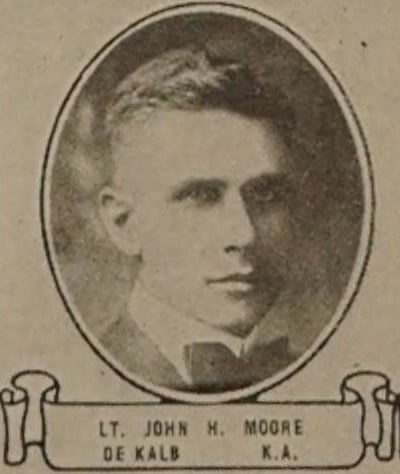
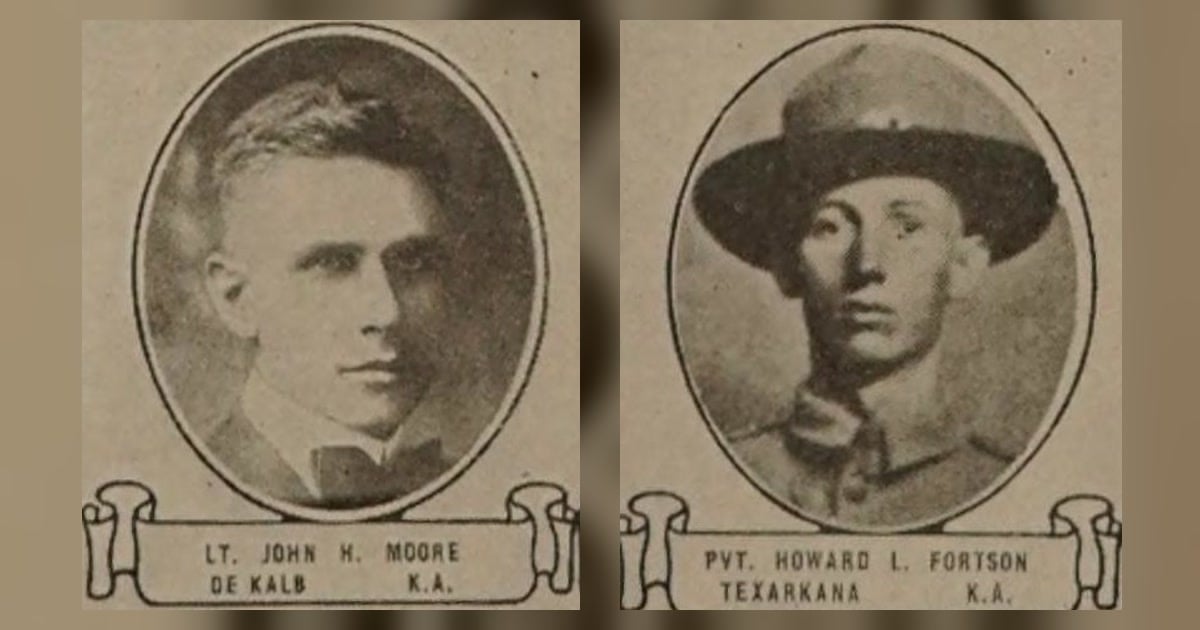
John Harwell Moore of De Kalb, listed on the Bowie County side (Army records spell his middle name Hartwell), was a second lieutenant with Company D, 3rd Machine Gun Battalion, 1st Division. On July 18, 1918, near Cutry, southwest of Soissons, he was leading his machine-gun section under heavy fire when a shell knocked him down, according to his Distinguished Service Cross citation. He got back up and went ahead to find a safer route for his men. They were able to advance. He was killed doing it.
The Army awarded him the Distinguished Service Cross, the nation’s second-highest award for valor, after his death. He is buried in the Oise-Aisne American Cemetery in France. He was 25.
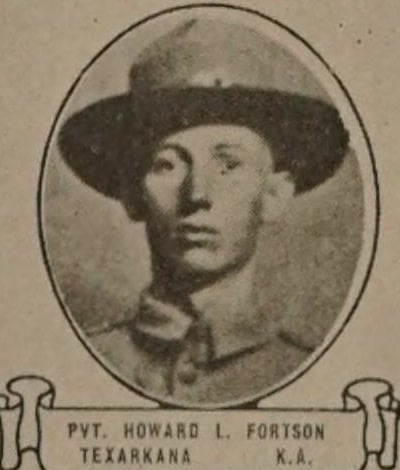
Howard L. Fortson shows how blurry the state line could be. “Soldiers of the Great War,” a three-volume 1920 memorial book of casualty lists and photographs, printed his picture in its Texas pages: a private from Texarkana, killed in action. The Texarkana monument lists him with the Miller County men.
Tobe Kruse, whose name the transcription spells “Krause,” never made it overseas. He died at Camp Travis in San Antonio on Oct. 22, 1918, at 28, according to a memorial record for his grave at Old Union Cemetery near Simms. That fall, influenza and pneumonia were killing soldiers in training camps across the country.
Others on the list appear in the 1920 book’s Texas pages, too: Frederick C. Ames, John L. Steitler, Edward F. Wilson and John C. Watts (printed in the book as Honn C. Watts) of Texarkana, Martin V. Tillman of Redwater and John O. Pinkerton of Texarkana, all listed as killed in action, and Otis Henry of Texarkana, George Higgs of New Boston and Burton Paul Ochs (printed as Burlon Paul Ochs) of Texarkana, listed as dying of wounds. A John Tyler of Simms is also listed as killed in action. He is likely, but not confirmed to be, the John Tyler named on the monument.
For families at home, the news usually came first in print. On Oct. 10, 1918, a month before the armistice, the San Antonio Evening News ran its daily “Roll of Honor” of Texans from that day’s Army and Marine Corps casualty lists. Two of the names were “John C. Watts, Texarkana; killed in action” and “John L. Steitler, Texarkana; killed in action.”
Texarkana’s war
The men on the monument were part of a much larger call-up. Over the course of the war, 1,143 Bowie County men and 645 Miller County men were inducted into the Army through the draft, according to the final report of the Provost Marshal General, the office that ran the draft, published in 1920. Each county had a single draft board, so both halves of Texarkana are counted in those totals.
That is roughly 33 men for every 1,000 residents in each county, based on the 1910 census, a little above the rate for Texas as a whole and a little below Arkansas’.
The two sides of the state line answered the first call differently. When the first quotas were set in 1917, Miller County was credited with 150 men who had already volunteered, enough to cover more than two-thirds of its quota of 219. Bowie County was credited with 32 volunteers against a quota of 389, so nearly all of its first contingent had to be drafted.
Draftees left from the depot. A 1918 train schedule the Provost Marshal reprinted as an example shows 28 Miller County men boarding Missouri Pacific train No. 36 in Texarkana at 7:15 a.m. on Aug. 22, bound for Camp Pike near Little Rock. Men from Ashdown came through Texarkana and ate breakfast in town before boarding.
The war was fought with money, too, and Texarkana raised it twice. Arkansas belonged to the Federal Reserve district run from St. Louis and Texas to the one run from Dallas, and each county carried its own Liberty Loan quota. Near the end of the Third Liberty Loan drive in April 1918, a Texarkana dispatch reported that Miller County had subscribed $516,000 in bonds, about $30,000 short of its quota, and that Bowie County, with a quota of $819,000, was still about $100,000 short. A band from the 346th Infantry at Camp Pike was booked to help with the final push.
The drives brought speakers to town. Humorist Opie Read, who had married a Texarkana woman in 1883, spoke in Texarkana for the Fourth Liberty Loan in September 1918, according to the Little River News of Ashdown.
Texarkana’s rail lines put it on the route of troop trains, and the Encyclopedia of Arkansas records that local women volunteered at a Red Cross canteen at Union Depot. Texarkana, Ark., was also headquarters of a district of the U.S. Employment Service, which in the fall of 1918 was recruiting thousands of laborers for Camp Pike.
Did the war change Texarkana?
Less than it changed the families who lost someone. Texarkana was already selling itself as a factory and railroad town before the United States entered the war. When the Arkansas Press Association met there in May 1916, the Batesville Guard reported that the Twin Cities’ 49 factories employed about 2,000 men and that their products were worth $3,126,000 in 1914. TXKtoday found no war plant or major war contract in Texarkana. Wartime demand drove up cotton prices across Texas and Arkansas, and they collapsed after the war, part of a farm slump that a 1937 history of neighboring Red River County called “the money depression of 1920.” Both Texarkanas grew between 1910 and 1920, but they kept growing through the 1920s, and no source credits the war for it.
The war’s most lasting local marks were the men’s own organizations and a Texarkana senator’s amendment. Texarkana Post No. 58 of the American Legion, on the Arkansas side, received its charter on Sept. 3, 1919. And U.S. Sen. Morris Sheppard of Texarkana introduced what became the 18th Amendment, establishing national Prohibition, on April 4, 1917, the day the Senate voted to declare war on Germany. Wartime laws to save grain had already restricted alcohol by the time the amendment was ratified in January 1919.
The women
Who led the Texarkana Memorial Unit is not recorded on the stone, and TXKtoday has not yet found a 1936 newspaper account of the dedication.
The USGenWeb transcription records a second group of 23 names below the dedication, “from both Miller and Bowie counties, in Texarkana.” Several are women, including Norah P. Sanderson, Nanie K. Foreman and Maude Clark Steel. Others are well-known men of the era, among them W. H. Arnold, J. K. Wadley, Henry Moore Jr., Andrew Rose and W. R. Grim. The transcription does not say what role they played. They may have been officers, members or donors.
At least two turn up in wartime records. W. H. Arnold of Texarkana spoke at a patriotic rally for Black residents in Ashdown during the Third Liberty Loan drive in April 1918, and Henry Moore Jr. of Texarkana served on an Arkansas committee planning farms for returning soldiers, according to the 1919 report of the Arkansas State Council of Defense. Whether any of the women who volunteered at the Union Depot canteen later joined the Memorial Unit is not known.
The timing fits a pattern. Many towns built their World War I memorials in the early 1920s. Others, slowed by money and then the Depression, took far longer. In Texarkana, 1936 was also the year of the Texas Centennial, when the state placed its statue of James Bowie a few blocks away on State Line Avenue. The Texas Historical Commission files the World War I monument among its 1936 monuments and statues, though it was a local project, not a state one.
Where it stands now
The Texas Historical Commission lists the monument as marker No. 9473 and records it as still in its original location. A 2012 downtown walking tour by the Arkansas Historic Preservation Program placed it “just to the west of the post office and courthouse building.”
Ninety years on, the Memorial Unit’s promise is still carved there: that the men’s sacrifice “will forever be accorded them by their countrymen.”
Do you have memories, family stories or photos of the World War I monument in Sheppard Park, its dedication in 1936 or the women of the Texarkana Memorial Unit? Do you know one of the men named on it? We’d like to hear from you.
Sources: Texas Historical Commission, Atlas marker 9473, “World War I Memorial”; USGenWeb Archives, Miller County, Ark., “World War I Monument” transcription; “Soldiers of the Great War,” Vol. 3 (Soldiers Record Publishing Association, 1920), via Internet Archive; War Department General Orders No. 126 (1918), via the Military Times Hall of Valor; Arkansas Historic Preservation Program, “Walks through History: Downtown Texarkana” (2012); Find a Grave memorial record for Tobe Kruse; Final Report of the Provost Marshal General (1920) and Report of the Provost Marshal General on the first draft (1917) and Second Report (1919), via Internet Archive; Little River News (Ashdown), April 10, April 24 and Sept. 28, 1918, via Chronicling America; San Antonio Evening News, Oct. 10, 1918; Batesville Guard, May 12, 1916; Report of the Arkansas State Council of Defense (1919); Encyclopedia of Arkansas, “Miller County”; Handbook of Texas, “Sheppard, John Morris”; Congressional Research Service; American Legion.