

He walked into the wrong recruiting office in Texarkana at 17 and ended up in Tokyo Bay: Navy radioman Howard Stone

Howard Stone was 17 and wanted to join the Coast Guard when he walked into the recruiting office in Texarkana, Texas, in the spring of 1943. He never found the Coast Guard’s door.
“I went in the first door I could find, and that was the Navy,” he said. He told the recruiter he was 18. “Whatever it was, I didn’t have any trouble getting in at that time.”
Three years later he was a radioman on a high-speed transport carrying Navy frogmen toward Japan for an invasion that never came, and he was in Tokyo Bay within two weeks of the surrender. He came home to Hope, Arkansas, went to college on the GI Bill and spent the most interesting years of his working life at a scientific balloon base in Palestine, Texas.
Stone told his story in a December 2011 oral history interview recorded at Cowhorn Creek Estates in Texarkana for the Library of Congress’ Veterans History Project. Lisa Shoalmire conducted the interview, court reporter Linda Kaiser took it down, and the transcript is public. Unless noted, the account below comes from that interview.
Article continues below
▼ Continue reading
“A head country hick”
Stone was born Aug. 25, 1925, in Dallas County, Texas, to Dewey and Lillian Stone, according to his obituary. He grew up partly near Love Field, “when it was a little, small Love Field,” and partly on the farm and ranch where his mother lived after she remarried, bouncing among Dallas, Fort Worth and Palestine. He quit high school after two years to work cattle “in the big thickets,” and spent some time in school in Hope, Arkansas, where his father lived.
The Navy sent him to boot camp in San Diego by “slow train, and a smoky train, at that.” It was his first trip anywhere. “Hope, Arkansas, is about as far as I ever went out of state, I think,” he said.
He had a good ear for sounds, and that got him into radio school: five months of code and typing at Texas A&M in College Station, then advanced radio training in Miami, where the Navy housed sailors in one of the city’s grand old hotels. He called himself “a head country hick” with no vocabulary who drove New Yorkers crazy with his drawl.
On the East Coast he helped crew two small submarine chasers that were brought down the coast and turned over to Russian sailors. The Russians were friendly, he said, and drank vodka the way Americans drank beer. He tried a big swallow to keep up. “I couldn’t talk for about ten minutes after that, and they were patting me on the back.”
A Brooklyn shipmate took him home to meet his Jewish family, and Stone dated a Jewish girl there until her parents decided the religious difference was too much. After the war, newly married, he got a letter from her asking to try again. “My new wife got rid of that letter,” he said.
Frogmen, downed pilots and a three-day storm
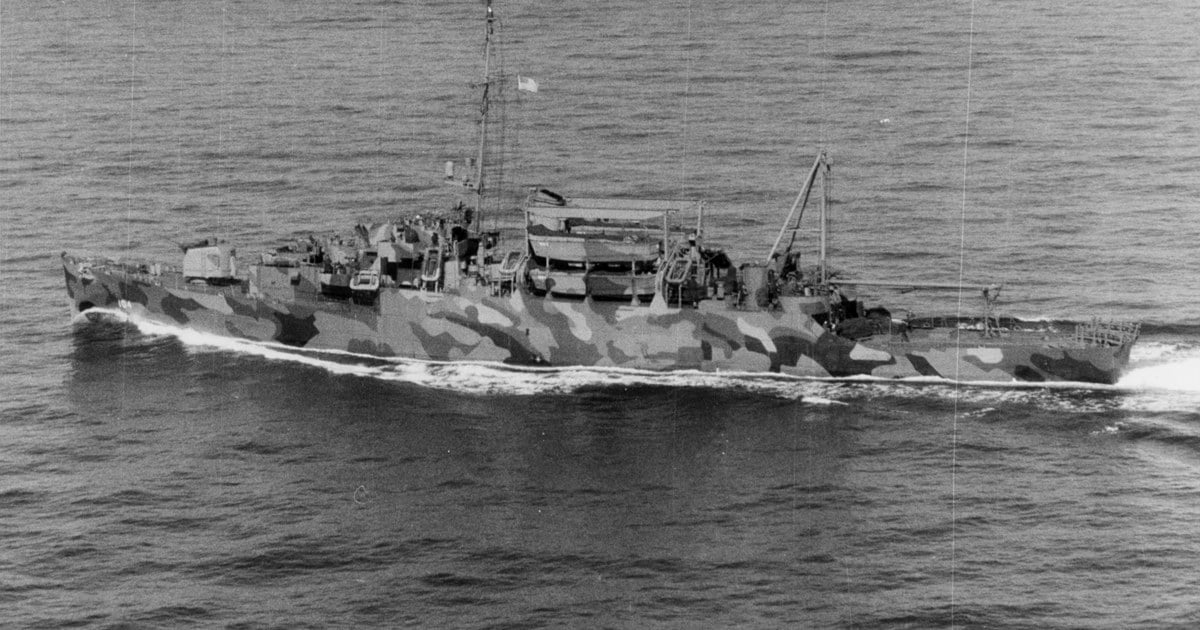
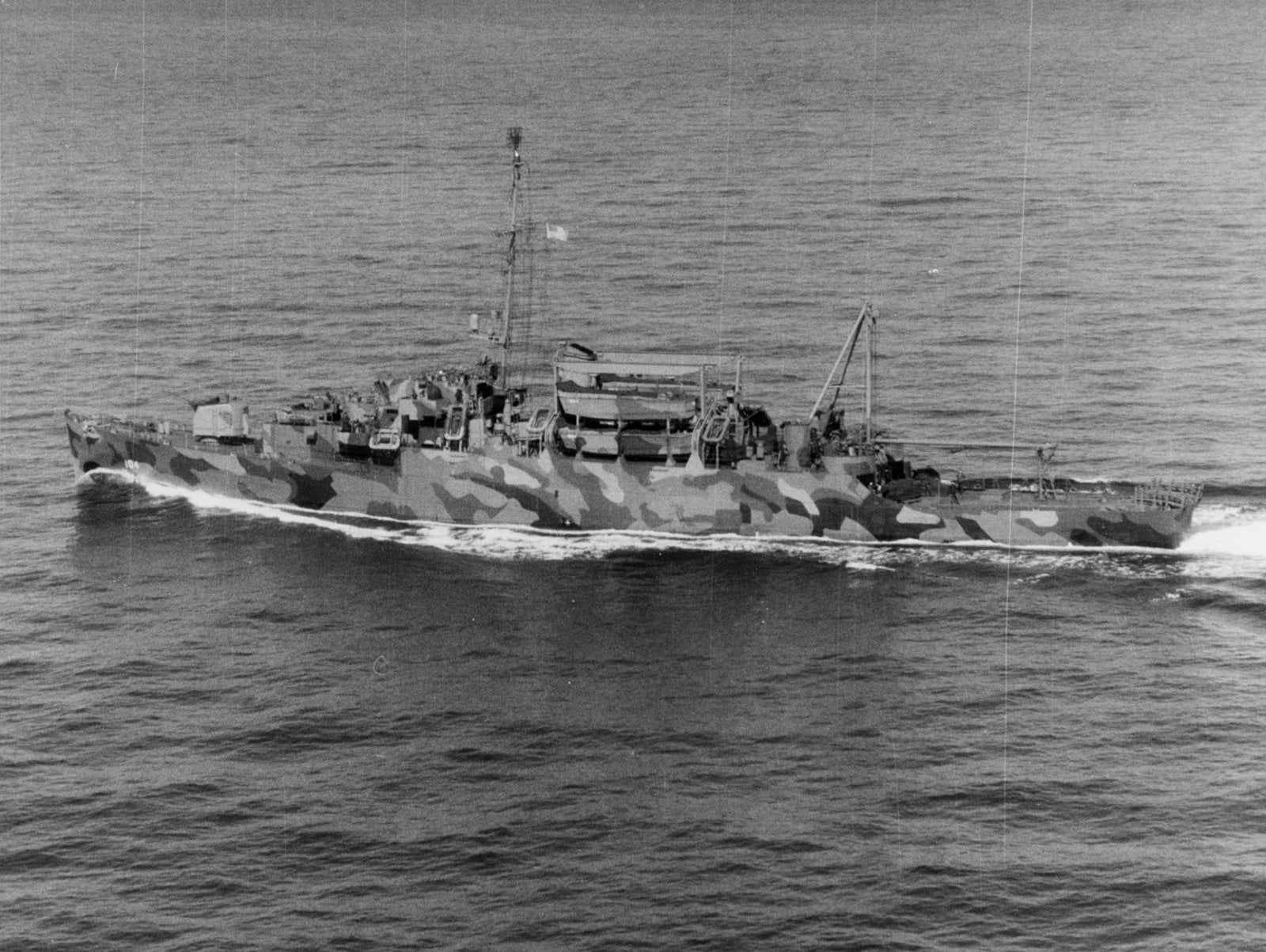
Stone’s ship was the USS William J. Pattison, a destroyer escort hull finished as a high-speed transport, designated APD-104. Navy records show she was built at Hingham, Massachusetts, outside Boston, commissioned Feb. 27, 1945, and sailed for the Pacific that May by way of the Panama Canal. Stone remembered her as the “Patterson,” a ship with room for 70 or 80 troops and a doctor aboard.
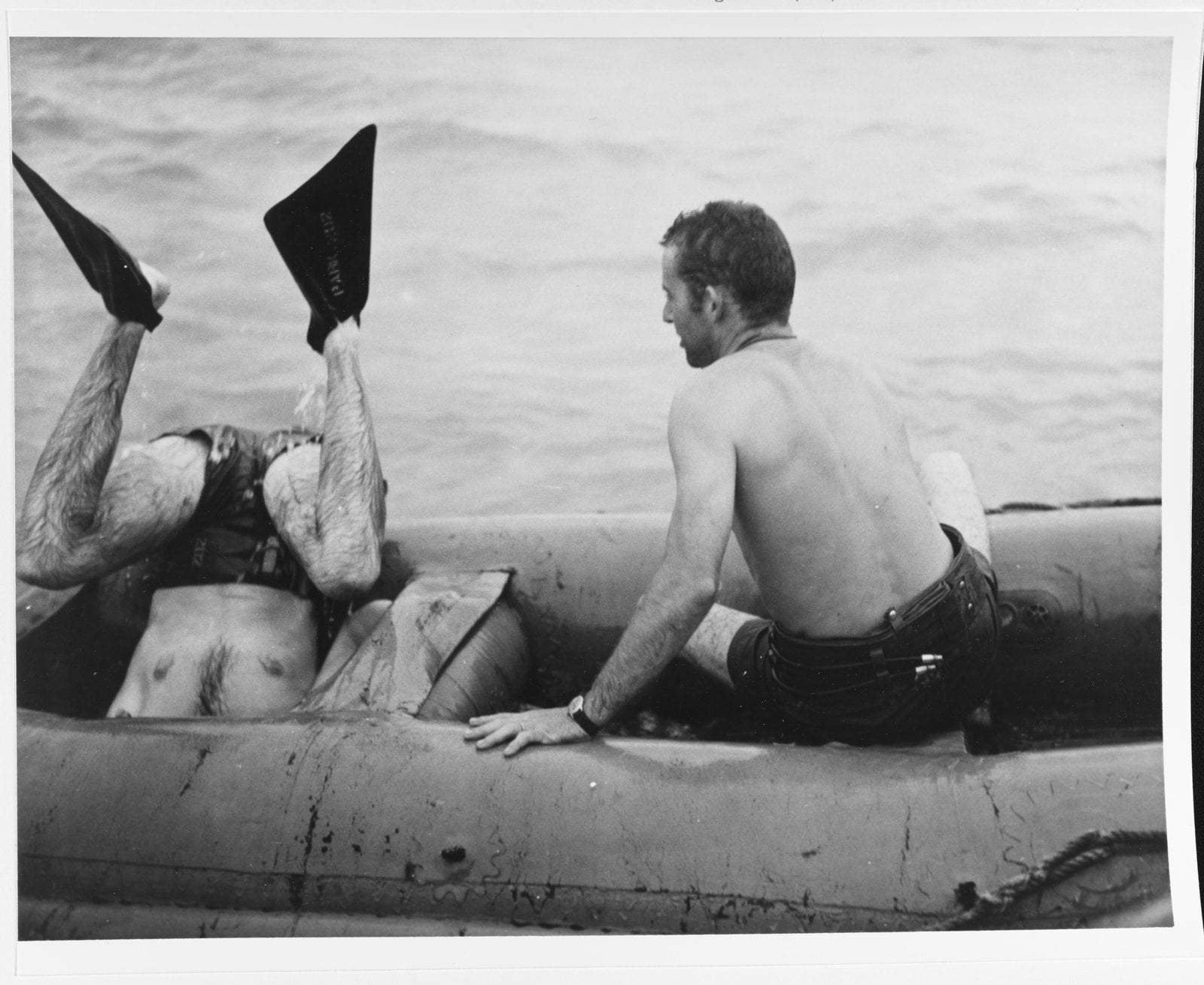
In Hawaii the ship trained with underwater demolition teams, the Navy’s “frogmen,” who would swim into enemy harbors to find and cut loose mines ahead of an invasion. “You couldn’t believe what these men could do,” Stone said. They dove off the highest point on the ship, swam under it, and practiced being snatched out of the water by boats running at full speed.
Everyone understood the job ahead. “We were headed for Japan,” Stone said, “and we were to be the advance thing, to get the mines out of the way, so we’d go in and invade.”
In the meantime the ship pulled downed pilots out of the water for the 5th Fleet’s carriers. Stone worked the radio shack during general quarters, relaying reports to the bridge. He never saw the rescues, only heard them. One pilot had drifted almost to the beach of a small Japanese-held island, towing boxes of food that planes had dropped to him. “I know the Japanese were waiting for that, probably,” Stone said. “But we picked him up just before he got into the island.” Another time the crew fished out a sailor who had gone berserk and jumped overboard.
The Navy’s history of the ship says she made two runs to Okinawa in late July and early August 1945 and sat through air raid alerts without seeing action. Stone remembered only one brush with enemy fire, rifle shots popping somewhere beyond a smokescreen. The thing that frightened him was the weather.
“We were in a hurricane for about three days off of Okinawa,” he said. “That was worse than the Japanese, because that little ship was pretty light, and it bounced all over the place.”
Tokyo Bay
Japan surrendered Aug. 15, 1945, while the Pattison was steaming from Okinawa to the Marianas, according to the Navy. Stone was at his typewriter in the radio shack when the final message came through. “I was typing the report, the last report we got, that the war was over, the end of the war, and the President was congratulating us,” he said. He kept the letter, signed by most of the crew, for the rest of his life.
At Guam the ship picked up Underwater Demolition Team 18 and sailed with the 3rd Fleet for Japan, arriving in Tokyo Bay on Aug. 27, 1945, Navy records show. Her frogmen inspected the harbor at the Yokosuka naval base when the Marines landed there Aug. 30, and the ship spent the next month helping demilitarize Japanese warships and scouting bases around the home islands.
Stone remembered sailing into a big Japanese shipbuilding port past caves with gun positions pointing out at the ships. “I thought, thank goodness the war’s over with,” he said. Inside the caves, he was told, men on bicycles pedaled to keep the air moving.
He got into Tokyo twice on liberty and found the people “tickled to death to see us.” They had already set up little stands along the streets to sell trinkets. They also followed around the biggest man on the ship, a blond Swede well over 6 feet tall who kept skinning his head on the ship’s low pipes. “I bet they thought, no wonder they lost the war, that man’s a giant,” Stone said.
The Pattison left Japan at the end of September and reached San Diego on Oct. 22, 1945, after stops at Guam, Eniwetok and Pearl Harbor, according to the Navy. Stone remembered one last search for a missing pilot who was never found. Early in 1946 the ship went back through the canal to Florida and was mothballed at Green Cove Springs, near Jacksonville. Stone was discharged at the Navy base in Memphis in April 1946, three years to the day after he went in, by his recollection.
Years later he looked his ship up on the computer. “They sold it for scrap iron,” he said. Navy records put the sale in 1962.
The GI Bill and the balloon base
Stone went back to Hope, where his father lived, finished some high school and took a counselor’s advice to try the college in Magnolia, now Southern Arkansas University. He moved on to Southern Methodist University in Dallas, first full time and then at night downtown while he worked. He finished about three years of college in business and accounting before work and a growing family ended it.
Asked whether he could have done it without the GI Bill, he said no. “I would have been back looking at taking care of cattle and feeding a lot of animals, probably.”
He married Mary Sue Easterling of Hope about 1947 and settled in Garland. They had two sons and a daughter. He spent 12 years in cost accounting for Gifford-Hill, the Dallas concrete pipe company, then ran his own bookkeeping and tax business.
Then came the job he called “about the most interesting job I ever had,” at the scientific balloon facility in Palestine. Scientists from around the world launched enormous research balloons there. “They put those balloons that started out about three stories high, and they get as big as a football field when they expanded,” Stone said. Airplanes followed them, and at the end of a flight a signal ripped the balloon and the instruments came down by parachute. “That was the preliminary things to rockets and things, because they didn’t know what was up there.”
The base opened outside Palestine in 1963 under the National Center for Atmospheric Research and became the National Scientific Balloon Facility in 1973. NASA runs it today as the Columbia Scientific Balloon Facility.
“More my hero than I was”
Stone moved to Texarkana in retirement to be between his children, one son in Little Rock, one in Dallas and a daughter here. At Cowhorn Creek Estates he collected the war stories of the men he ate with, a pilot who flew in two wars, a woman who ferried cargo planes, a man who had eaten nothing but rice for months as a prisoner and never touched it again.
“I always thought they were more interesting than mine, really,” he said. “A lot of them was more my hero than I was.”
Shoalmire pushed back. The pilots he fished out of the water, she told him, “think you are on angel’s wings, I promise.”
Stone was a member of First Baptist Church of Texarkana, the Optimist Club and a longtime Boy Scout leader, according to his obituary. His wife, Margaret Ellen Stone, died in September 2013. Howard Leroy Stone died Sept. 15, 2017, at Cowhorn Creek Estates. He was 92. He was buried at Land of Memory Cemetery in Palestine. He was survived by his sons, Zeb and Andy Stone, his daughter, Kelly Fleet, his brother, Bill Stone, two sisters, six grandchildren and four great-grandchildren.
On the funeral home’s tribute wall, his son Zeb wrote that for years his father collected money for the hourly workers at his retirement community and handed each of them cash at Christmas.
Of the Navy, Stone said in 2011: “It’s the best fun I ever had in my life, I guess, really, just joining the Navy.”
Sources
- Library of Congress, Veterans History Project: Howard Leroy Stone Collection (AFC/2001/001/91682), interview transcript, December 2011, Texarkana, Texas
- Dictionary of American Naval Fighting Ships, William J. Pattison (APD-104), Naval History and Heritage Command
- Obituary of Howard L. Stone, Herrington/Land of Memory Funeral Home, Palestine, Texas, September 2017
- NASA, Columbia Scientific Balloon Facility history
Did you know Howard Stone? Do you have photos of him? TXKtoday would like to hear from you. Contact us here.