

The 85 at Rondo: Measles, 1862, and the women who got them headstones
In the late summer of 1862, disease swept a Confederate camp at Rondo, east of Texarkana. Eighty-five men lie there in a common grave, unnamed. In the 1930s, a Texarkana women's group and Rep. Effiegene Wingo got them 17 government stones, one for every five.

Part 2 of 11 for 11, a TXK Today series remembering Texarkana-area veterans through America’s wars. A new story every day through Veterans Day.
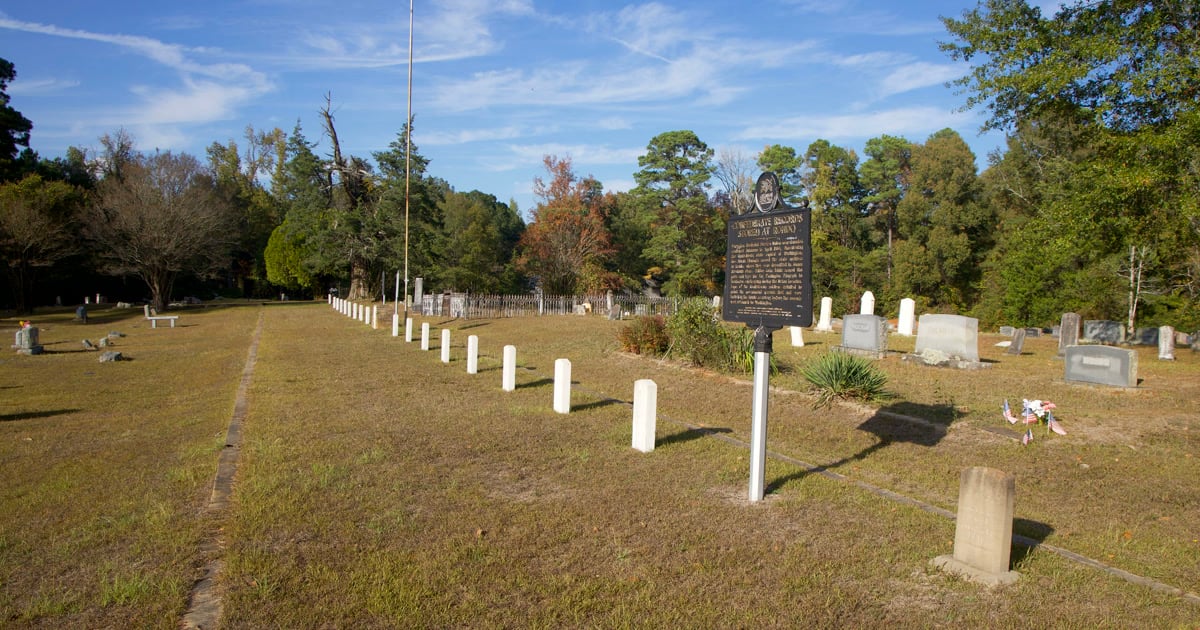
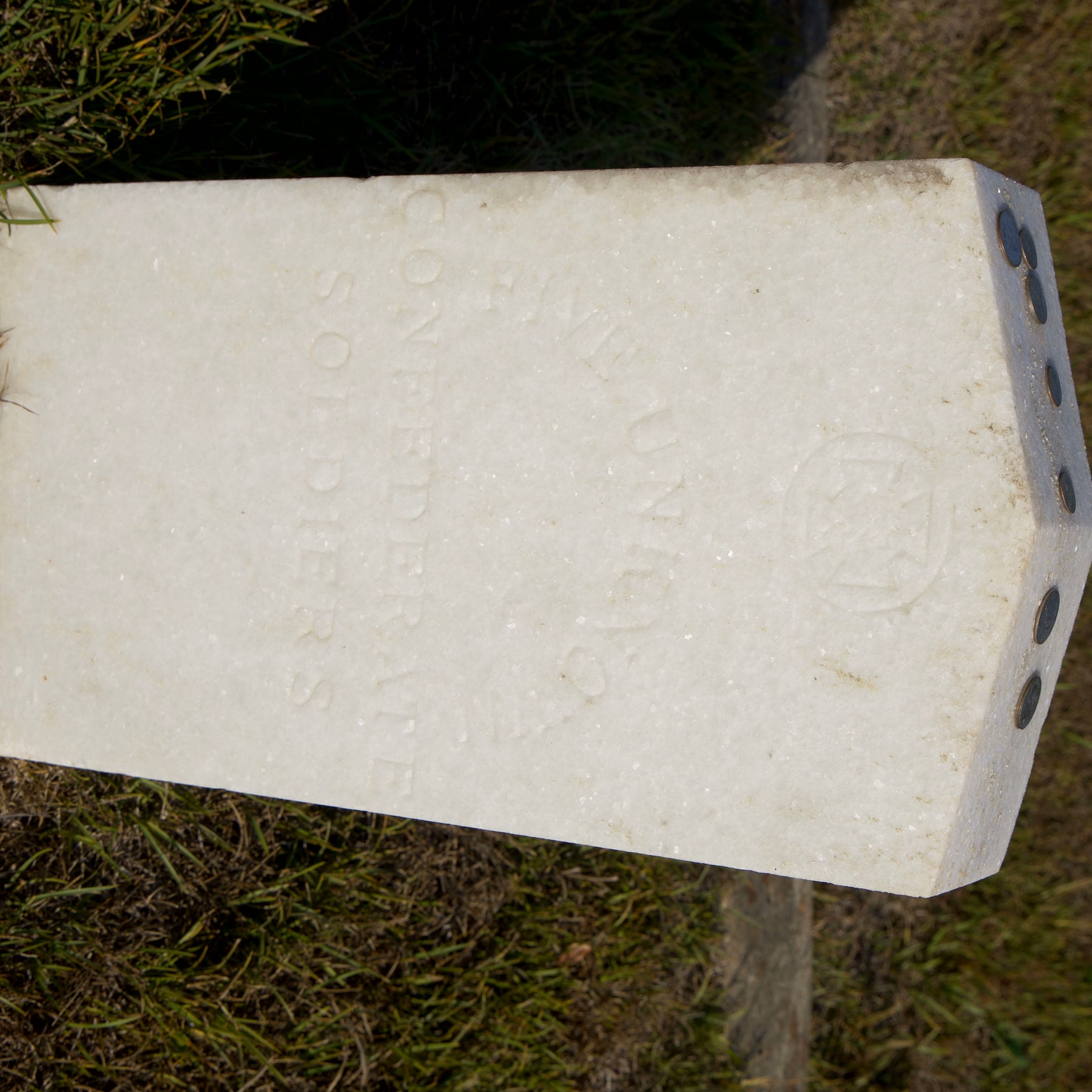
In the middle of Old Rondo Cemetery, a few miles east of downtown Texarkana, 17 small marble stones stand in a straight line. Each one reads the same: “Five Unknown Confederate Soldiers.”
Together they mark 85 men who never reached a battlefield. They died of disease in a Confederate camp at Rondo in the late summer of 1862, according to the site’s National Register of Historic Places nomination. Their names are not on the stones, and no list of their names is known to have been published.
A regiment from Northeast Texas
Most of the dead are believed to have belonged to the 19th Texas Infantry. The regiment was organized in the spring of 1862 from Northeast Texas counties including Davis (now Cass), Marion, Titus, Harrison, Hopkins and Upshur, according to the Handbook of Texas. Its colonel, Richard Waterhouse, was a merchant who helped raise the regiment in and around Jefferson. In May 1862 it counted 886 men.
On June 12, 1862, Brig. Gen. Henry E. McCulloch ordered Confederate troops east of Tyler to march to Little Rock, which was threatened by a Union army under Gen. Samuel Curtis. The 19th Texas headed northeast, across the state line, and stopped at Rondo, then in Lafayette County, Ark.
Joseph P. Blessington, a soldier in another Texas regiment, passed the camp on Sept. 6, 1862. “We passed through a little village named Rondo,” he wrote in his 1875 history of the division. Waterhouse’s men “did us the honor of presenting arms as we passed their camp.”
Article continues below
▼ Continue reading
Measles in camp
While the regiment was at Rondo, measles struck, “killing dozens of Waterhouse’s Rebel soldiers,” the National Register nomination says. The Handbook of Texas adds dysentery and diarrhea to the toll and says between 30 and 40 sick men had to be left behind when the regiment moved on.
The sources differ. The nomination places at least seven companies at Rondo from July through early September. The Handbook says both battalions reached the camp, which it calls Camp Josephine McDermott, by Aug. 29 and stayed more than a month. It counts 24 deaths at Rondo itself. The nomination says the remains of 85 soldiers who died in the epidemic were later reburied there. Men left behind sick may account for some of the gap, but the records reviewed for this story do not settle it.
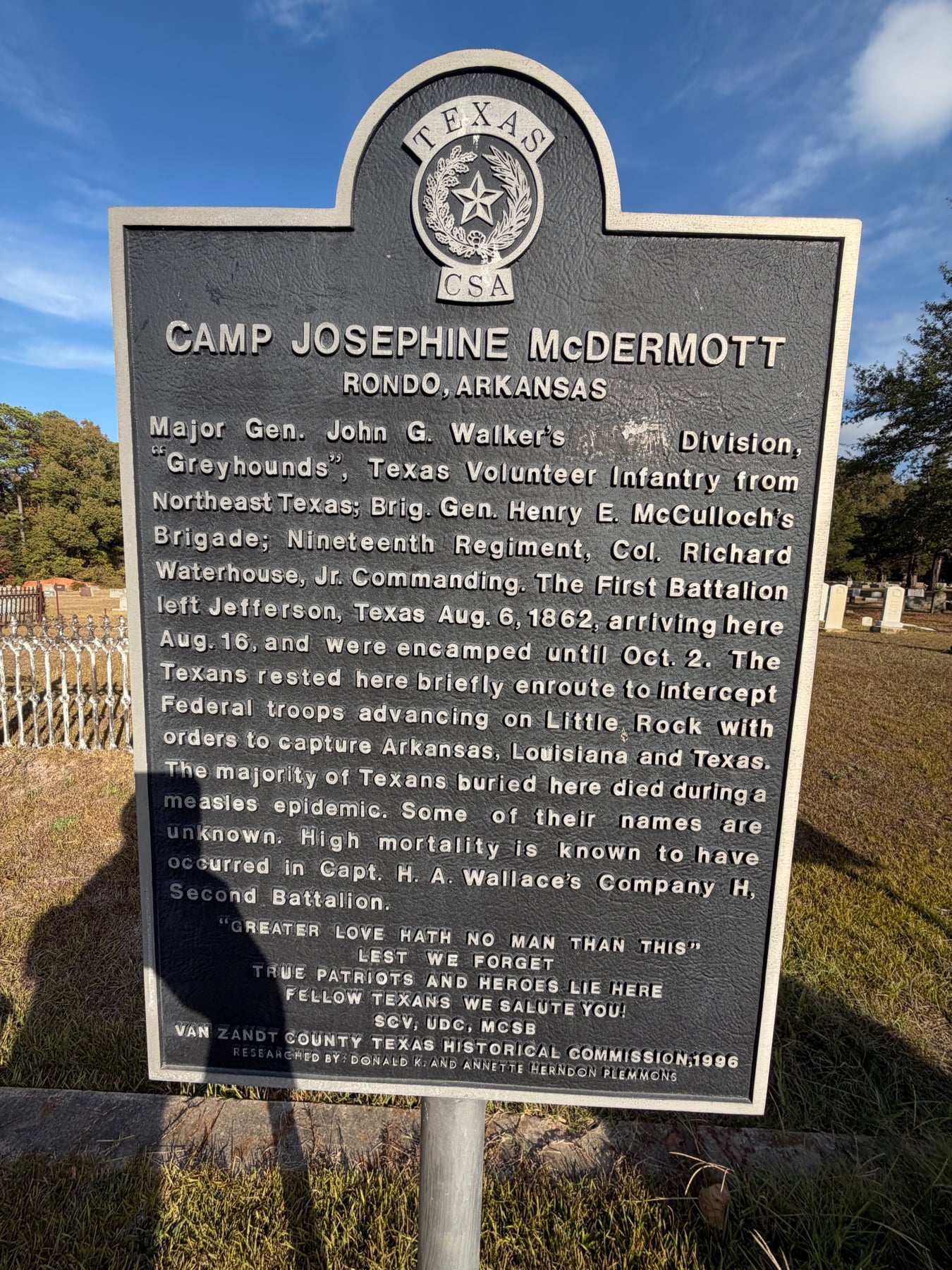
A marker at the cemetery adds a third account. Placed in 1996 by the Van Zandt County Historical Commission in Texas, it says the regiment’s First Battalion left Jefferson on Aug. 6, 1862, arrived at Rondo on Aug. 16 and camped there until Oct. 2. “The majority of Texans buried here died during a measles epidemic,” it reads. “High mortality is known to have occurred in Capt. H. A. Wallace’s Company H, Second Battalion.”
The march did not get easier. At Camp Nelson, near Cabot, Ark., more men died of measles. By the end of 1862, the 19th Texas had lost 119 men to weather, short supplies and disease since leaving Jefferson, according to the Handbook. It had not yet fought a battle. That came later, as part of Walker’s Texas Division, at Milliken’s Bend, La., in 1863 and at Mansfield and Pleasant Hill, La., and Jenkins’ Ferry, Ark., in 1864.
Rondo’s toll was not unusual for the war. Disease killed about twice as many soldiers as combat did. The National Park Service counts 224,580 Union deaths from disease against 110,100 killed in battle, and 164,000 Confederate disease deaths against 94,000 killed. Measles spread quickly in camps crowded with men from farms and small towns, many of whom had never had it.
One stone for every five men
After the war, the remains of the 85 were dug up from where they had first been buried and reburied side by side in a common grave in the Old Rondo Cemetery, according to the nomination, which cites a 1958 history of Rondo by Iola Edwards Field.
The government stones came about 70 years after the deaths.
The Albert Pike Chapter of the United Daughters of the Confederacy was organized in Texarkana in 1931 and “immediately began efforts to recognize the unknown soldiers” at Rondo, the nomination says. The chapter worked with U.S. Rep. Effiegene Wingo of De Queen, described in the nomination as a granddaughter of Confederate soldiers. She had succeeded her late husband, Otis Wingo, and served from 1930 to 1933, according to the Encyclopedia of Arkansas.
A 1929 federal law had authorized government headstones for Confederate graves in private cemeteries, according to the U.S. Department of Veterans Affairs. The chapter sought federal help to acquire the burial plot and mark it. Seventeen marble markers were placed, one for every five men.
The plot was sold to the chapter for $1 on Dec. 7, 1934. The first dedication ceremony was held that year, with a speech by Confederate veteran T.T.C. Anderson, according to the nomination.
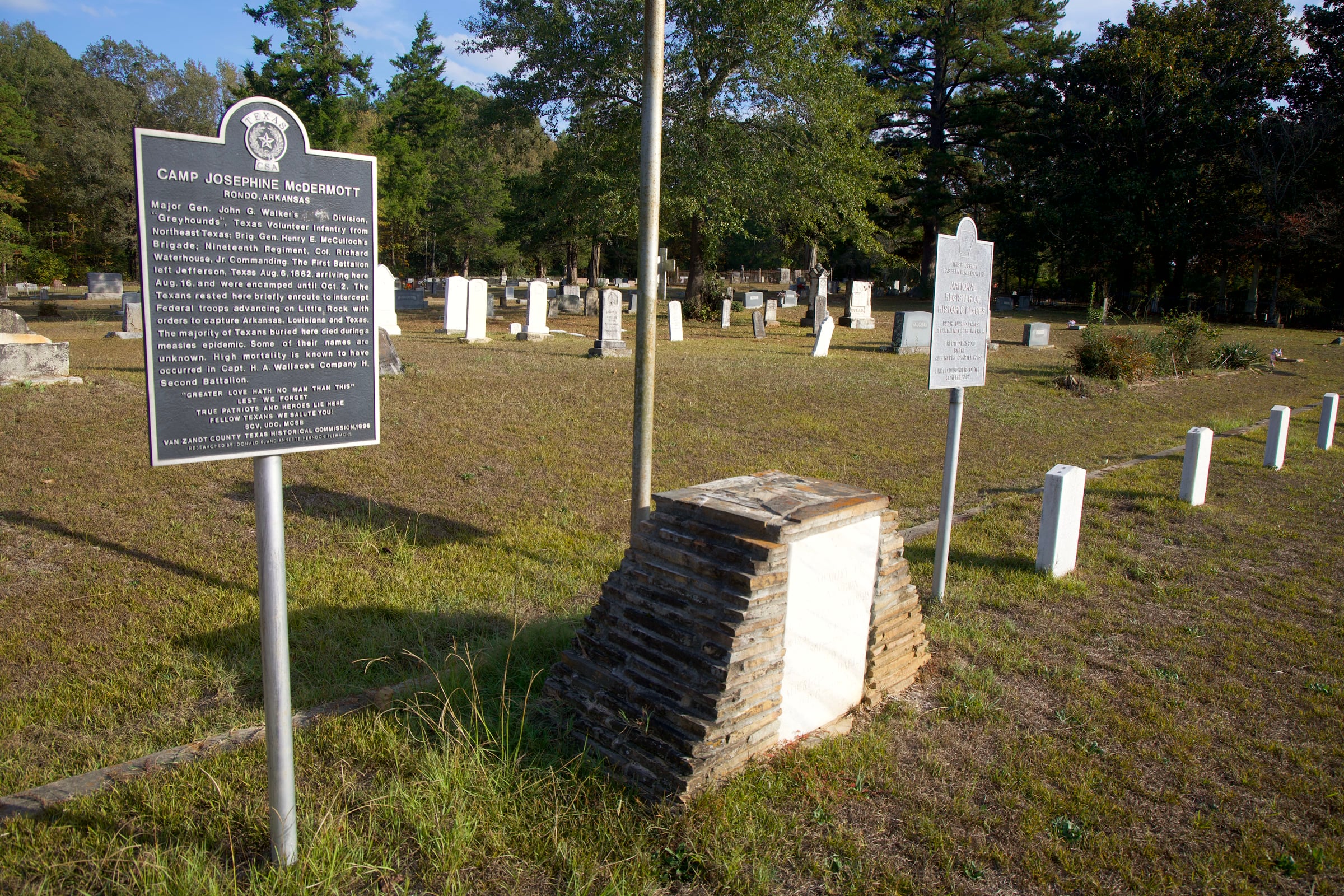
In 1962, during the Civil War centennial, the chapter added a small stepped monument of fieldstone with a marble face. It reads: “In memory of 85 unknown Confederate soldiers, War Between the States, 1861-1865.”
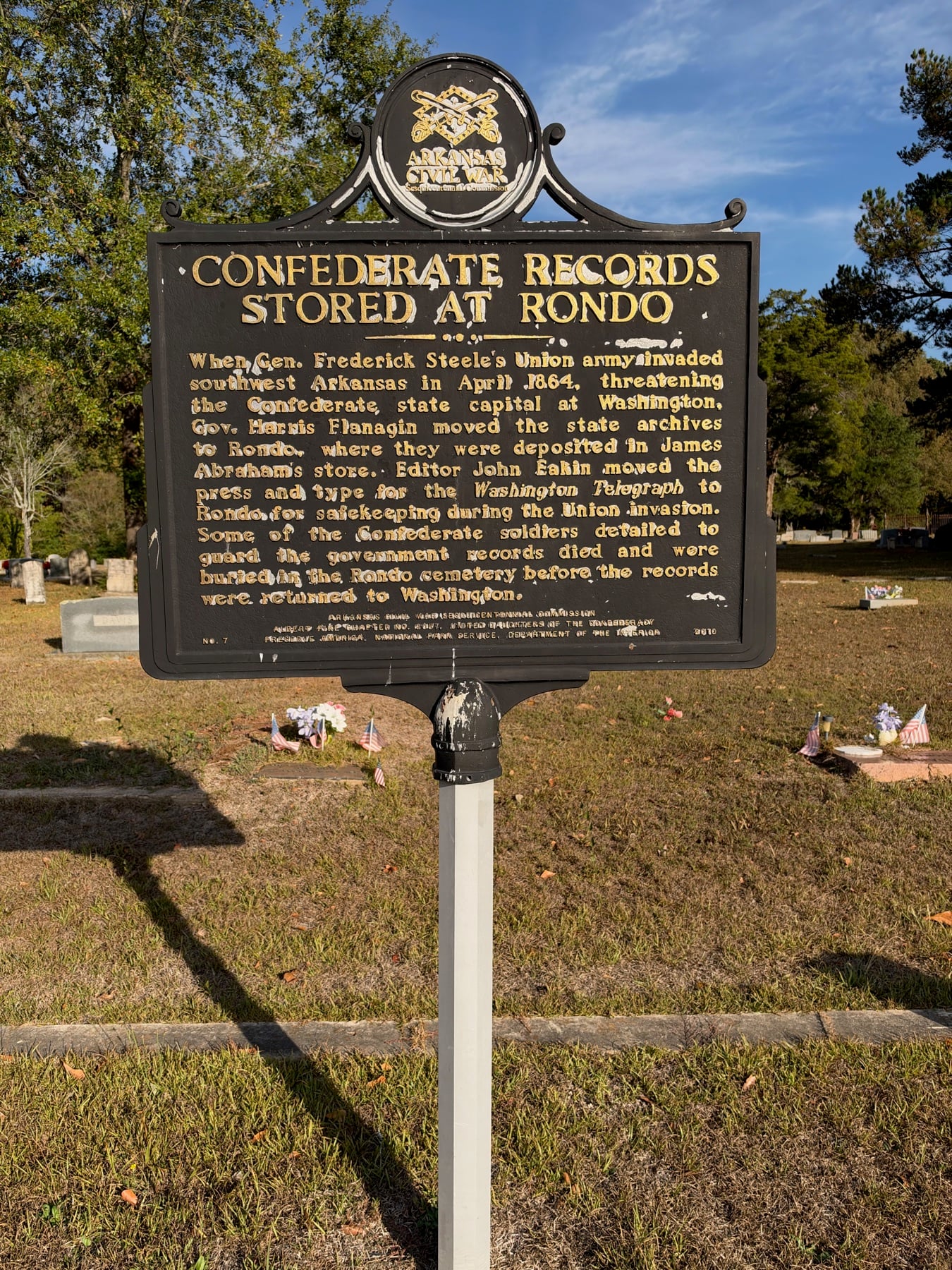
The 85 are not the cemetery’s only Confederate dead. When Union Gen. Frederick Steele’s army invaded southwest Arkansas in April 1864, threatening the Confederate state capital at Washington, Gov. Harris Flanagin moved the state archives to Rondo, where they were stored in James Abraham’s store, according to a 2010 marker from the Arkansas Civil War Sesquicentennial Commission. Some of the soldiers detailed to guard the records died and were buried in the Rondo cemetery before the records went back to Washington, the marker says.
On the National Register
The Confederate Section, Plot 72 of the cemetery at 1612 Smith Road, was listed on the National Register of Historic Places on Sept. 22, 2004, according to the Encyclopedia of Arkansas. The Albert Pike Chapter, No. 2057, put up a plaque marking the listing in May 2006.
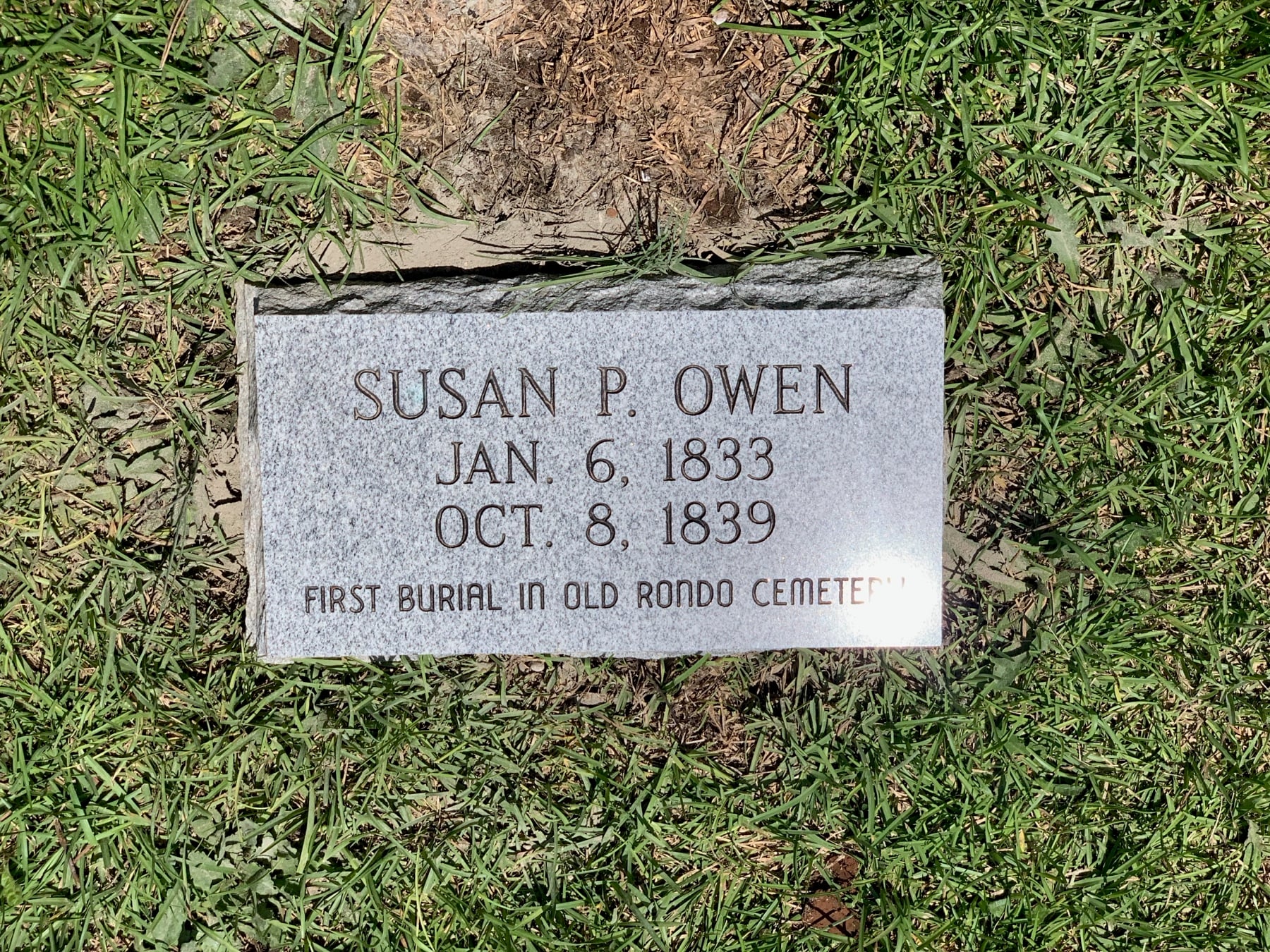
The cemetery itself is older than the war. Alexander Owen donated the land for it in 1836, and his daughter, Susan P. Owen, became its first burial when she died Oct. 8, 1839, at 6, TXKtoday reported in 2019, when a new headstone replaced her broken, unreadable original.
The listing is as much about the 1930s as about 1862. It was nominated under a statewide study of Civil War commemorative sculpture. Its significance, the nomination says, lies in the chapter’s efforts “to reflect members’ perception of the noble character and valor of their veterans and their cause.” Only the 17 stones and the border count as historic. The 1962 monument and the later marker do not.
The regiment came from a part of Texas where slavery drove the economy. Next door in Bowie County, enslaved people outnumbered white residents in 1860, 2,651 to 2,401, according to the Handbook of Texas.
As of 2004, the chapter held a memorial service at the cemetery every May. The 85 men remain unnamed. Confederate service records for the 19th Texas, held by the National Archives, may still identify some of the men who died there.
Did an ancestor serve in the 19th Texas Infantry or die at Rondo in 1862? Do you have family stories, letters or old photos of the Rondo cemetery or the UDC’s work there? We’d like to hear from you.
Sources: National Register of Historic Places nomination, “Confederate Section–Old Rondo Cemetery,” Miller County, Ark. (ref. 04001029), prepared by Mark Christ, Arkansas Historic Preservation Program, 2004, via National Archives; Encyclopedia of Arkansas, “Old Rondo Cemetery, Confederate Section”; TXKtoday, “Oldest grave in Rondo Cemetery gets new headstone,” June 20, 2019; historical markers at Old Rondo Cemetery: “Camp Josephine McDermott” (Van Zandt County Historical Commission, 1996) and “Confederate Records Stored at Rondo” (Arkansas Civil War Sesquicentennial Commission, 2010) and “Effiegene Locke Wingo”; Handbook of Texas Online, “Nineteenth Texas Infantry” and “Bowie County”; Joseph P. Blessington, “The Campaigns of Walker’s Texas Division” (1875); National Park Service, “Facts: The Civil War”; U.S. Department of Veterans Affairs, National Cemetery Administration, “History of Government Furnished Headstones and Markers”.