


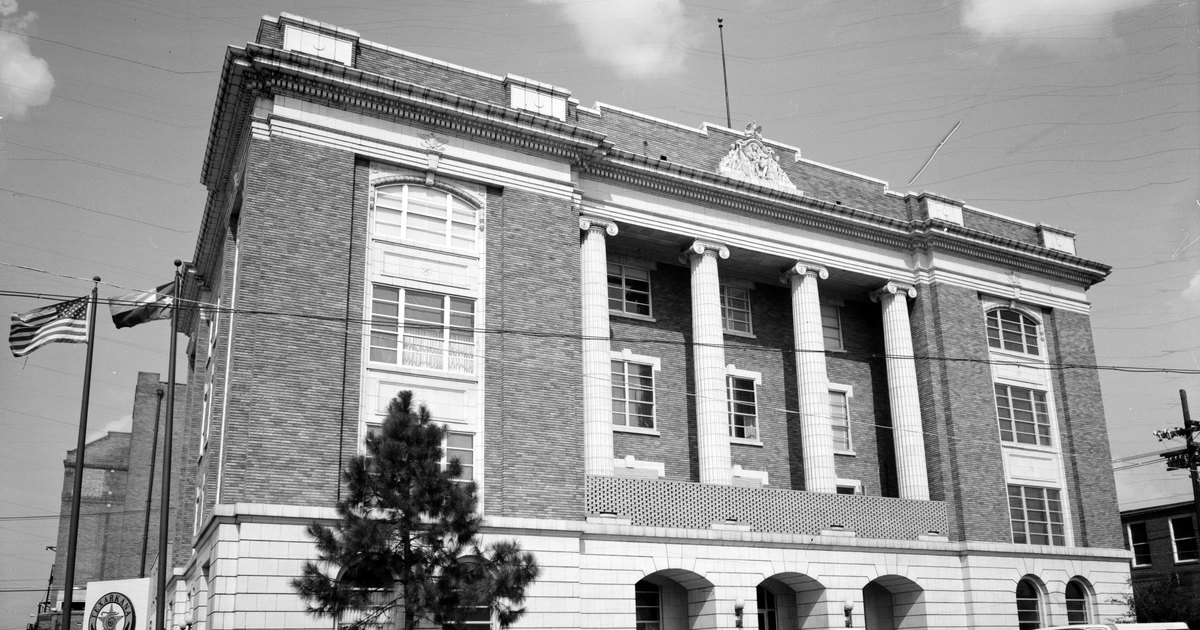
On Nov. 12, 1925, Texarkana, Texas, threw a party for a building.
The new four-story Municipal Building on Texas Boulevard at Third Street was dedicated that Thursday with a parade, a banquet, an orchestra and a concert by the Fire Department’s drum and bugle corps, according to a 1981 history prepared for the Historic American Buildings Survey from the Four States Press coverage of the day. The building was open for inspection all day, the Naples Monitor reported, and “the ceremonies closed with a banquet in the evening.”
Thursday marks 101 years, and the building is still Texarkana, Texas, City Hall.
881 to 149
Voters approved $200,000 in bonds for “a new municipal building” in a special election Aug. 21, 1923, by a vote of 881 to 149, according to city council minutes summarized in the survey. An advisory committee of John J. King, W. A. McCartney and John W. Wheeler oversaw the project.
The council asked two firms to work together: C. H. Page and Brother of Austin designed the building and did the engineering, and Witt, Seibert and Halsey of Texarkana drew the working plans and supervised construction, for $50 a week, the minutes show. The architects’ fee was 5% of the building’s cost.
Article continues below
▼ Continue reading
Ten general contractors bid on July 16, 1924. Murch Brothers Construction Co. won with the low bid of $149,050, more than $10,000 under the next lowest. Daley and Hoffman got the plumbing and heating contract for $16,488 and Logan Electric the wiring for $3,855.
One request came from the public before the doors opened. On June 9, 1925, Mrs. L. A. Lawson of the Texarkana Women’s Club asked the council to make sure the new building had a women’s restroom, the survey notes.
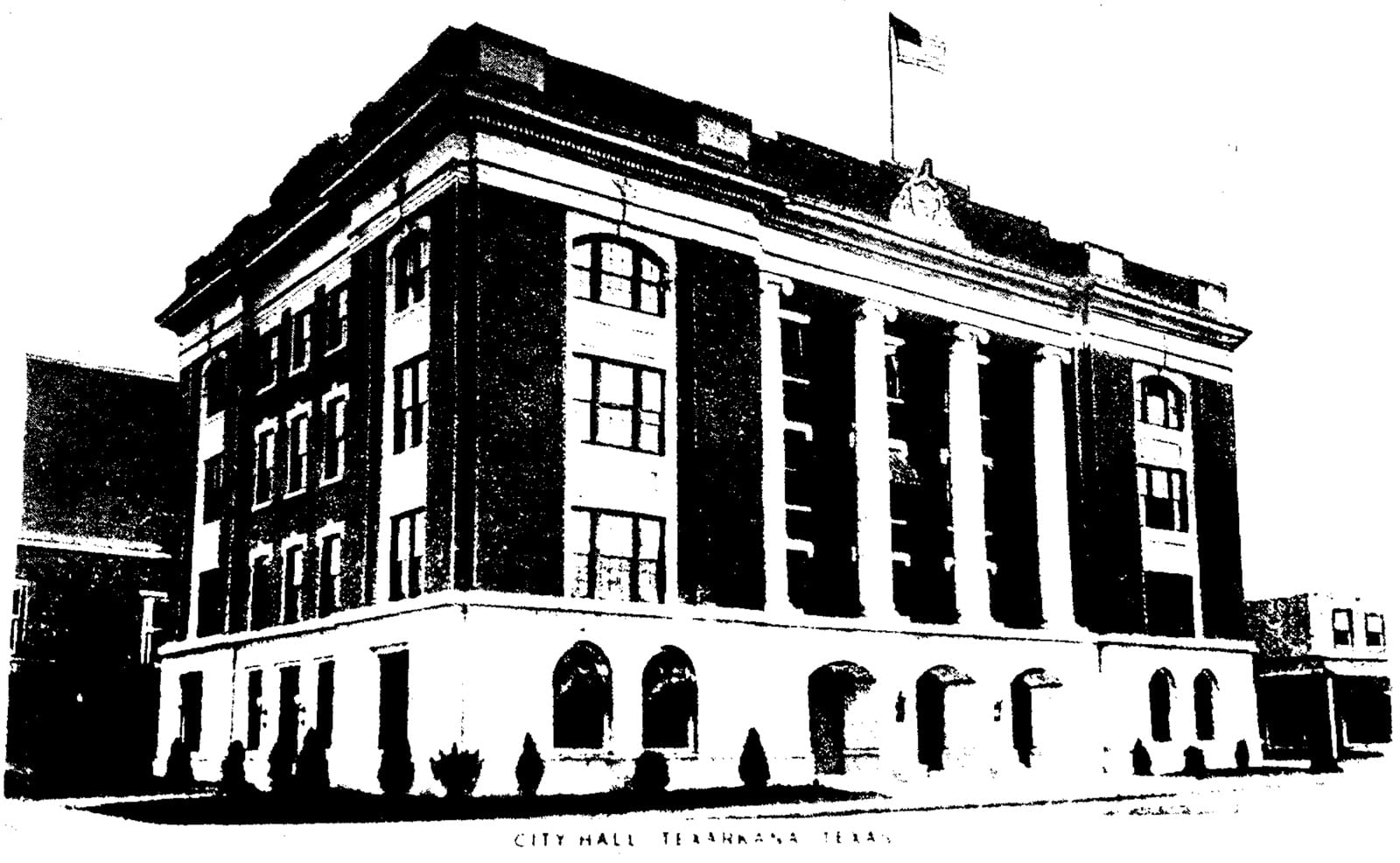
A courthouse on the fourth floor
The building was designed to hold city offices on three floors and the Court of Civil Appeals on the fourth. The survey repeats a local story, which it calls a rumor, that the fourth-floor space was part of a “deal” to bring the appeals court to Texarkana.
The council, led by Mayor H. S. Brashear, held its first meeting in the new building on Sept. 1, 1925. A Chamber of Commerce representative, M. E. Melton, asked that the dedication be timed with what the survey calls a “Senator and Congressman Convention,” and the council agreed on Nov. 12.
The day’s surprise came in the second-floor courtroom. Federal Judge W. L. Estes of the Eastern District of Texas, who was born at Boston when it was the Bowie County seat, pulled an American flag off a portrait of Judge John J. King, a former Bowie County judge and state legislator, and called King the “leader of this body of men,” according to the Four States Press account cited in the survey. Philadelphia artist H. L. Brewer painted the portrait.
The ceremony left out part of King’s story. As county judge in August 1893, he shot Texarkana newspaper editor William J. Allen on a downtown street after Allen attacked the commissioners court in print. Allen died, and King was tried for murder and acquitted, according to the Handbook of Texas and Texarkana newspapers of the day. King died in 1940.
The offer to Bowie County
Within four months, the new building was at the center of a countywide fight. Texarkana’s city council offered it to Bowie County as a courthouse if voters would move the county seat from Boston to Texarkana, according to the Texarkana-based Farm-Labor Union News, which opposed the move.
Texarkana had held the courthouse before. A county seat fight was “brewing in Bowie county” in September 1885, the Clarksville Standard reported, and voters soon moved the seat from the old town of Boston to Texarkana. It stayed about five years. In 1890 a majority vote carried it to the geographical center of the county, “where it has since remained, despite several attempts of Texarkana to win it back,” the Dallas News reported in 1926. The Daily Texarkanian offered its own explanation in 1895: “If Texarkana, Texas had built a good court house the county seat would have remained here for Bowie county.”
A majority of the commissioners court inspected the building and declared it “entirely inadequate,” in a paid statement in the paper on March 11, 1926, and warned that moving the county seat would mean a bond issue for a new courthouse and jail. Rural readers were told that jurors from the west end of the county would have to travel to Texarkana a day early.
Opponents also reached back to the 1880s. Their ad reprinted a bond dated Sept. 19, 1885, in which Texarkana businessmen promised the county a courthouse rent-free for five years, and it claimed the county had been forced to pay rent anyway. A Texarkana ad in the same paper a week later promised quarters in the Municipal Building “for as long as the county needs the space.”
The election on March 23, 1926, drew what the Red River County Review called the largest vote ever polled in Bowie County. Texarkana won a clear majority, about 11,300 votes to a little more than 6,000 by the newspapers’ unofficial counts, but moving a county seat took two-thirds, and the city fell short. Inside Texarkana, the vote was 6,874 to 65 for the move. Forty-eight city voters left their sick beds and were carried to the polls in ambulances, according to a Dallas News report reprinted in the Cass County Sun. Loudspeakers on the main streets broadcast the returns, the Review reported. It was not the city’s first loss. A try about five years earlier had fallen about 600 votes short of two-thirds, according to the Dallas News.
The county seat stayed at Boston. The Municipal Building kept its city offices and its appeals court.
Federal Credit Union No. 1
The first federal credit union in the United States started in this building, with pocket change.
Sen. Morris Sheppard of Texarkana wrote the Federal Credit Union Act, which President Franklin D. Roosevelt signed June 26, 1934. It let groups of working people pool their savings and lend to one another under a federal charter. The first charter went to Sheppard’s hometown on Oct. 1, 1934, according to the National Credit Union Administration: Charter No. 1, the Morris Sheppard Texarkana Federal Credit Union. Sheppard died in office in 1941.
It began with $7.75. That much change, “pooled in 1934 by a few persons in Texarkana, Texas, provided the start of Federal Credit Union No. 1,” a federal credit union official, William E. Allen, wrote in the Social Security Bulletin in 1959. It was “appropriately named for the author of the legislation,” he wrote.
It was organized to serve employees of the city of Texarkana, Texas, and it ran out of City Hall, the trade paper Credit Union Times reported on its 70th anniversary in 2004. For decades it had no office of its own. A city employee served as treasurer on the side, and the credit union lived wherever that person worked. “The office would be in the city secretary’s office, the inspection office, or another office located in the building, depending on who the Treasurer was at the time,” manager Michelle Daniels told the paper. In 1944, the job paid $12.50 a month.
That was also the only year the credit union failed to pay a dividend, according to the paper. It lost $18.43.
By the end of 1934, 78 federal charters had been approved, the agency’s records show. As of June 30, 2026, there were 2,649 federal credit unions with 80.4 million members.
Bobbie Eitel, hired as assistant secretary-treasurer in 1954, ran it from 1964 and became its first full-time paid manager in 1993, after she retired from the city. Known as “Ms. Bobbie,” she stayed until 2001, and on her watch the credit union got a permanent space in the building. Daniels found that her husband, a Texarkana firefighter, had a great-grandfather and a great-great-uncle who were firefighters and early members.
In 2004 it had about 1,000 members and $6 million in assets, with no checking accounts, no credit cards and no ATMs. It was still in City Hall, and Daniels said a move was possible. By 2010 its website listed the address it uses today, 419 W. Fourth St.
It still holds Charter No. 1. Federal records list about 1,240 members and $13.6 million in assets, and membership is open to employees of both Texarkanas, Nash, Wake Village, Bowie and Miller counties and Texarkana Water Utilities, and their families.
Still City Hall
The 1981 survey found the original white tile floors, black wrought-iron staircases with oak handrails, brass light fixtures and a 1924 elevator still in place, though offices had been rearranged and aluminum sash had replaced some wood windows.
The city of Texarkana, Texas, today lists City Hall at 220 Texas Blvd.
Fun facts about City Hall over the years
- It is the second city hall on the corner. A 1908 city directory put the earlier City Hall at Third and Maple, the street now called Texas Boulevard, according to the Sixth Court of Appeals’ history. City preservation officer Matt Solomon told KTAL in 2025 that the first building went up in the 1880s and was demolished in 1924 to make way for this one.
- The alderman who asked for flowers became mayor. In January 1926, Alderman L. S. Kennedy told the council “there should be some flowers and shrubbery planted around the building,” the survey says. By May 1928 he was the Texas-side mayor, welcoming more than 350 editors and newspaper representatives to a joint Texas-Arkansas press convention.
- An appeals court upstairs for 60 years. The state appeals court for this region, now the Sixth Court of Appeals, was created in 1907 and was housed in the old city hall before moving to the fourth floor of the new building. Chief Justice George W. Johnson, 57, was found dead in the court’s chambers there in January 1944, apparently of heart trouble, the Detroit News-Herald reported. The court did not leave until 1985, when it moved to the second floor of the Bi-State Justice Building.
- Cash on the council table. On July 15, 1946, Mayor W. N. Harkness dropped two $500 bills on the council table and accused three aldermen of taking $1,000 bribes to vote for extending Spruce Street. The aldermen denied it. A Bowie County grand jury indicted all three, and the three aldermen and the mayor resigned in August. Harkness then won his seat back in the special election his own charges had forced. One alderman, Lee Talley, was acquitted by a jury in Paris that October, and the judge ordered an acquittal for a second, Albert McWilliams. Lawyers on both sides said the remaining cases were unlikely to be tried, and a later grand jury reported finding no other evidence of corruption in city government. Harkness resigned a second time that November.
- Farm credit started here, too. Thirty-seven farmers and stockmen met at City Hall in 1934 to organize the Texarkana Production Credit Association, which financed crops and livestock in Bowie, Cass, Morris and Red River counties, the Citizens Journal of Atlanta reported in 1948.
- Its architects also built on the state line. Witt, Seibert and Halsey, the Texarkana firm that drew City Hall’s working plans, also designed the federal building at 500 N. State Line Ave. with Perkins, Chatten and Hammond of Chicago. That building, which straddles the state line, was completed in 1933.
- Red and gold. The council chamber was decorated in red and gold with the city seal when the federal survey was written in 1981.
- A 1951 makeover. Shreveport architects Peyton and Bosworth remodeled the second-floor courtroom and the third floor in 1951.
- Air conditioning, by the brick. A 1968 project added drop ceilings and fluorescent lights and rewired the building for air conditioning. By 1981, brick latticework screened the air conditioning units in three second-floor windows on the west side.
- Candy downstairs. In 1981, the first floor had a candy shop.
- The originals stayed in the building. As of 1981, the 27 original 1924 plan sheets were kept by the Public Works department, and the council minute books from 1923 to 1925 were in a second-floor vault.
- A landmark at 100. The Texas Historical Commission named City Hall a Recorded Texas Historic Landmark in 2025, the building’s centennial year. The city dedicated its historical marker on Nov. 9, 2026, in front of the building.
Do you have photographs from inside City Hall over the years, or family stories about the 1926 county seat election? We’d like to hear from you. Contact TXKtoday.
Sources: Historic American Buildings Survey, HABS TX-230, Municipal Building, Texarkana, Texas (1981), Library of Congress, which cites Texarkana, Texas, city council minutes, 1923-25, and the Four States Press, Nov. 12 and 13, 1925; The Naples Monitor, Nov. 13, 1925; The Farm-Labor Union News (Texarkana), March 11, 1926, March 18, 1926 and Feb. 25, 1926; The Standard (Clarksville), Sept. 11, 1885; The Daily Texarkanian, Feb. 14, 1895; Red River County Review, March 25, 1926; The Cass County Sun, March 30, 1926; Mount Pleasant Daily Times, May 25, 1928; The Clarksville Times, July 19, 1946 (reprinting the Texarkana Gazette), Aug. 2, Aug. 23, Sept. 20, Oct. 25, Nov. 1 and Nov. 22, 1946; The Detroit News-Herald, Jan. 13, 1944; The Citizens Journal (Atlanta), Feb. 5, 1948, all via the Portal to Texas History; Sixth Court of Appeals, About the Court and court history; Handbook of Texas, “King, John Jefferson”; Federal Judicial Center, William Lee Estes; KTAL, November 2025; National Register of Historic Places nomination, U.S. Post Office and Courthouse, Texarkana; National Credit Union Administration historical timeline, 1954 annual report, credit union locator and quarterly data summary, June 30, 2026; William E. Allen, Social Security Bulletin, June 1959; Credit Union Times, Nov. 2, 2004; Morris Sheppard Texarkana Federal Credit Union; City of Texarkana, Texas, website.