

Bowie County approves 10-year tax break for Red Barn Solar, with no buyer yet for the power

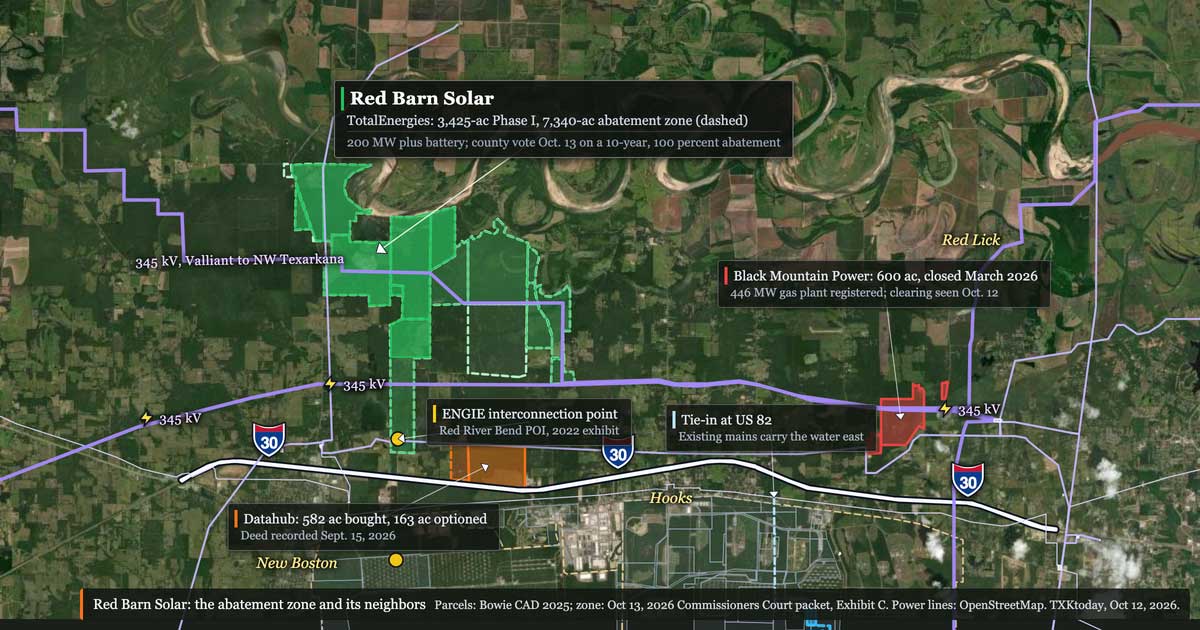
Bowie County commissioners approved a 10-year, 100% break on county property taxes for Red Barn Solar on Oct. 13, along with a road use agreement and the reinvestment zone that makes the tax break legal. The package clears the way for TotalEnergies to build a $264.5 million solar and battery plant on about 3,400 acres of timber land between State Highway 8 and the Red River, north of New Boston and Hooks.
The abatement passed unanimously. Commissioner Mike Carter voted against the reinvestment zone and the road use agreement but supported the abatement, the Texarkana Gazette reported. The vote came after a public hearing in which residents questioned whether the county was getting enough in return.
TXKtoday laid out the terms of the deal before the meeting. Here is what commissioners approved and what is still unsettled.
What the county gave up and what it gets
The abatement waives all county property taxes on the new improvements for 10 years, starting the January after the plant begins commercial operation. It covers only the county’s taxes. New Boston ISD’s school taxes are not affected, and the company’s application projects more than $28 million in school taxes over 30 years.
In place of county taxes, Red Barn Solar will pay $1,500 per megawatt of installed capacity each year. At the planned 200 megawatts, that is $300,000 a year, or $3 million over the 10 years, and the payment rises if the company installs more capacity. That is about 54% more than the $194,492 a year the company first asked for in its application, which was prepared by the Rockwall tax consultant KE Andrews. Connor Danahy of KE Andrews told commissioners the county had negotiated better terms than the original proposal, the Gazette reported.
The county still gives up more than it collects. Using the tax rate and the $264.5 million value in the company’s own application, the plant would owe about $1.05 million in county taxes in its first full year without an abatement, so the deal costs the county roughly $750,000 that year before the equipment starts to depreciate. Those figures are TXKtoday’s math from the application, not the county’s. County Judge Bobby Howell told the hearing the plant’s taxable value will not be known precisely until it is built and appraised.
The jobs commitment is two full-time positions during the abatement, plus a good-faith effort to create 125 or more temporary construction jobs. The agreement also requires the company to keep the plant running for 10 years after the abatement ends and limits the site to solar generation, storage and the lines needed to deliver the power.
The road deal
The road use agreement requires Red Barn Solar to identify the county roads it will use for construction and document their condition before work starts. It sets rules for heavy loads, repairs of project-related damage and underground electrical lines across county rights of way, and it requires a $100,000 surety bond before significant construction traffic begins.
When it would run, and for whom
The timeline depends on which document you read. The application the county approved says construction is expected to start in the third quarter of 2027, with full operation by the end of 2028. TotalEnergies representative John Erard gave commissioners the same outline, with construction taking about 18 months and commercial operation in late 2028, the Gazette reported.
But the project’s interconnection agreement with Southwest Power Pool and SWEPCO, accepted by federal regulators Feb. 27, sets a commercial operation target of Nov. 15, 2027, about a year earlier. Under that agreement the plant would connect at Orynth, a new SWEPCO substation across the Red River in McCurtain County, Oklahoma, and sell its output on the regional wholesale market. If the earlier date holds, the county’s abatement clock would start in January 2028 rather than January 2029.
No buyer for the power has been announced. Erard told commissioners the company was responding to regional electricity demand and intended to supply the grid, the Gazette reported. TotalEnergies announced in February that it will sell Google 1 gigawatt of Texas solar power over 15 years, but that deal names two other projects, Wichita and Mustang Creek, not Red Barn. By comparison, RWE announced in June that Meta will buy the output of its Rabbit’s Foot Solar project south of DeKalb, which carries the same $300,000-a-year payment terms from the county.
What residents asked
According to the Gazette’s account of the hearing, Kara Craig of County Road 2103 said she feared the project would lower nearby property values and criticized the court for giving a large developer tax relief while residents pay higher property taxes. Justin Cook of Hooks asked whether the county had independently compared the payments with the taxes it would otherwise collect, and raised conflicts of interest involving the landholding entities, road damage, emergency response and decommissioning. Danny Proctor of Leary asked about equipment suppliers, permanent jobs and road repairs. Tom Parsons raised flooding, battery safety and environmental risks.
Howell argued the agreements give the county contractual protections it would otherwise lack, because its power to regulate development in unincorporated areas is limited. Erard said the company has been developing the project since 2020, is willing to discuss keeping tree stands and setting panels back from roads, has not chosen a battery technology and is considering panels from the U.S. manufacturer First Solar.
The county had not posted minutes of the meeting as of Sunday. The Commissioners Court’s next regular meeting is Oct. 26.