


Navigating Dangerous Intersections: A Safety Guide For Drivers

Intersections represent the circulatory system of modern roadways, crucial junctions where paths converge and traffic flows must be carefully managed. Despite their functional necessity, they’re also among the most hazardous locations any driver encounters daily. The complex dance of vehicles, pedestrians, and traffic signals can create a high-risk environment for conflicts and collisions. Understanding the inherent dangers and adopting a proactive, defensive driving approach is not merely a recommendation but a critical component of road safety.
Here’s a safety guide for drivers for navigating dangerous intersections.
Understanding Intersection Design and Its Flaws
Not all intersections are created equal. Their design plays a pivotal role in their safety profile. The most common types include:
- Standard Four-Way Intersections: Controlled by stop signs or traffic signals, these are ubiquitous. Their primary risk lies in left-hand turns across oncoming traffic and the potential for drivers to run red lights or stop signs.
- T-Intersections: These are where one road terminates at another. Hazards include failing to yield the right-of-way when merging onto the through-road.
- Traffic Circles and Roundabouts: Designed to improve traffic flow and reduce high-speed, right-angle collisions, these require drivers to yield upon entry and navigate a counter-clockwise flow. Their safety is compromised when drivers fail to yield to traffic already in the circle or attempt to change lanes within it.
- Uncontrolled Intersections: These have no traffic signals or stop signs, presenting a significant challenge. The universal rule is that the vehicle arriving first has the right of way. If two vehicles arrive simultaneously, the vehicle on the right has the right-of-way. Confusion and a lack of clear communication often lead to collisions at these junctions.
Design flaws or maintenance issues can exacerbate risks. Poor visibility due to overgrown foliage, inadequate lighting at night, faded road markings, and malfunctioning or poorly timed traffic signals can all contribute to the danger, turning a routine crossing into a potential accident site.
Furthermore, the consequences of a momentary lapse in attention or a misjudgment of speed in road intersections can be severe and life-altering. Therefore, for those navigating these areas in locations like Houston, Texas, they can explore the most dangerous road intersections in Houston, to learn some specific traffic patterns and high-volume corridors that create recurring dangers for commuters and residents alike.
Common Types of Intersection Collisions
The dynamics of an intersection can lead to specific and often predictable collision types. Recognizing these scenarios can help drivers anticipate and avoid them. These include:
Right-Angle (T-Bone) Collisions
Often the most dangerous, these occur when the one vehicle’s front portion strikes the side of another. They frequently result from a driver running a red light or stop sign, and they pose a high risk of serious injury because the side of a vehicle offers less protection than the front or rear.
Left-Turn Accidents
This is one of the most common intersection crashes. It happens when a driver making a left turn misjudges the speed of oncoming traffic, violates the right-of-way of another vehicle, or turns in front of a motorcycle or bicycle that is difficult to see.
Rear-End Collisions
At intersections, these often occur when a lead vehicle stops suddenly for a yellow or red light, or to yield to a pedestrian, and the following driver is distracted or following too closely to react in time.
Sideswipe Accidents
These intersection accidents can happen in intersections with multiple turn lanes when a driver drifts out of their designated lane during a turn.
Pedestrian and Cyclist Incidents
Intersections are primary conflict points for vehicles and vulnerable road users. A driver failing to check crosswalks before making a turn is a leading cause of these often-devastating car accidents.
Proactive Strategies for Safe Navigation
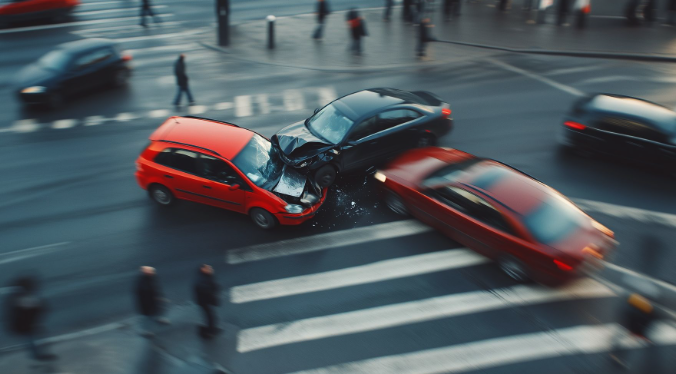
Safety is an active pursuit. Drivers must engage in a continuous process of observation, prediction, and reaction. Some proactive strategies for safe navigation include:
Scan, Signal, and Prepare
Upon approaching any intersection, a driver’s awareness should heighten. They should begin scanning the area well in advance, looking not just at the traffic lights but also at the crosswalks, sidewalks, and shoulders. Checking mirrors to understand the traffic situation behind is also essential.
If a lane change is necessary, signal early and complete the maneuver before reaching the intersection. Foot should hover over the brake pedal, ready to slow down or stop. This “cover the brake” technique can shave critical fractions of a second off reaction time.
Master Right-of-Way Rules
Right-of-way rules are designed to create order, but they do not guarantee safety. A driver may legally have the right-of-way, but they must never assume it will be ceded by others. The rules are clear: at a stop sign, the first vehicle to arrive proceeds first. At a four-way stop, if two cars arrive simultaneously, the vehicle on the right has the right-of-way. A green light gives the right to proceed, but only when the intersection is clear. A yellow light is a warning to prepare to stop, not a signal to speed up.
Execute Turns with Precision
When executing turns in dangerous intersections, precision is key to avoid auto accidents. Here’s what to consider:
Left Turns
When facing a solid green light, it’s important to enter the intersection only enough to begin the turn, but keep the wheels straight. If rear-ended with wheels turned, the vehicle could be pushed into oncoming traffic. Yielding to all oncoming traffic and pedestrians is also crucial.
Right Turns on Red
While legal in most jurisdictions unless posted otherwise, this maneuver requires a complete stop before the crosswalk. The driver must yield to all traffic with a green light and to any pedestrians or cyclists in the crosswalk.
Conclusion
Navigating dangerous intersections is a test of a driver’s skill, patience, and foresight. By keeping the information mentioned above in mind, motorists can significantly mitigate the inherent risks. Through consistent application of these principles, every driver can contribute to making the roads safer for everyone.