

“Remember, Remember”: Otis Henry and the monument his mother built
Cpl. Otis Henry of Texarkana died of wounds in France on Oct. 6, 1918, with the 90th Division. Thirteen years later, his mother put up the doughboy monument, with an angel and a mourner at its base, that still marks his grave at Rose Hill Cemetery.

Part 4 of 11 for 11, a TXK Today series remembering Texarkana-area veterans through America’s wars. A new story every day through Veterans Day.
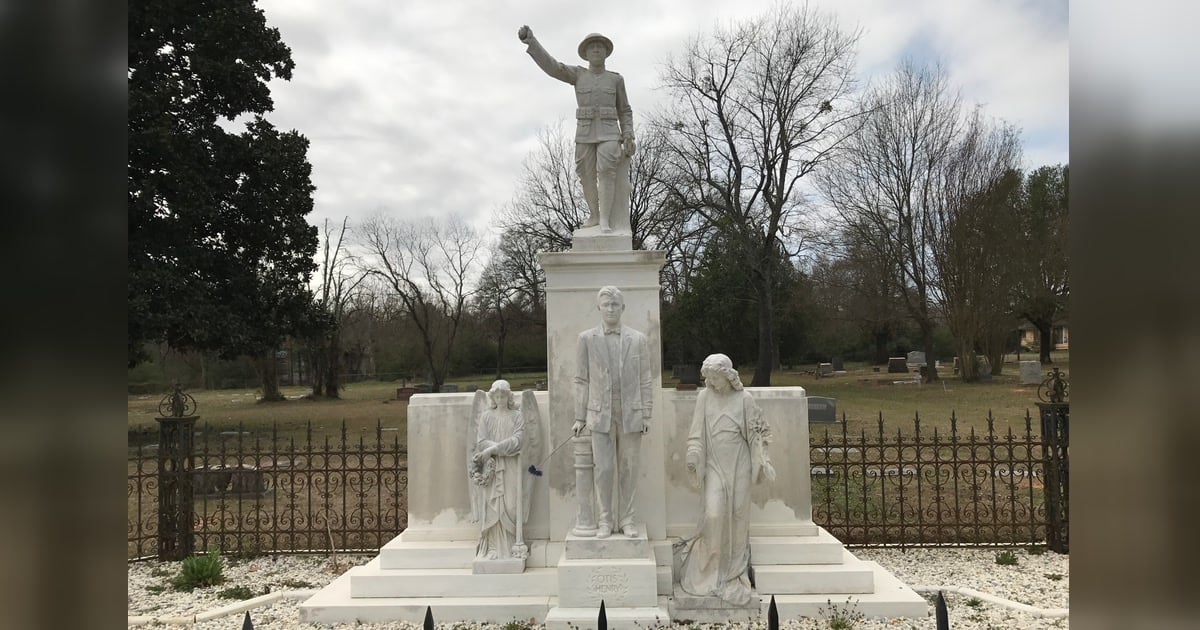
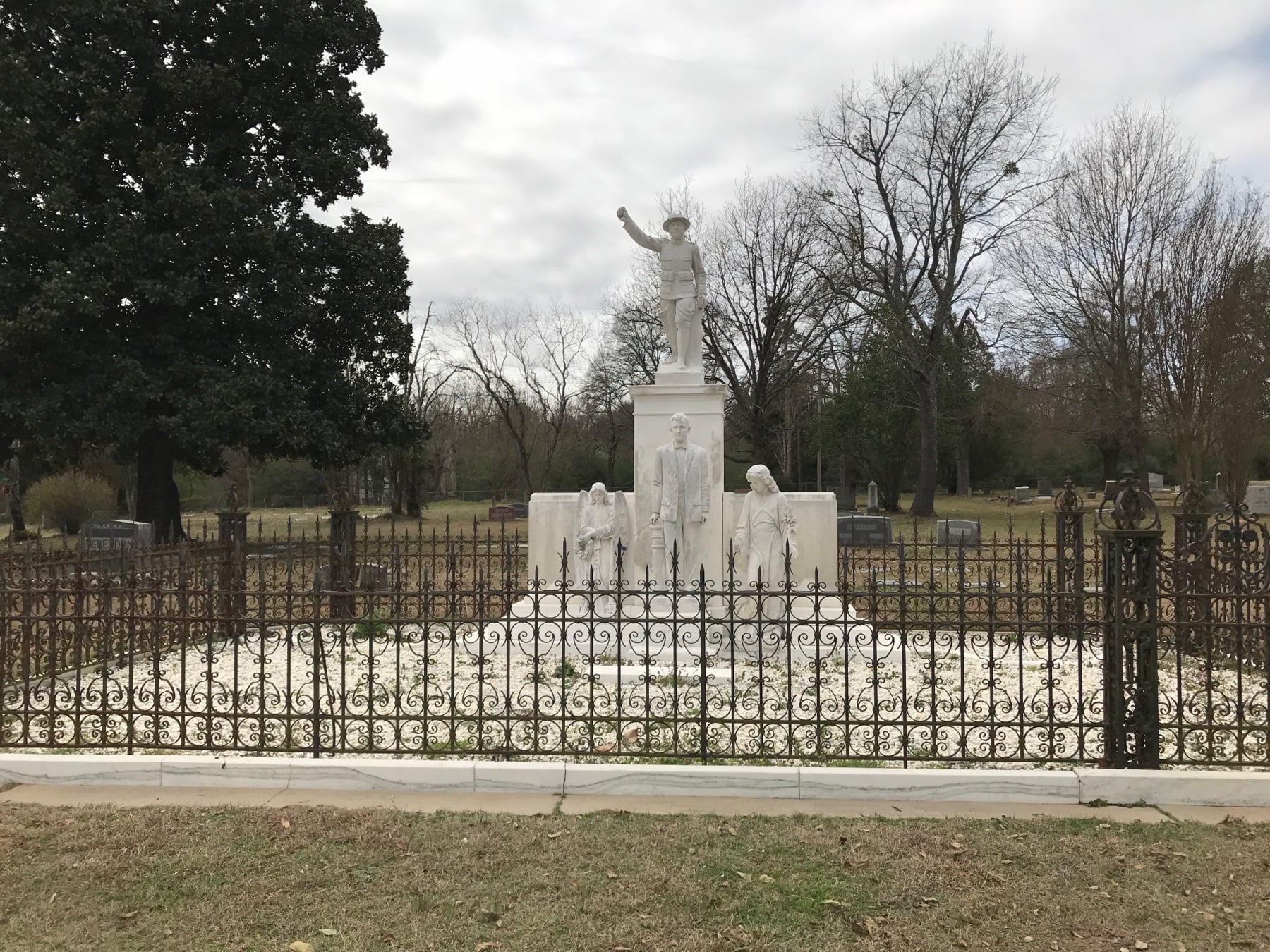
Near the back of Rose Hill Cemetery in Texarkana, a stone soldier raises a grenade over the grave of a young man who died in France in 1918.
Below the doughboy stands a smaller figure of the same man, Otis Henry, in a suit and bow tie, one hand resting on a stack of books. An angel with folded wings stands on one side of him, her arms crossed and a wreath in her hand. A robed woman holding lilies stands on the other, her head bowed. The word “Remember” is carved twice on the base at her feet.
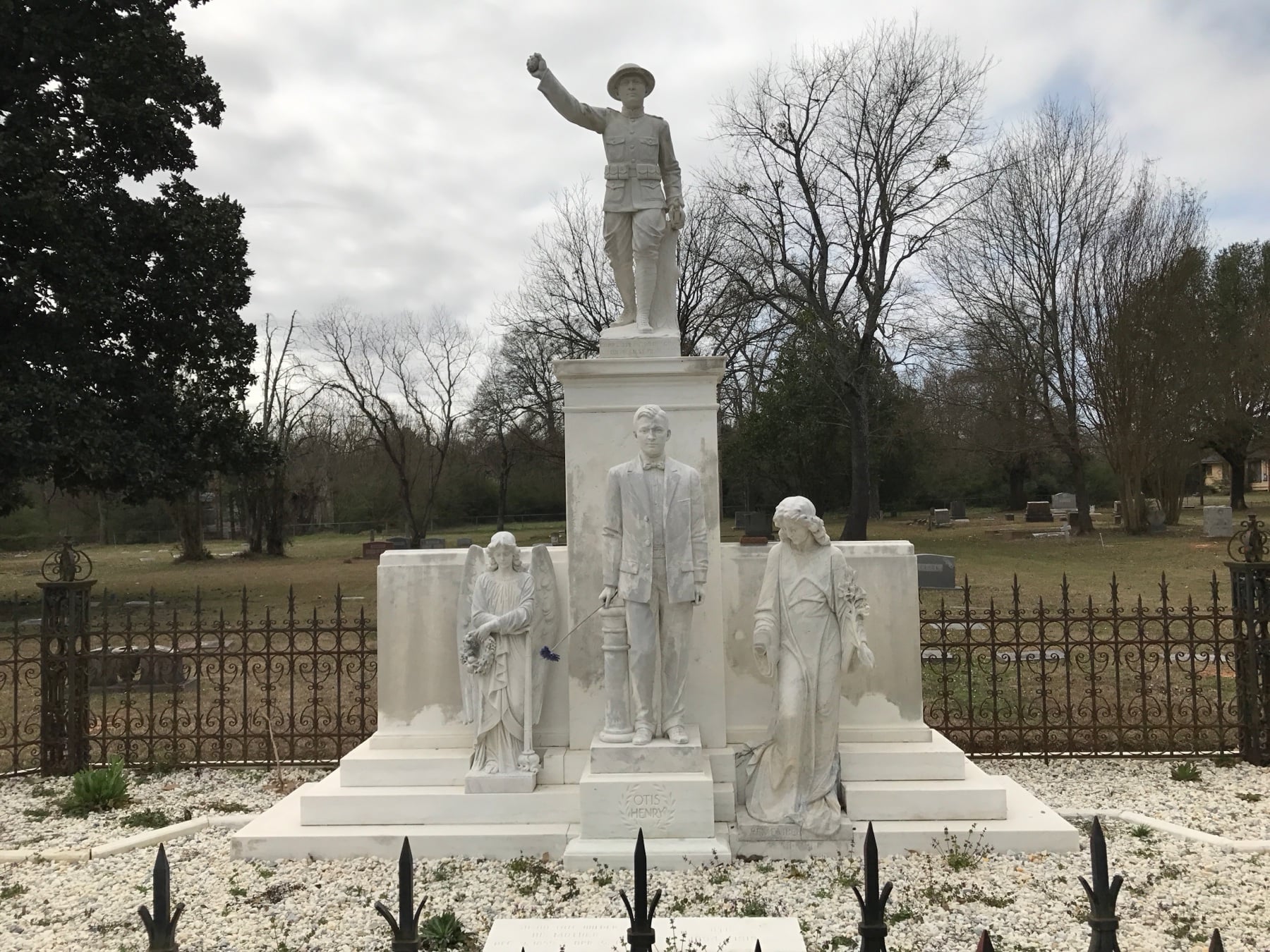
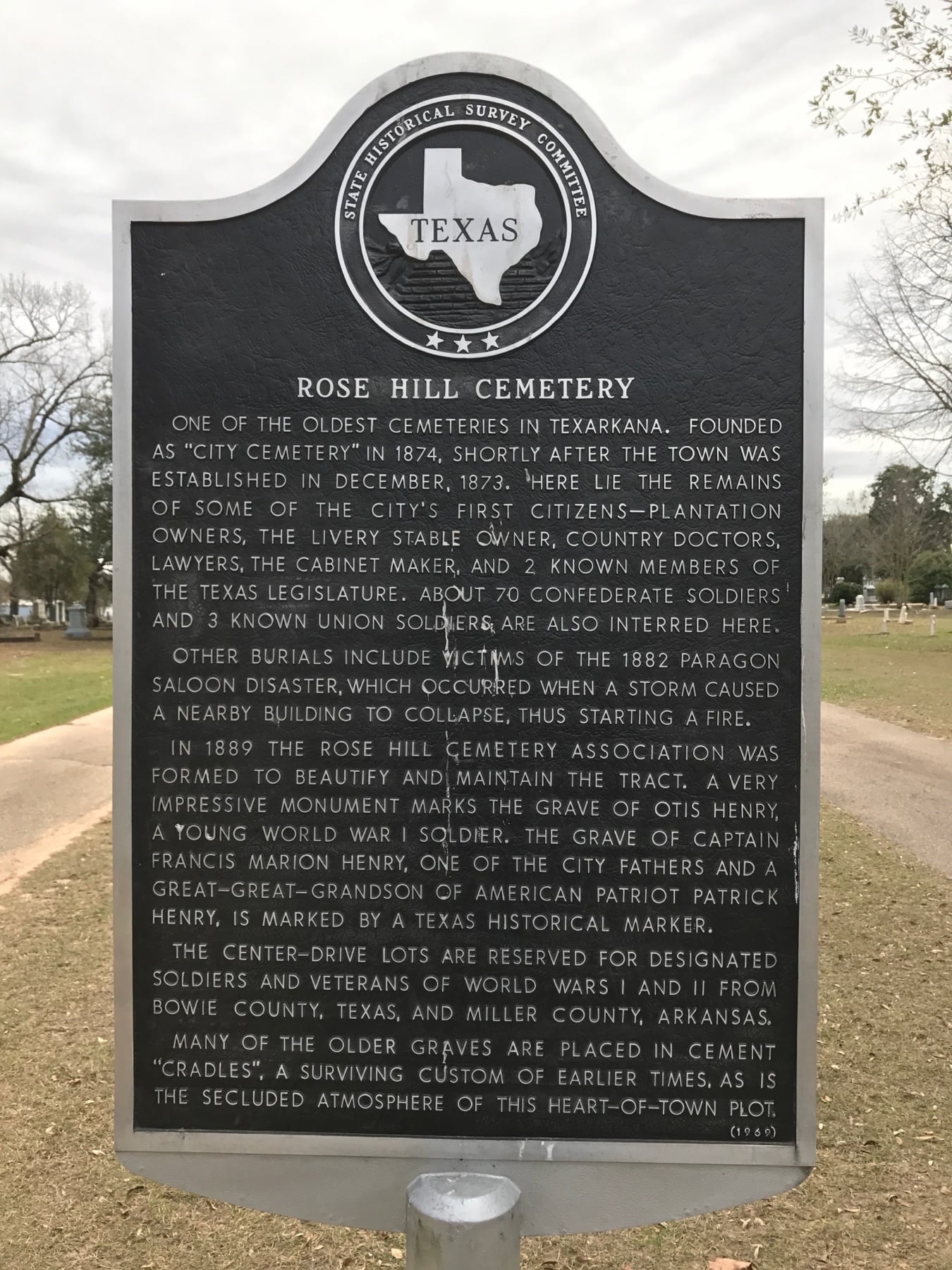
His mother, Susan Tate Henry Wilder, put the monument up in 1931, 13 years after his death. When the state marked the cemetery in 1969, through the State Historical Survey Committee that later became the Texas Historical Commission, its marker singled out the grave: “A very impressive monument marks the grave of Otis Henry, a young World War I soldier.”
What the records say
“Soldiers of the Great War,” a national memorial book published in 1920, lists Otis Henry of Texarkana among the Texas soldiers who died of wounds, with the rank of private.
A more detailed record appears in “A History of the 90th Division,” published by the division’s veterans association the same year. Its casualty list, compiled from the official records of the division adjutant, includes “Otis Henry, Co. H, 359th Infantry,” under corporals: “Died of wounds,” Oct. 6, 1918.

Texas newspapers carried his name a month after he died. The War Department casualty list printed Nov. 7, 1918, four days before the armistice, listed him under “Died of wounds”: “Corporals: … Otis Henry, Texarkana, Tex.”
Article continues below
▼ Continue reading
The monument gives the same date. Its inscription, as recorded by a Smithsonian American Art Museum survey of outdoor sculpture, reads: “Corporal 359th Inf. 90th Div. Co. H. Gassed one kilometer southeast of Vincey. Died Oct. 6, 1918. Born June 22, 1894, Denison, Texas.” A shorter version carved at the soldier’s feet says he was gassed one kilometer southeast of the “vil. of Vincey.”
A 2018 Austin Chronicle column on the memorial, by Gerald E. McLeod, placed his death 36 days before the Nov. 11, 1918, armistice, which also points to Oct. 6.
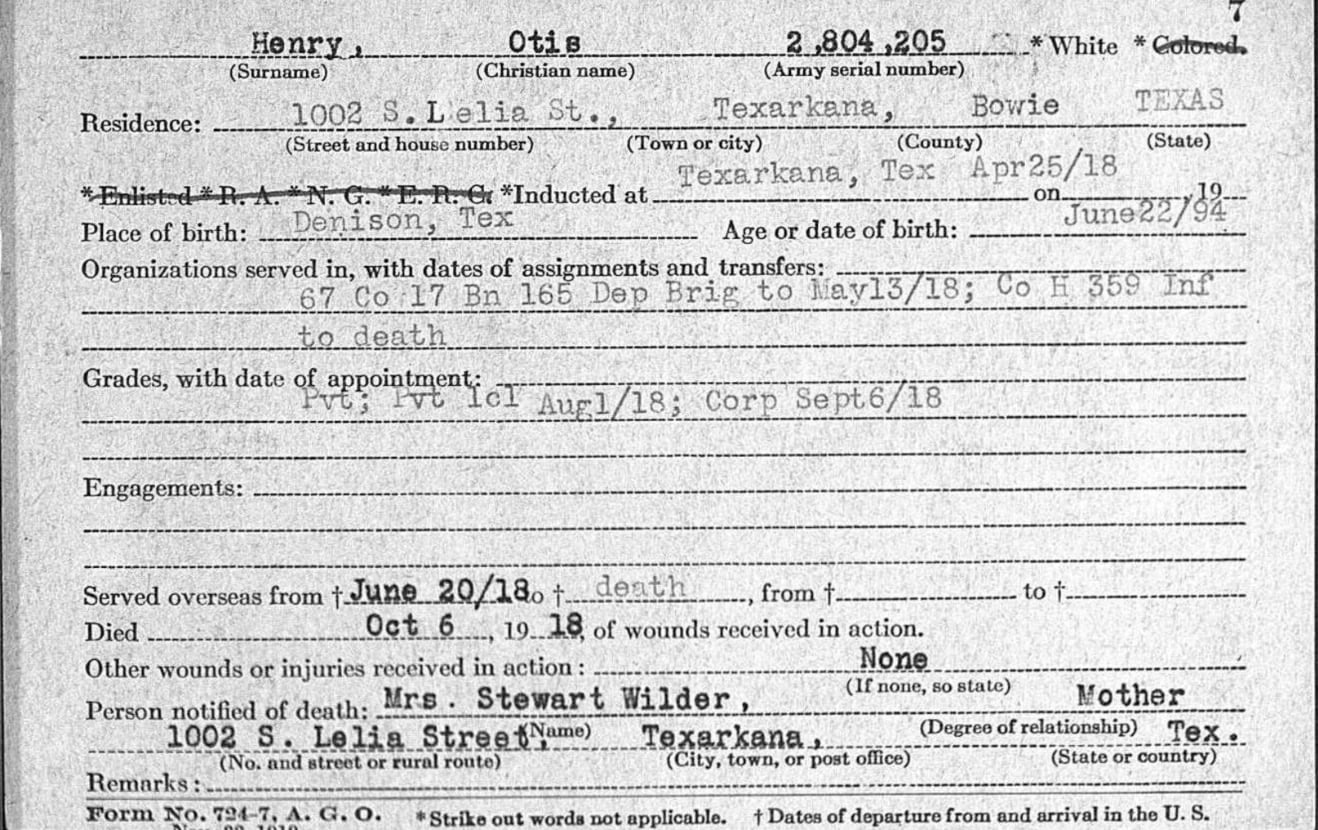
His Army service card settles it. The card, kept with the state’s World War I records of enlisted men who died, says Henry died Oct. 6, 1918, “of wounds received in action.” It shows how his rank changed, which may explain the national book’s “private”: he entered as a private, was made private first class Aug. 1, 1918, and corporal Sept. 6, a month before he died.
According to the card, he was inducted at Texarkana on April 25, 1918, and served with the 165th Depot Brigade until May 13, when he joined Company H of the 359th Infantry. He went overseas June 20. The person notified of his death was his mother, listed as “Mrs. Stewart Wilder,” of 1002 S. Lelia St. in Texarkana.
No town called Vincey lay near the 90th Division’s lines that fall. France’s one Vincey is in the Vosges, well south of the front. The division’s sector did include Vilcey-sur-Trey, a village whose valley soldiers called “Death Valley.” All of the division’s transport, the division history says, “was forced to cross what was known as ‘Death Valley’ through Vilcey-sur-Trey or Villers-sous-Preny, which was under constant observation during daylight.” The stone may refer to Vilcey, but TXKtoday has not confirmed that.
Where he served
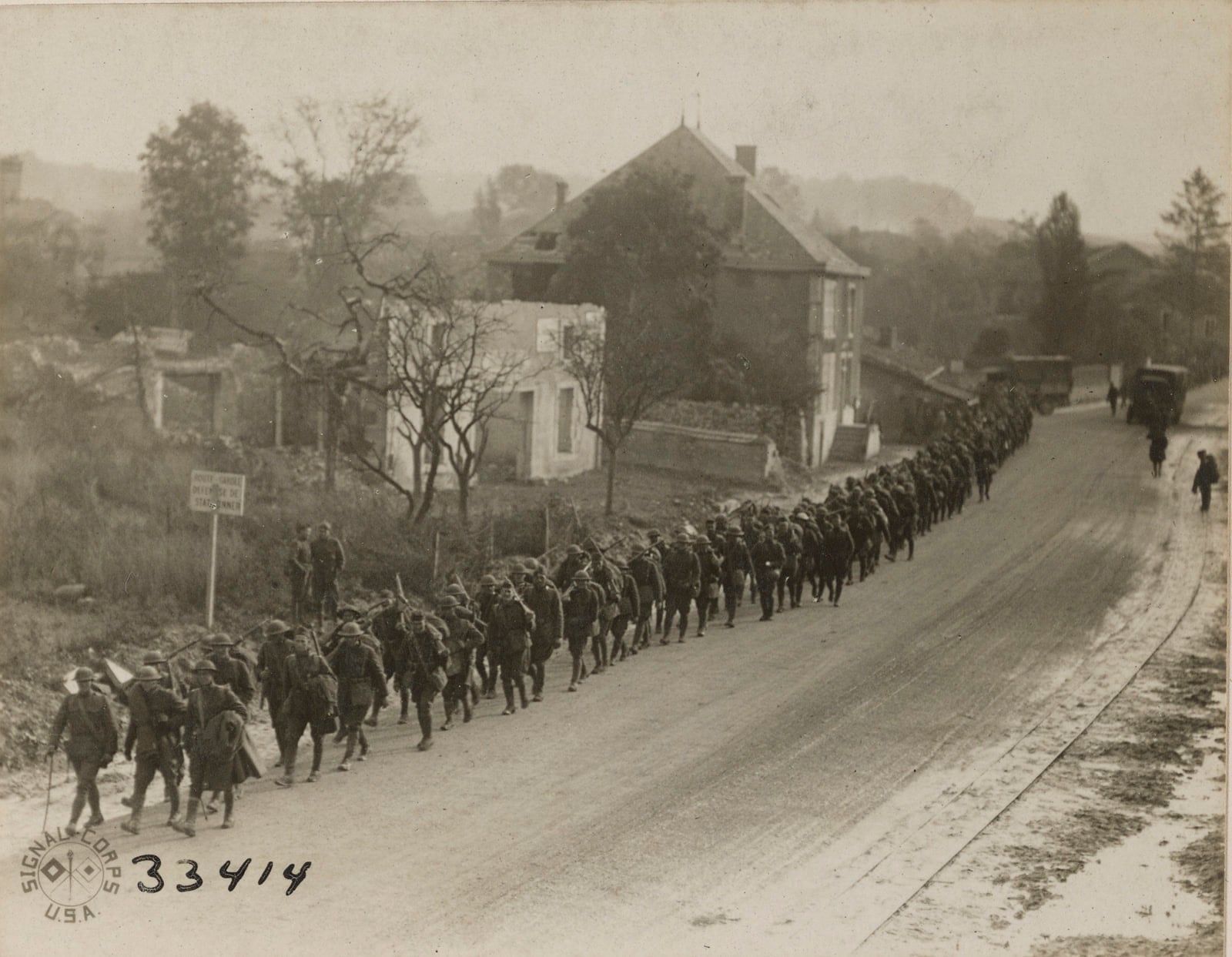
The 90th Division was first made up of draftees from Texas and Oklahoma and trained at Camp Travis in San Antonio. It went into the line in Lorraine, north of Toul, in late August 1918 and attacked in the St. Mihiel offensive on Sept. 12.
Afterward it held the line north of Pont-a-Mousson into October. The division history calls German artillery on the east bank of the Moselle River “the greatest source of trouble” in those weeks. The regiments’ kitchens, set up near springs in the woods, “were constantly shelled, especially with gas.” On Oct. 2, mustard gas saturated the north edge of the Bois des Rappes, a wood in the division’s sector. It hit hardest in the zone of the 2nd Battalion of the neighboring 358th Infantry, and 150 of its men were evacuated that day. “The effects of the gas were horrible beyond description,” the history says.
Otis Henry died four days later. The division was relieved Oct. 8 to 10 and moved to the Meuse-Argonne.
His mother
Most of what is known about Susan Wilder comes from Traci Rylands, who wrote about the grave on her blog, Adventures in Cemetery Hopping, in 2023 and pieced the family’s story together from census and draft records. Otis’ Army service card confirms his birth date and birthplace and his mother’s married name and address.
By Rylands’ account, Susan Tate was born in Upshur County, Texas, in 1859 and married Jack Henry, a railroad brakeman, in Longview in 1885. Otis was born in Denison on June 22, 1894. Rylands found no trace of Jack Henry after the 1900 census. The 1910 census recorded that Susan had given birth to five children and that one was living. In March of that year she married Stewart Wilder, also a railroad man, in Arkansas.
Otis registered for the draft in 1917 from 1002 S. Lelia St. in Texarkana, on the same street as Rose Hill. He was working as a soda dispenser at a Shreveport drugstore. The registration described him as “of medium height and stout with gray eyes and dark brown hair,” the Texarkana Museum of Regional History told the Austin Chronicle. He was 24 when he died.
The museum system has called him the first person from Bowie County to die in World War I, and Rylands repeated the claim. The records say otherwise. Lt. John Hartwell Moore of De Kalb was killed near Soissons on July 18, 1918. Pvt. John Louis Steitler of Texarkana, in Company K of Otis Henry’s own regiment, was killed Sept. 15 and lies in the St. Mihiel American Cemetery. Pvt. Burlon Paul Ochs of Texarkana died Sept. 21, and Pvt. Martin Vanburner Tillman of Redwater was killed Sept. 26; both are buried at Rose Hill. How the claim arose is unclear. The June 1921 service at which he was buried was described at the time as Texarkana’s first military funeral, and that distinction may have attached itself to him over the years.
His body came home in 1921, when the government was returning thousands of the war dead at families’ request. Texarkana buried him on June 29, 1921, in what the Southern Messenger, a Texas Catholic weekly, called “the first military funeral ever held in Texarkana.” Two soldiers were buried in a local cemetery that afternoon and two more at a suburban cemetery the next day, with the American Legion in charge. One of the dead, Burlon Paul Ochs, who also lies at Rose Hill, had a Requiem Mass at Sacred Heart Church that morning and was “laid to rest alongside that of his comrad, Otis Henry,” the paper reported, followed by a rifle salute and taps. “Texarkana paid a tribute to its soldier dead that will never be forgotten,” it said.
Ten years later, the monument went up.
What she paid for it, and how long she saved, are not recorded in any source TXKtoday has found. The Smithsonian American Art Museum’s inventory of outdoor sculpture, drawing on a 1993 survey of Texas, credits the design to Morris U. Allen of Allen Monuments in Texarkana, the firm that built it. The museum system says the figures are Italian marble. The Austin Chronicle called the figure on top “a copy of the doughboy design.” Rylands wrote that it resembles E. M. Viquesney’s “Spirit of the American Doughboy,” a statue sold to towns across the country in the 1920s and 1930s.
The museum system reads the monument as a program of mourning symbols: the column of books under Otis’ hand for knowledge cut short, the inverted torch in the angel’s hand for a sudden death, her wreath of roses for victory, the five stars on the robed woman’s tunic for the five wounds of Christ, and the laurel wreath around his name for military victory.
Her son’s name lived on in other ways. By 1946, Texarkana’s Veterans of Foreign Wars post was the Otis Henry Post. That November the post accused the War Assets Administration of mishandling surplus sales at Red River Arsenal and voted to investigate on its own, the Clarksville Times reported. His name is also among those on the World War I monument a group of Texarkana women dedicated in Sheppard Park in 1936.
Stewart Wilder died in January 1937 at 69, Rylands reported. Susan Wilder died April 9, 1941, at 81. She is buried with her son. They share a small marker at the foot of the monument she built. It calls her simply “his mother.”
The cemetery
The ground around the Henry plot is one of the oldest cemeteries in Texarkana. The 1969 marker says it was founded as “City Cemetery” in 1874, shortly after the town was established in December 1873, and that it holds “some of the city’s first citizens,” among them plantation owners, country doctors, lawyers, the livery stable owner, the cabinet maker and two members of the Texas Legislature.
Otis Henry was far from the first soldier buried there. The marker counts about 70 Confederate soldiers and three known Union soldiers. It also notes the victims of the 1882 Paragon Saloon disaster, when a storm brought a nearby building down on the saloon and started a fire.
The Rose Hill Cemetery Association was formed in 1889 “to beautify and maintain the tract,” the marker says. The city’s cemetery page credits its founding to Mrs. J.T. Rosborough. The association was later dissolved, and the city of Texarkana, Texas, owns and maintains the cemetery today. It has not sold a plot since 2001.
Otis Henry’s is one of two graves the marker names. The other belongs to Capt. Francis Marion Henry, a Confederate veteran and great-great-grandson of Patrick Henry who bought land in Texarkana about 1873, won a seat in the Texas Senate in 1876 and practiced law in the city for 34 years. His grave has carried its own state marker since 1967. Nothing in the records TXKtoday reviewed connects the two Henry families.
The marker also records that the lots along the center drive are reserved for soldiers and veterans of World Wars I and II from Bowie County, Texas, and Miller County, Arkansas. The city says the graves down the middle hold soldiers of World War II, Korea and other wars. Many of the older graves sit in cement “cradles,” the marker says, “a surviving custom of earlier times, as is the secluded atmosphere of this heart-of-town plot.”
Rose Hill Cemetery is at Phenie Avenue and Lelia Street. Its gates are open daily from 7 a.m. to 7 p.m.
Are you related to Otis Henry or Susan Tate Henry Wilder? Do you have photos of Otis, letters he sent home or family stories about the monument? We’d like to hear from you through our contact page.
Sources: George Wythe, “A History of the 90th Division” (90th Division Association, 1920), via Internet Archive, including Annex No. 4, “Casualty List of Officers and Men”; “Soldiers of the Great War,” Vol. 3 (Soldiers Record Publishing Association, 1920), via Internet Archive; Otis Henry service card, AGO Form 724-7, “Texas, World War I Records, 1917-1920,” via FamilySearch; Smithsonian American Art Museum, Art Inventories Catalog, “Otis Henry World War I Memorial” (IAS TX001047), from the 1993 Save Outdoor Sculpture survey of Texas; Texarkana Museums System, “Texarkana Time Machine” (June 28, 2014); Texas Historical Commission, Atlas marker 9505, “Rose Hill Cemetery” (1969); Texas Historical Commission, Atlas marker 9485, “Francis Marion Henry” (1967); City of Texarkana, Texas, Rose Hill Cemetery; Traci Rylands, Adventures in Cemetery Hopping (2023); Austin Chronicle, “Day Trips: World War I Memorials” (2017) and “Day Trips: Otis Henry Memorial, Texarkana” (2018); The San Antonio Light, Nov. 7, 1918, p. 3 (War Department casualty list); Southern Messenger, July 7, 1921, p. 2, “Soldiers Laid To Rest”; The Clarksville Times, Nov. 29, 1946, all via The Portal to Texas History; National Archives photo 111-SC-33414.