

CCC at 14, Okinawa at 18, then 45 years with Arkansas Power and Light: Navy seaman Thomas Dew

Thomas Dew was 14 when he lied about his age to get into the Civilian Conservation Corps in 1940. The government paid him $27 a month to plant trees and fight forest fires on the north shore of Lake Superior. He kept $5 and sent $22 home to his father’s farm in Arkansas.
He was still in that Minnesota camp when Pearl Harbor was bombed. By 18 he was operating the cargo booms of an attack transport off Okinawa, swinging trucks and jeeps out of the hold and down into landing craft while battleships pounded the island.
Dew told his story in a December 2011 oral history interview recorded at Cowhorn Creek Estates in Texarkana for the Library of Congress’ Veterans History Project, with his wife, Frances, at his side correcting dates. Lisa Shoalmire conducted the interview, court reporter Linda Kaiser took it down, and the transcript is public. Unless noted, the account below comes from that interview.
A farm boy on the White River
Dew was born Sept. 7, 1926, in Griffithville, Arkansas, according to his obituary, and grew up on a farm near Des Arc, on the White River about 50 miles east of Little Rock. His father, Thomas W. Dew, had repaired railroads in France as an Army private in World War I. His mother, Ruby Lucille Bruce Dew, raised eight children. The family milked cows, sold cream, smoked their own pork and butchered a beef in cold weather.
“Everybody was poor back then right where I lived,” Dew said. “I never was hungry, and I always had what I needed, but it was more or less home grown stuff.”
The week after Pearl Harbor, Marine recruiters came to the CCC camp at Two Harbors, Minnesota, to sign up the whole camp. Dew turned them down. He wanted to go home first. When he got there, his friends were joining the Navy, and he liked the uniform. He also read a comic strip about Coast Guard sailors. “I thought, man, that was really something, to be on a ship like that,” he said.
He signed up at Des Arc in June 1943, was sworn in at Little Rock and rode a troop train to San Diego with the windows open behind a coal-burning engine. Three days of smoke and cinders later, “we was black,” he said.
Boot camp was 12 weeks. He had boxed for the YMCA in Little Rock and boxed for his company in San Diego. Then came stevedore school, where he learned to run the winches and booms that load a ship, and gunnery school, where he learned to swap a red-hot 20 mm barrel into a tank of water and have a cool one firing in seconds.
Article continues below
▼ Continue reading
USS Goshen
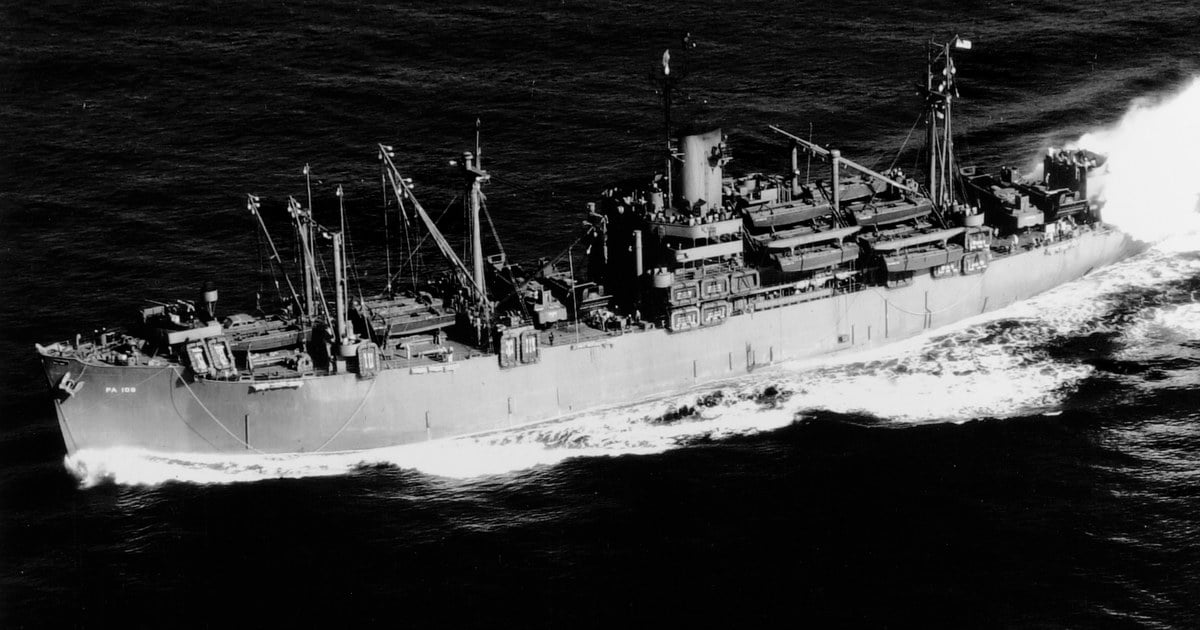
Dew’s ship, the attack transport USS Goshen, was still being finished at San Francisco when he reported to Treasure Island. He watched her launched and worked aboard rigging her before she was commissioned on Dec. 13, 1944, according to Navy records. The ship carried about 500 sailors and more than 1,400 troops with their trucks, guns and ammunition, and put them ashore in her own landing craft.
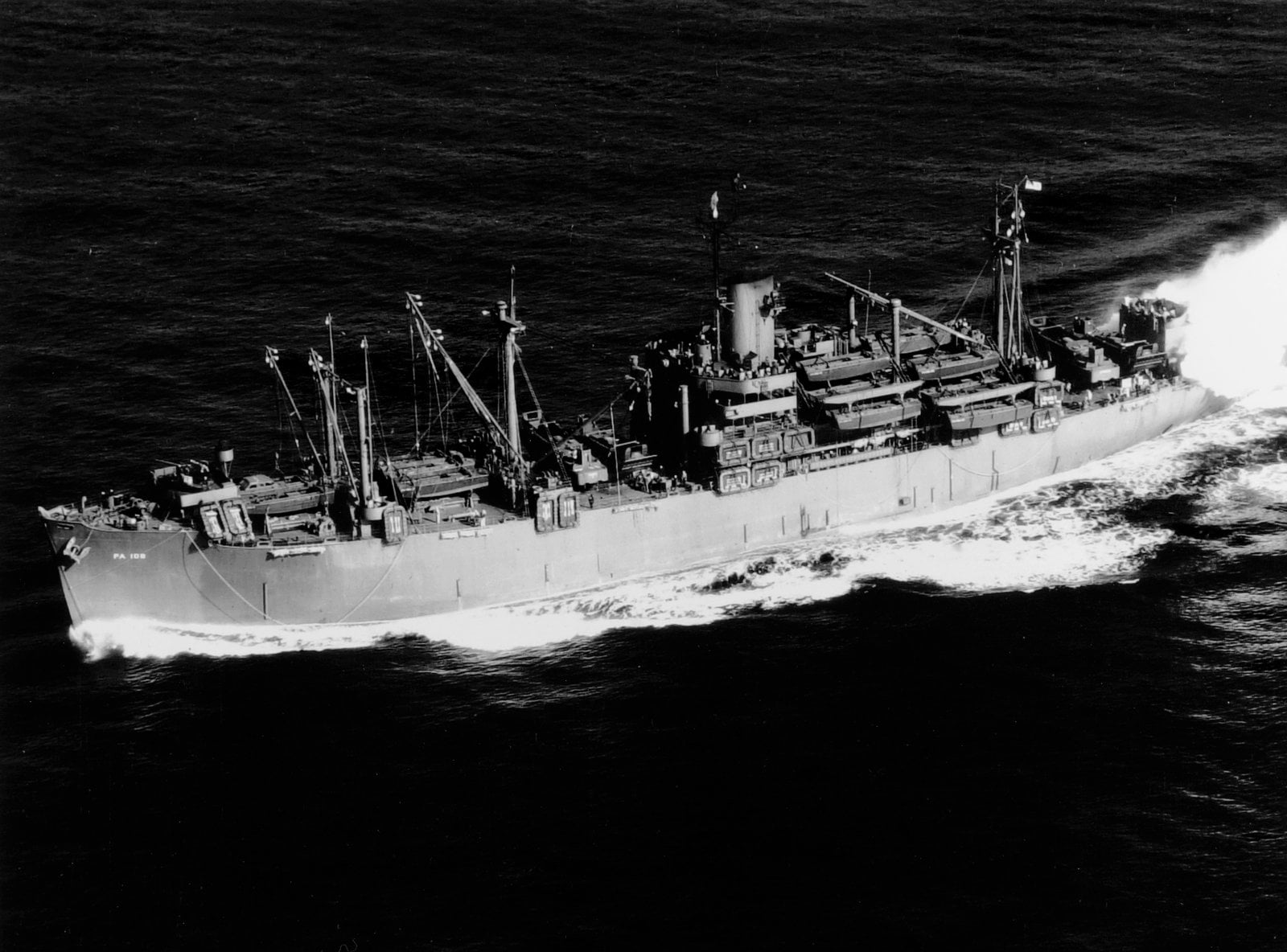
After a shakedown cruise the crew picked up Marines and invaded an island off the Southern California coast “over and over,” Dew said, until every man knew his job. The Goshen left Long Beach on Feb. 4, 1945, loaded more than 1,400 troops at Honolulu and sailed west by way of Ulithi and Eniwetok, Navy records show.
Dew stood watches in the crow’s nest, scanning sea and sky with binoculars for four hours at a stretch, and later at the helm. One rough night the captain’s voice came down the speaking tube. “He said, helmsman. I said, aye-aye, sir. He said, what’s your course? I said, zero three zero, sir. He said, well, get on it, then.”
He also learned the hard way not to dump an oily rag over the side while the ship was underway. The wind carried it straight up to the bridge, and he lost his next liberty.
Okinawa
The Goshen arrived off the Hagushi beaches at Okinawa on April 17, 1945, 16 days after the first landings, and spent five days unloading, according to the Navy’s history of the ship. Dew had the morning watch as they came in and watched the horizon flash all night.
“When it got light, finally got light, you could see the battleships,” he said. “They was firing those big guns into Okinawa, and just almost continuously.”
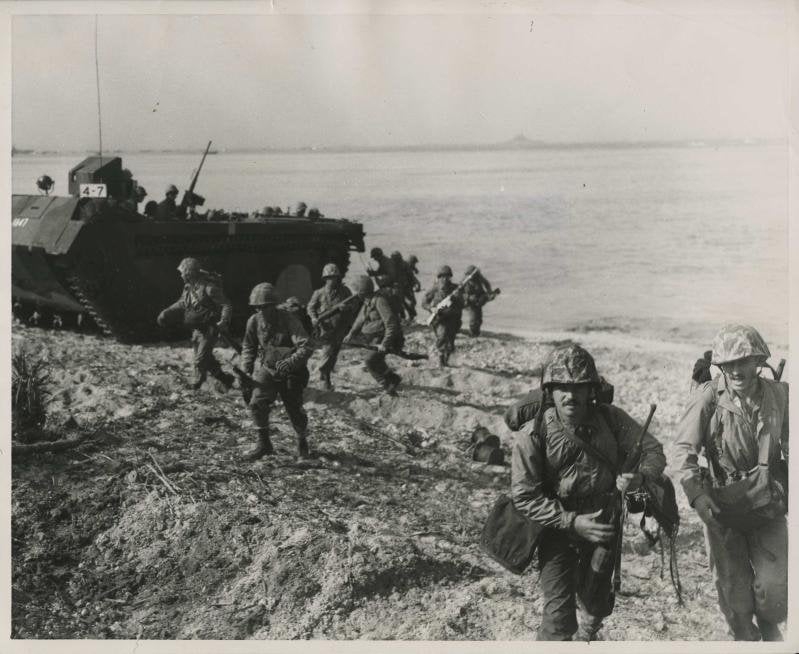
His job was on the winch controls, lifting trucks and jeeps out of the hold and lowering them over the side into the landing craft he could not see, guided by a sailor’s hand signals at the rail. “I’m not trying to build myself up, but I think I was good at what I did,” he said.
At night Japanese suicide planes came over. Instead of firing, the transports went dark and sent their boats circling with smoke generators until the anchorage was hidden. The Japanese dropped bombs into the smoke anyway. A ship next to the Goshen was hit and several men were killed, Dew said. The Goshen took some of the wounded aboard and carried them to Saipan. One died on the way and was buried at sea.
The Goshen was back in San Francisco by June 3, Navy records show. She picked up Seabees in California and Army airfield construction crews in Washington state and carried them and their equipment back across the Pacific. The ship was in the Marianas when Japan gave up in August. Dew was working on deck when the shouting started. “All of a sudden, everybody on the ship was happy,” he said. Some shipmates, he suspected, had brewed something to celebrate with.
Starving Japan, northern China and a sign in Virginia
For the next four months the Goshen hauled occupation troops between the Philippines and Japan, according to the Navy. Dew remembered landing troops at Yokohama and then far to the north at Otaru, on Hokkaido. On the way in, he saw the body of an American pilot floating in the water with his parachute still packed. The ship did not stop.
Ashore, the Japanese “were actually starving,” he said. Anything thrown off the ship at the dock was grabbed and eaten. People bowed to the sailors in the street. Dew saw a 1930s Chevrolet running on gas from a coal burner mounted where the trunk had been. He did not see a young woman anywhere. “They hid the young women somewhere,” he said.
He and two shipmates, Ashley and Loveday, went to a movie theater in Otaru. The woman in the ticket booth could not understand them and waved them in free. When their eyes adjusted they found Japanese patrons on every side and a war movie on the screen. “The Japanese was winning it,” Dew said. “I said, let’s get out of here.”
Later, Dew said, the Goshen carried Marines through the Yellow Sea to northern China, where Nationalists and Communists were starting to fight each other. On liberty Dew rode a rickshaw pulled by a running man, rented a room for the night and traded a dollar for a wad of Chinese bills. Some Russian soldiers there tried to pick a fight by insulting President Roosevelt. “We ignored it and got out of there,” he said.
In December 1945 the Goshen joined Operation Magic Carpet, the fleet’s effort to bring servicemen home. Navy records show she left Sasebo, Japan, on Dec. 10 with more than 1,400 Marines and reached San Diego on Dec. 28. Dew remembered them as the Marines who had raised the flag on Iwo Jima. The captain ran the ship hard and got in a day early, to bands and crowds on the pier. Dew, on the deck crew, was the sailor who ran down the ladder to catch the mooring line.
“It was amazing,” he said. “I’ll always remember that.”
The ship went on through the Panama Canal to Virginia, arriving at Lynnhaven Roads on Feb. 12, 1946, according to the Navy. In Virginia Beach, fresh from the Pacific, Dew walked past a church with a sign in the yard: “Dogs and sailors stay off of this property.” It stung him then, he said, and it stung him 65 years later.
He left the ship in New York with enough points to go home and spent eight days seeing the city while his paperwork was processed, the subway, the Statue of Liberty, a stage show. “I had a ball,” he said. He was discharged at the naval air station near Memphis in June 1946 and hitched a ride to North Little Rock, still in his sailor suit because he owned no other clothes.
The Goshen was decommissioned at Norfolk that April. She spent 25 years as a freighter named Canada Mail and California Mail before she was scrapped in Taiwan in 1973, according to Navy records.
Forty-five years with the power company
Dew had worked briefly for Arkansas Power and Light before he enlisted, and the company gave him his job back. He had spent his nights at sea studying electricity from books in the ship’s library. Back home he earned his high school diploma at night through Little Rock High School and used the GI Bill to get a radio broadcasting and repair license he never used, because the power company kept promoting him.
He became a supervisor in Little Rock, assistant superintendent in Pine Bluff and then superintendent back in the Little Rock area. His obituary says he retired as superintendent of the Baseline District after 45 years with the company, now Entergy Arkansas.
He kept up with his shipmates for the rest of his life. Goshen crewmen held a reunion every year, the first at the Admiral Nimitz Museum in Fredericksburg, Texas, and in 2011 they were planning what they expected to be the last one, back in Fredericksburg. “We’re getting so old and there’s not many of us left,” he said. His friend Ashley from the theater in Otaru had died that year.
Dew’s younger brother, Howard Bruce Dew, made a 20-year career of the Navy after serving in the Korean War era. His own grandson, he noted with wonder, stood 6 feet 9 inches. “Back when I was a kid, anybody that was 6’9″ was a giant.”
Frances Goodwin Dew, his wife of 48 years, died before him. Thomas H. Dew died Jan. 1, 2021, in Texarkana, at 94. He was buried with a graveside service at the Arkansas State Veterans Cemetery in North Little Rock on Jan. 11, 2021, during the pandemic, with mourners asked to bring their own masks. He was survived by his sons, Tommy and Stephen Dew, his daughters, Linda Singer and Janie McGowan, three stepsons, his sister Sammie Dew Reynolds, six grandchildren and six great-grandchildren, according to his obituary.
Sources
- Library of Congress, Veterans History Project: Thomas Hudgins Dew Collection (AFC/2001/001/91675), interview transcript, Dec. 3, 2011, Texarkana, Texas
- Dictionary of American Naval Fighting Ships, Goshen (APA-108), Naval History and Heritage Command
- Obituary of Thomas H. Dew, Roller Funeral Homes, January 2021
Did you know Thomas Dew, or did you serve on the USS Goshen? Do you have photos? TXKtoday would like to hear from you. Contact us here.