

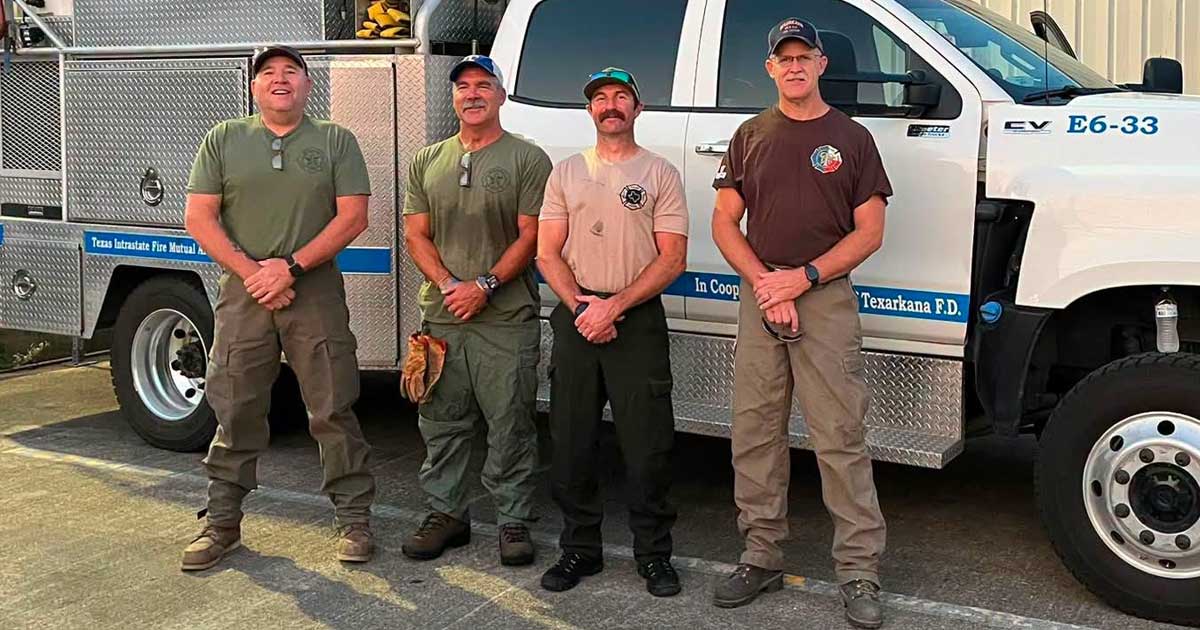
Texarkana firefighters battling North Texas wildfires with state strike team

TEXARKANA, Texas — Three members of the Texarkana, Texas, Fire Department are on the fire lines in North Texas this week, deployed with a state mutual aid strike team as Texas moves into the peak of its wildfire season.
Firefighters Danny Douglas, Lucas Shelton and Chris Black, along with Noah Shipman of the Tyler Fire Department, are deployed with TIFMAS Strike Team 184, an East Texas engine strike team activated through the Texas Intrastate Fire Mutual Aid System. The team is currently operating in the Wichita Falls area, where crews have worked multiple wildfires that together have burned more than 1,000 acres.
Strike Team 184 is made up of firefighters and engines from departments across East Texas, including Texarkana, Longview, Lufkin, Nacogdoches and Smith County. The team mobilized in early August after the state issued a TIFMAS request for assistance, and it was initially assigned to the Bear Hollow Fire in Jack County, a brush fire burning near Wizard Wells, about 65 miles northwest of Fort Worth. The Texas A&M Forest Service reported that fire had grown to roughly 400 acres in its first days as ground crews worked alongside aircraft and heavy equipment to build containment.
Why they’re there
The deployment comes as fire danger climbs sharply across North Texas and the Rolling Plains. On Aug. 4, Gov. Greg Abbott directed the Texas Division of Emergency Management to activate additional state wildfire response resources, citing elevated fire danger across the Texas Panhandle and North Texas. That order came about a week after the Texas A&M Forest Service raised the state’s Wildland Fire Preparedness Level to Level 2, positioning firefighters, aircraft and heavy equipment ahead of what is traditionally the peak month for Texas wildfires.
Conditions on the ground in the Wichita Falls region tell the story. Wichita County commissioners enacted a 30-day countywide burn ban Aug. 4 as the area’s drought index climbed amid a stretch of triple-digit temperatures, and neighboring Clay County had already put its own burn ban in place. Weeks of extreme heat have cured grasses and brush across the region, leaving fuels dry enough that a single spark — a dragging chain, a downed power line, roadside equipment — can put a fast-moving grass fire on the landscape.
How TIFMAS works
TIFMAS, coordinated by the Texas A&M Forest Service, is the framework the state uses to move local firefighting resources to wherever they’re needed most — what forest service officials have described as the state’s surge capacity. When a wildfire or other disaster outgrows what local departments can handle, the state can activate strike teams — typically five engines plus a strike team leader — drawn from participating fire departments across Texas.
For the departments that send them, the math works in the community’s favor: the state covers the cost of deployed firefighters, including overtime, so cities like Texarkana incur no expense while their personnel gain frontline wildland firefighting experience. A typical TIFMAS deployment runs about nine days, though assignments can be extended depending on fire activity.
Texarkana firefighters have answered TIFMAS calls for years, deploying to wildfires and disasters across the state — experience that pays dividends at home, where the same drought and heat driving fires in North Texas have kept local crews busy with grass fires on both sides of the state line.
TXKtoday will update this story as the deployment continues.