

FedEx overtime suit lands in Texarkana, Texas, federal court as East Texas combines 88 cases under one judge

TEXARKANA, Texas – A FedEx delivery driver has filed the first of the company’s overtime lawsuits in the Texarkana Division of the U.S. District Court for the Eastern District of Texas. Nine days earlier, that court combined 88 of the nearly identical suits under a single judge in Tyler.
David Hamilton sued Federal Express Corp. on Saturday. He says he worked as a FedEx delivery driver in the Eastern District of Texas but was paid by intermediary companies that FedEx calls “independent service providers,” according to his 14-page complaint. Hamilton says he drove a vehicle weighing less than 10,001 pounds and was never paid overtime for hours beyond 40 a week. The complaint does not say where he was based.
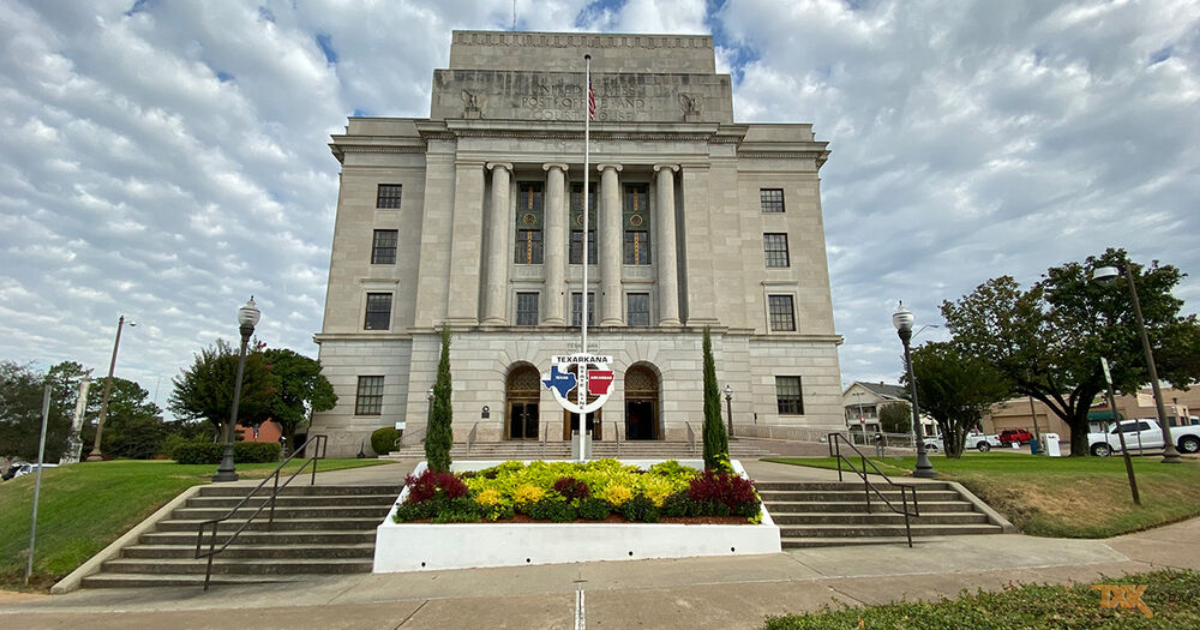
His suit is the Texas-side counterpart to the five filed Oct. 8 in the Texarkana Division of the Western District of Arkansas, as TXKtoday reported. Both courts sit in the U.S. Post Office and Courthouse on State Line Avenue.
Like the Arkansas plaintiffs, Hamilton was one of thousands of drivers in a mass action against FedEx in federal court in Pittsburgh. That case was broken up May 18, when U.S. District Judge Robert J. Colville severed every driver’s claim and ordered each driver to refile in an appropriate court within 60 days. The parties agreed to pause that deadline while they tried mediation, which failed, according to the complaint. Hamilton is represented by Sarah Schalman-Bergen and Shannon Liss-Riordan of the Boston firm Lichten & Liss-Riordan, the same firm that filed the Arkansas suits.
The Eastern District of Texas has already moved to handle the wave as one case. On Oct. 15, Chief U.S. District Judge Amos L. Mazzant III signed a general order reassigning 88 FedEx suits to U.S. District Judge J. Campbell Barker. The suits had been filed Sept. 23-26 in the Beaumont, Lufkin, Sherman and Tyler divisions before six judges. The order found that they “involve at least one common question of law or fact” and consolidated them for pretrial purposes into the first one filed, Beck v. Federal Express Corp.
Article continues below
▼ Continue reading
The other 87 cases were administratively closed, and all filings now go on the Beck docket. Any trials would go back to the judges who sent the cases, the order says.
Barker issued his first order in the combined case Oct. 21. “Given the consolidation of over 80 actions,” he wrote, he would not let each driver file a separate notice demanding a jury. Instead, each side will file one combined jury demand within 30 days after all parties have appeared and discovery opens.
Hamilton’s suit came after the consolidation and is not part of it. It is assigned to U.S. District Judge Robert W. Schroeder III in Texarkana. The general order says later FedEx cases “fitting the same criteria” may be reassigned to Barker if the judges involved agree. As of Monday, court records showed no such move in Hamilton’s case. Two other drivers also filed suit Saturday in the Tyler Division.
No similar consolidation order appears in the Arkansas cases, court records show. The Western District of Arkansas now lists 63 suits against Federal Express. All are assigned to U.S. District Judge Timothy L. Brooks in Fayetteville and remain separate cases. Two were added Oct. 23 in the El Dorado and Hot Springs divisions. The Texarkana count is still five.
The Eastern District of Arkansas lists 87, all before U.S. District Judge James M. Moody Jr. in Little Rock, including five filed Oct. 21. Filings in those cases mark them as related to the first one there, Taylor v. Federal Express Corp.
As of Monday, the docket in one of the Texarkana, Arkansas, cases, filed by Christopher King, who says he drove for FedEx in Miller County, showed no answer or motion from FedEx.
Each suit brings a single claim under the Fair Labor Standards Act and seeks back pay, liquidated damages, interest and attorneys’ fees. The drivers argue that FedEx is their employer because it controls their routes, uniforms, scanners and conduct. FedEx told the Las Vegas Review-Journal that its service providers “are contractually and legally obligated to comply with wage-and-hour laws,” and the company has said the providers, not FedEx, employ the drivers.
A lawsuit presents only one side of a dispute. The allegations have not been proven in court.