

Abbott claims credit as a data center bows out in East Texas. The record tells a fuller story.

TEXARKANA, Texas — Gov. Greg Abbott’s office announced Thursday that a proposed data center near Cedar Creek Lake will not be built, framing the withdrawal as proof that his new data center standards have teeth. The headline on the press release said the project fell short of “Governor Abbott’s New Standards.”
“Data centers that want to do business in Texas must meet a clear standard. This project did not,” Abbott said in the release. “Diode did the right thing by withdrawing their project. If other data center developments refuse to meet these standards, I expect them to do the same.”
The announcement deserves a closer look, on three counts: who actually stopped the project, what “standards” currently exist, and when the release went out.
What the developer and the county say
Kansas-based Diode Ventures had proposed a data center near Cedar Creek Lake in Henderson County, southeast of Dallas. According to reporting by the Fort Worth Star-Telegram cited by KERA, the site was expected to take 12 years to build out and consume 5 million gallons of lake water per day by its fifth year. It would have sat amid a developed subdivision with hundreds of homes around it.
Residents organized against it under the banner “Save Cedar Creek Lake.” In their withdrawal letter to Henderson County Judge Wade McKinney and county commissioners, Diode co-presidents Rachel Attebery and Josh Johnson pointed to what they heard from the community. The perspectives shared by residents and local leaders, they wrote, led the company to conclude the site’s close proximity to the rural residential community did not meet the standard that should guide data center development.
Henderson County Commissioner Wendy Spivey put it more directly. The outcome, she said, was not the work of one person or one elected official. It was the result of the community coming together.
Residents celebrated. “Some folks even went out last night and celebrated because the community really came together in this fight,” resident Stacy Farmer told KLTV. Farmer added that she wants the Legislature to act: “I’m pro technology, but not at the expense of we, the people.”
The governor’s release recasts that community fight as compliance with his directives.
What “standards” actually exist
There is, as of today, no law prohibiting a data center from building next to a rural neighborhood in Texas, no statute requiring water-efficient cooling, and no binding rule that a project “reduce” residential electric bills to proceed.
Abbott’s June 10 directive is a letter to the Public Utility Commission and ERCOT. His call to ban AI data centers from rural neighborhoods is a campaign-stop pledge made in Bullard earlier this month. The PUC’s response, filed this week, lists rules on forecasting, interconnection costs and grid planning, all of which govern how projects connect to the ERCOT grid, not where they can be built. The Legislature does not convene in regular session until January 2027.
In other words, nothing in state law forced Diode out, and nothing in state law currently prevents the next developer from proposing the same project on the same site. What stopped this one was a company deciding a fight with an organized community was not worth it.
The timing
The Texas Tribune reported that Abbott’s office issued the announcement shortly before Democratic gubernatorial nominee Gina Hinojosa held a news conference Thursday calling on Abbott to sign an emergency executive order imposing a moratorium on data center development until the Legislature meets. “Greg Abbott talks a big game about what he will do after the election,” Hinojosa said. A day earlier, U.S. Senate candidate James Talarico released his own data center regulation plan.
The election-year reversal is the backdrop. As TXK Today has reported, Abbott spent more than a decade recruiting this industry. He expanded the data center sales tax exemption in 2015, broke ground on Facebook’s Fort Worth campus that year, declared Texas open for crypto business in 2021, and as recently as November stood with Google’s CEO to announce a $40 billion data center investment, calling Texas “the epicenter of AI development.” He has received more than $2 million from tech and AI-linked donors since 2025, according to E&E News, citing Transparency USA data.
Seven months after the Google announcement, his office is issuing press releases when data centers do not get built.
The Bowie County question
The governor’s closing line, that he expects other projects failing his standards to withdraw, raises an obvious local question: does that expectation extend to Bowie County?
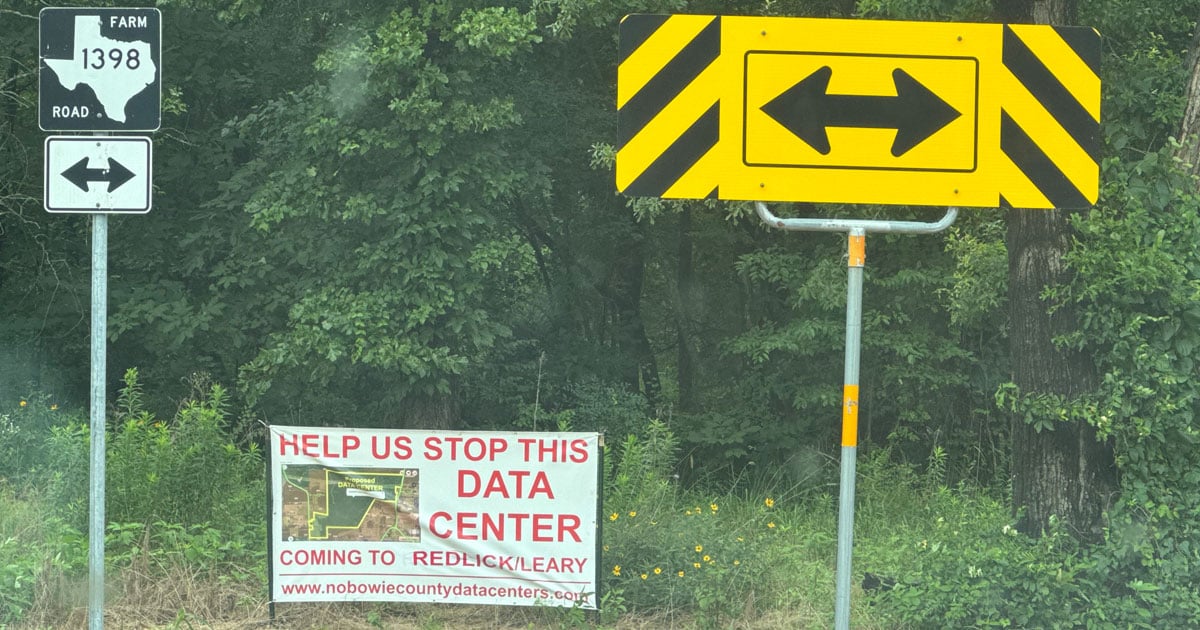
Two large projects are in motion here. TexAmericas Center’s Project Big Pine, the 500-acre data center campus announced in April, drew a standing-room-only opposition crowd at a Texarkana City Council meeting citing water, electricity and pollution concerns, much like Cedar Creek Lake. And Black Mountain Power’s proposed gas-fired plant near Redlick and Leary sits in exactly the kind of rural, unincorporated area Abbott now says should be off limits, and has drawn its own yard-sign opposition.
Neither project connects to the ERCOT grid that Abbott’s directives cover. Both would answer to any statewide legislation, if it passes, in 2027 at the earliest. Whether the governor’s expectation reaches northeast Texas, or stops at the ERCOT boundary, is a question TXK Today has posed to the governor’s office.
Until the Legislature acts, the Cedar Creek Lake outcome stands as evidence of something, just not what the press release claims. It shows what organized residents can do.