


The proposal to pipe Millwood Lake water to Texas is now formally in front of the state, and it has a named buyer and a price tag for the pipeline: the North Texas Municipal Water District and nearly $2 billion.
Heartland Water Partners and the Southwest Arkansas Water District filed their application with the Arkansas Natural Resources Commission on Nov. 6. The commission received it Wednesday as a report, with no vote. Its director said the staff will hold at least one public hearing in southwest Arkansas, likely in December, and that the effect on fish and wildlife is “not one of the main factors” the state will weigh.
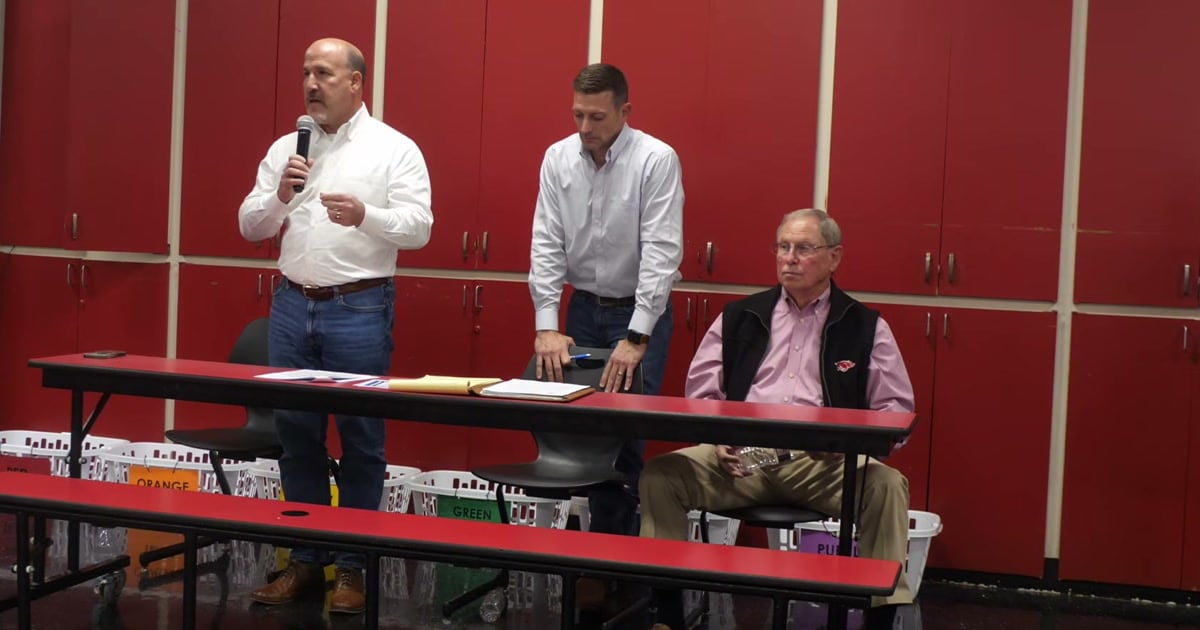
Six days earlier, on Nov. 12, Texarkana, Arkansas, City Manager Tyler Richards, Heartland CEO Kevin Lafferty and water district board member Danny Gray took questions for about an hour and 15 minutes at a town hall at North Heights Community School. The Democrat-Gazette put the crowd at about 70. The city posted video of the meeting Thursday.
“Whether you support the project or oppose it, I just appreciate you coming out and being willing to give your input,” Richards told the crowd.
TXKtoday has covered the plan since Richards first presented it Oct. 5, through the draft exclusivity agreement and the board’s 6-0 vote Oct. 13 to let the application go forward. Here is what is new.
Article continues below
▼ Continue reading
The buyer has a name
Until now the city had not publicly said who would take the water. The draft agreement named no Texas buyer.
“The intended buyer is North Texas Municipal Water District,” Richards said at the town hall. He compared it to the Southwest Arkansas Water District: a public wholesaler that supplies cities, in this case suburbs north and east of Dallas such as Wylie and Frisco.
The district has not committed to anything. Its executive director, Jenna Covington, said in a statement reported by The Dallas Morning News that the district is “open to exploring the feasibility of this water purchase with the appropriate partners.” The newspaper reported that district staff have had only informal talks with Heartland and that contract terms have not been discussed.
Lafferty said the same thing from the other side. “We haven’t had those specific negotiations with North Texas yet,” he said. He said the district’s member cities use about 360 million gallons a day and expect to need 450 million to 500 million in coming decades.
The application calls for moving 115 million gallons a day from Millwood to Bois d’Arc Lake, a North Texas Municipal Water District reservoir in Fannin County, Texas, through a 127-mile pipeline, Chris Colclasure, director of the state Natural Resources Division, told commissioners Wednesday.
A pipeline costing ‘almost $2 billion’
Lafferty gave the first public cost estimate for the pipeline. He described a 72-inch steel line that would take four to four and a half years to build.
“Some early engineering estimates are this could be almost a $2 billion pipeline project to move this water into the North Texas area,” he said.
Heartland would build, own and operate the line, he said, and would pay for upgrades to the water district’s Millwood intake. Richards said the cities’ only cost is their own attorneys.
Lafferty said the price North Texas pays has to cover that construction. “If they can’t pay a price high enough to afford the transportation and the construction of a project like this, then the project won’t be able to go,” he said.
He also said every contract would be public, in Arkansas and in Texas. “Everybody will be able to see the rates and to know who’s paying what, who’s getting what,” he said. The draft exclusivity agreement the board approved in October says its terms “shall be kept strictly confidential,” with exceptions for the Arkansas Freedom of Information Act and public meetings.
Heartland is a company formed by Grey Rock Investment Partners, a Dallas private equity firm.
What the state said Wednesday
The application was item 7 on the commission’s Wednesday agenda in Little Rock. The chairman called it a non-action item. Arkansas TV recorded the meeting, and the discussion ran about 25 minutes.
Colclasure said the application runs more than 600 pages and his staff has not finished reading it. He said the commission has approved transfers of water within Arkansas before, but never one out of state.
“This is the first time that we’ve ever considered one of these,” he said.
The next step is a public hearing in southwest Arkansas, “maybe potentially more than one,” likely in December, he said. No date or place is set. Notice has to run in a newspaper for two consecutive weeks first.
The staff then writes a report and recommendation for the commission. Colclasure said that will likely come in March. The commission’s next regular meetings are Jan. 20 and March 17, and he said January is not possible. The recommendation then goes to the General Assembly, which convenes Jan. 11. No water can leave Arkansas without the Legislature’s approval. Richards told the town hall the state review takes 120 days and that he hopes lawmakers vote in March or April.
Colclasure said the review turns on water supply in Arkansas and the present and future demand in that part of the state.
“The big question for us is going to be, if we sell that water and we need water, where do we get it?” he said.
He pointed to the length of the deal. “You’re talking about locking it up for 40 years,” he said. “A lot can happen in a 40-year period.” And he said this transfer differs from a city’s ordinary water use, where some of the water returns to the river as treated wastewater or runoff. “If you’re moving that water 127 miles away, none of it goes back to the basin,” he said.
A commissioner asked whether the staff could get a study of the effect on fisheries in the lake and below it. Colclasure said the Corps of Engineers allocated the water years ago and that minimum flows for fish and wildlife were taken into account then.
“We will at least consider that, but it’s not one of the main factors,” he said. The main factors under state rules and statutes, he said, are supply and demand in the region.
Asked whether Louisiana could object, Colclasure said he does not know yet and that the staff will look at the Red River Compact among Arkansas, Texas, Louisiana and Oklahoma.
The state also has to set its own price. “We still have to determine the price to be paid to the state of Arkansas as part of this process,” Colclasure said, adding that none of that has been worked out. Richards told the town hall that nobody knows what the state fee will be and that if the state takes a cut, the cities would have to decide whether the deal is still worth it.
Colclasure said the work will strain a small staff. He has two people in water planning, he said, and the one who does most of it also reviews the water projects the commission funds. He said he had more than 60 voicemails about the application.
Commissioner Eddie Glover of Conway offered an early opinion. “If we can sell them water, I say sell them water,” he said, then added that it was too early to say and “it may be a terrible idea.”
Another commissioner asked whether politics would play a role in the recommendation. Colclasure said the Legislature is political, but the staff’s report “will be based on what we find.”
Richards attended and spoke briefly. He said the city spent two years studying the plan. “I think you’ll find in the application that we found no negative impacts,” he told commissioners. The chairman asked whether anyone wanted to speak against the project. No one did.
If lawmakers approve, the deal returns to each city. “Each of their boards will have to vote again to enter into any kind of final agreement,” Richards said at the town hall.
The deal as it stands
Richards described a 40-year lease of about 115 million gallons a day from three cities: Texarkana, Ashdown and Ogden. Texarkana’s share would be up to 110 million. The city would keep about 40 million gallons a day against an average demand of about 7 million and a projected 9.2 million in 2050.
“It is not a sale of our water rights by any means,” Richards said. “It’s essentially a lease.” The cities would get the water back when the contract ends.
He put the revenue at more than $20 million a year across the three cities. The price has not been set. North Texas would pay Heartland to move the water and pay the cities for the raw water, he said.
“I assure you, I nor our board would ever approve of the final contract unless we’re getting what that water is worth,” Richards said.
Not all of it would be profit. Gray said the water district would be pumping about twice as much water and that the added cost of running the pumps would be about $3 million a year, charged to the city. That comes on top of the roughly $541,000 a year the city already pays the U.S. Army Corps of Engineers for the rights.
Richards said the exclusivity agreement with Heartland “hasn’t quite been signed yet” as of the town hall, a month after the board authorized it. Under that agreement Heartland owes Texarkana a $550,000 reservation payment after the application is filed. “We’ll have that first payment here real soon,” Richards said.
Hope will not be part of it. The Hope Water and Light Commission voted against participating in the sale, the utility said in an Oct. 29 statement reported by SWARK.today.
Hope Water and Light holds rights to 12 million gallons a day in Millwood, SWARK.today reported. It has activated 3 million of that through the water district, uses about 2 million and holds the other 9 million in reserve for future use. The utility said it is committed to “ensuring that local water needs remain a priority in its planning and decision-making.”
Richards said the only discussion he knew of at the Hope meeting involved a data center development there. Gray said the utility did not oppose the project. “They voted against selling their water,” he said.
No environmental study of the city’s own
Mike Seifert, a Millwood fishing guide who said he is a retired Colgate-Palmolive quality director and a retired Red River Army Depot chemist, asked the most questions. He wanted to know whether the Arkansas Game and Fish Commission or the U.S. Fish and Wildlife Service had reviewed the plan and what it would mean for protected mussels, bats and fish below the dam.
“We did not have an environmental study conducted ourselves,” Richards said. “The Corps included that in their master plan.”
He said the Corps’ Millwood Lake Master Plan considered the full 265 million gallons a day of withdrawals the lake was designed for in the 1960s, and that he expects the Natural Resources Commission or another state agency to conduct an environmental review. “If it comes up that we need to go get one, I’m sure we can work that out,” he said.
Six days later, Colclasure told commissioners that fish and wildlife is not among the main factors in the state’s review.
The lake study the city relies on was done by Jordan Furnans, a licensed professional engineer with a doctorate, Richards said. Furnans was with Spheros Environmental when he began the work and has since started his own firm. Heartland commissioned the study, Richards told the board in October.
Richards said the study found the added withdrawal would not affect the Corps’ minimum release from the dam, which he put at about 155 cubic feet per second, or roughly 100 million gallons a day. Releases have averaged 1.7 billion gallons a day over the past 12 months, much of it in drought, he said, and 3.8 billion gallons a day over the 36 years the study covered.
Seifert said the lake has silted in badly since he began fishing it in the late 1960s, to six or eight feet deep outside the Little River channel. Richards said the lake was designed with a 100-year sediment reserve below the pool the water rights come from, that the U.S. Geological Survey resurveyed the lake bottom in 2023, and that the reserve has not filled.
Seifert asked whether the Corps could raise the lake two or three feet to add storage, which he noted would take an act of Congress. Richards said he would take the idea to the Corps.
Drought
The region is in a drought now, and several people asked what happens to the pipeline in a dry year.
“If there’s drought, if there’s low water, low storage conditions, no water goes to Texas,” Richards said. He said those limits are written into the application, so they would have to be in any final contract.
“Arkansas’ current and future water needs are our priority,” he said.
Another resident asked what happens if Wright Patman Lake, which now supplies about 70% of the water in the joint Texarkana system, runs short. Richards said the Millwood plant can supply both cities by itself and does so whenever the Wright Patman plant shuts down. Gray said peak summer demand across every city the system serves is about 20 million gallons a day.
Hickey and the income tax exemption
Seifert asked why state Sen. Jimmy Hickey Jr. and Rep. Carol Dalby, both Texarkana Republicans, oppose the plan.
Richards said his understanding is that Hickey had worked on a plan to sell Red River water to Texas to pay for locks and dams, at up to nine times the volume, and that it “was shut down.” He told the audience to ask Hickey directly.
Hickey has given his own account: that the governor’s office twice declined to support the Red River sale in 2025, and that a private investor group with a lobbyist close to the governor then pursuing a Millwood sale was a “red flag.”
A resident asked whether the deal puts at risk the state income tax exemption for people who live in Texarkana, Arkansas. Hickey told the Democrat-Gazette last month that lawmakers could go after the exemption if the water deal goes through.
“We have heard that from a single legislator,” Richards said. “This project and our income tax exemption are two completely unrelated items.”
He said repeal would take a majority of the Legislature, that past attempts have failed and that the city would fight any new one. With the governor proposing more income tax cuts statewide, he said, raising taxes on Texarkana “makes absolutely no sense.”
Data centers, water bills and price
Asked whether the water is headed for data centers, Richards said the city would be selling to a municipal water district and has no say over that district’s customers. “We are not selling to a data center,” he said. Lafferty said the district is a nonprofit and needs the water for population growth.
On water bills, Richards said the deal has no direct effect, but the revenue could be used to retire bonds that recent rate increases are tied to. How the money is spent is the board’s decision, he said.
Not everyone who spoke was skeptical. Joey Martin, who said he has done business on the Arkansas side for 29 years, said the Amazon facility there generates about $7,500 a year in taxes for the city by his count. “We would have to bring in over 2,100 of those” to match the water revenue, he said.
Steve Douglas called the plan the best opportunity for the city in a hundred years, then listed conditions. He said every agreement with Heartland should be public, that the city should not lock in a price for 40 years when water may be worth more later, and that officials should not rush to meet state deadlines.
“Most of what I hear is negative,” Douglas said. He said residents worry most about what happens to the money. “The public generally doesn’t see government as good stewards of money sometimes,” he said.
Richards said he agreed with every point.
Current Wright Patman, Millwood and Red River levels, with flood stages and history charts