

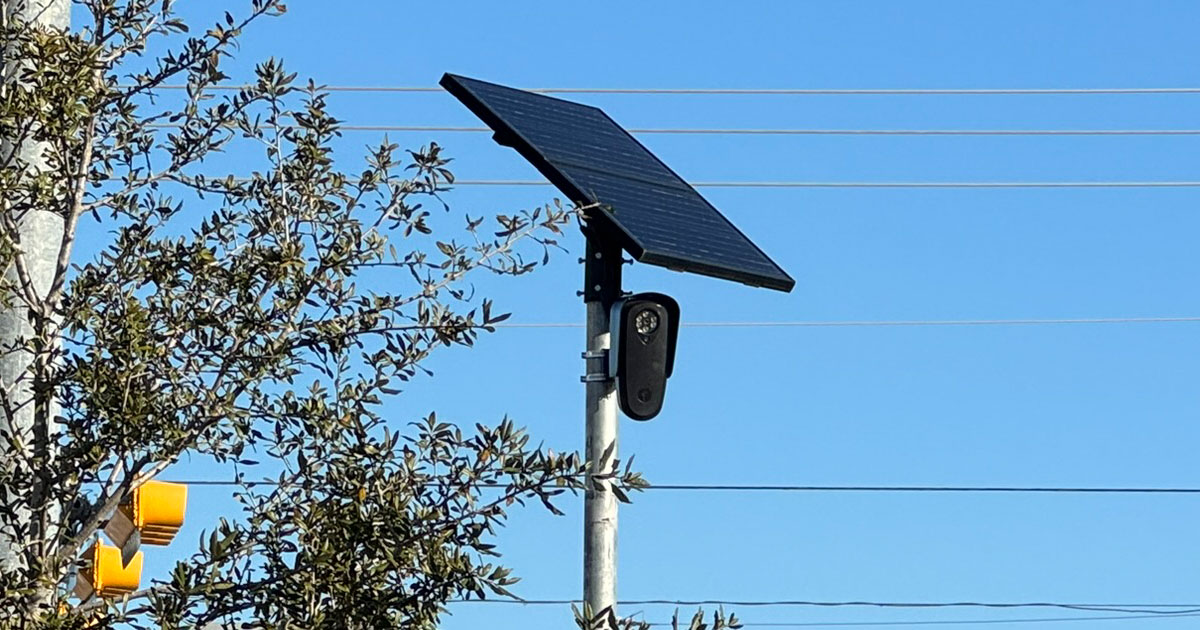
Texarkana, Texas police ran 305 license plate reader searches during a recent 30-day stretch. Two thirds of them reached beyond Texarkana to more than 1,000 law enforcement agencies across the country.

Texarkana, Texas police ran 305 license plate reader searches during a recent 30-day stretch. Two thirds of them reached beyond Texarkana to more than 1,000 law enforcement agencies across the country.
TXKtoday reviewed the department’s Flock Safety search audit log covering July 6 through Aug. 4. The log records the date and time of each search, the reason an officer entered, and how far across Flock’s shared network the search reached. It does not include license plate numbers, and the user IDs are redacted, so individual officers cannot be identified.
Of the 305 searches, 209 went out to Flock’s national network. The typical one reached 1,089 partner agencies. The largest reached 1,345. There was almost no middle ground. A search either stayed local, usually querying two networks, or it went nationwide.
Larceny and theft was the most common stated reason, accounting for 85 searches. Warrants and fugitive cases accounted for 47. Stolen vehicles, 29. Drugs and narcotics, 20. Stolen property, 18. Hit and run crashes, 17.
Further down the list were categories that get less attention in public discussions of the technology. Nine welfare checks. Nine missing person searches. Five for fleeing or eluding. Four for disorderly conduct. One for trespass. One for animal cruelty. Nearly all of those were run against the national network.
Officers chose from 25 distinct reason codes over the 30 days.
The traffic question
Seven searches listed “Traffic Infraction” as the reason. Four of those reached more than 1,000 agencies.
That entry stood out because the department’s consistent public position has been that Flock is not a traffic enforcement tool. TXKtoday asked about it Thursday morning.
Public Information Officer Shawn Vaughn initially said the department does not use the cameras for traffic enforcement in any way whatsoever, and suggested the entries were likely hit and run crashes. The log contains a separate reason code for hit and run and car accidents, which officers used 17 times during the same period. Told that, Vaughn agreed the label did not look good on a public portal.
He checked further and returned with specifics that afternoon.
A couple of the searches were hit and run crashes, Vaughn said. One involved a driver who threw a soda can at another vehicle in what appeared to be road rage. In that case the officer ran a vehicle description through the system to try to identify a tag number. The remaining searches came from reports of reckless drivers.
All of them appear to be legitimate law enforcement uses, Vaughn said. He drew a distinction worth repeating. The cameras do not capture a driver running a red light and do not measure a vehicle’s speed.
That distinction holds up. Flock is not generating traffic tickets in Texarkana. What the entries reflect is officers picking the closest available label from a list of overlapping reason codes after someone called to report an incident on the road.
What the system has produced
The Texarkana Texas Police Department published its own explanation of the program this week, along with examples.
A Flock alert helped locate a man wanted for capital murder out of Little Rock, who was found at a local hotel. Another helped find a missing Texarkana woman with dementia after her vehicle was entered into a national missing persons database and turned up roughly 100 miles from home. Cameras were among the tools that helped detectives solve a theft from an ATM on Stateline Avenue within hours.
The department wrote that the cameras are not watching people and do not use facial recognition, that data is deleted automatically after 30 days unless preserved for an investigation, and that access is limited to authorized officers and the department’s crime analyst.
Across the state line, Texarkana Arkansas Police Department Capt. Zach White provided his own list of results from this summer.
In May, officers arrested a man wanted on a felony domestic assault charge after a hotlist alert flagged a vehicle he was known to drive. In June, TAPD helped Prescott, Arkansas officers identify a suspect vehicle in an ATM robbery, then coordinated with the Cass County Sheriff’s Office to intercept it. That same month, officers recovered a stolen motorcycle through an alert and arrested a driver who turned out to have felony warrants in Little Rock and Saline County. A separate June alert led to a stolen vehicle, an arrest, an outstanding warrant and cocaine recovered from the car.
In July, officers recovered a vehicle stolen out of the Dallas-Fort Worth area. Days later, a cargo truck stolen from a local food bank was tracked to the DFW area and stopped with help from Dallas police. The truck and more than $42,000 in goods were recovered and returned. Officers also used the system to identify suspects in an ATM robbery on Arkansas Boulevard, narrowing the search to a nearby apartment complex.
In March, TAPD used Flock to track a man wanted for rape who had driven from Illinois through Texarkana. He was stopped near San Antonio and arrested.
That last case answers a question the Texas log raises. A vehicle that passes through town and keeps going is only findable if agencies elsewhere are sharing. It is the clearest available argument for why so many Texarkana searches reach across the country.
White said the department has begun tracking these outcomes more closely as license plate readers draw increased attention, and described the technology as a force multiplier in locating people actively engaged in criminal activity. He said the department hopes to share more examples as it continues using the technology to return stolen property and arrest violent offenders.
The Arkansas log goes dark
There is one thing readers can no longer check for themselves.
In June, TXKtoday published an analysis of 226 TAPD searches drawn from the department’s public Flock transparency portal. That portal’s audit log is no longer available.
Asked why, White said the department reviewed the state law governing license plate reader records and concluded the information should not be shared as it understands the statute.
White pointed to Arkansas Code 12-12-1804, which he characterized as stating that captured plate data shall not be shared, and to the definition of that term in 12-12-1802. Because the definition is broad, he said, the department decided to remove the audit log to comply with current state law. He said the department would update its practices as legislation is updated and catches up with technology.
White also offered to provide information on the department’s success with license plate readers, which is the source of the case list above.
The statute is worth reading closely, because the question is closer than either side of it looks.
The definition is genuinely broad. Arkansas Code 12-12-1802 defines captured plate data as GPS coordinates, date and time, photograph, license plate number, and any other data captured by or derived from an automatic license plate reader system. An audit log is arguably derived from the system, which makes TAPD’s reading defensible on the text.
Three things cut the other way.
First, the log contains none of the data types the statute lists. The Texas log TXKtoday reviewed has no plate numbers, no photographs and no location coordinates. It records that a search happened, roughly when, under what offense category, and how many networks it touched. It is a record of police activity, not of any driver’s movements.
Second, 12-12-1804 is written as a purpose limitation rather than a secrecy rule. It says captured plate data shall not be used or shared for any other purpose than the law enforcement uses the statute authorizes, and sets retention limits. A separate provision bars agencies from selling, trading or exchanging the data. Another expressly permits sharing with other law enforcement agencies when the data shows evidence of an offense.
Third, the same subchapter contains an affirmative transparency requirement. Section 12-12-1805 directs agencies to adopt rules and policies for obtaining, retaining and destroying the data and to make those rules and policies available for public inspection.
Other Arkansas agencies have reached a different conclusion under the same law. The Fort Smith and Cabot police departments both maintain public Flock transparency portals, with Cabot’s updated as recently as July 17.
The legislature amended this subchapter in 2025 through Act 668, adjusting retention periods and authorized uses. It did not address search audit logs.
TXKtoday is not in a position to say which reading is correct, and White did not claim certainty either. He described the decision as based on how the department understands the statute as currently written, and said practices would change if the law does.
Where it stands
Both departments answered questions for this story. That is worth stating plainly, and it is not how these exchanges always go in other jurisdictions.
What the record now shows is two departments on one street moving in opposite directions on the same question. On the Texas side, a public log exists and the department explained entries in it when asked. On the Arkansas side, the log that produced TXKtoday’s June reporting has been taken down, on a reading of state law that at least two other Arkansas agencies do not appear to share.