

Best Peptide Companies in 2026: 10 Research Suppliers Compared

By Stewart Johnson, Peptide Supply Chain Analyst, 7+ Years. Reviewed by Lauren Miller, Editor. Last updated: October, 2026
To compare the 10 best peptide companies in 2026, we checked each vendor’s website for COA access, named lab, testing methods, extra tests, vial-to-report link, visible pricing, and shipping terms. If picking a vendor has ever felt like spinning a roulette wheel, this guide takes most of the guesswork out.
Best Peptide Companies at a Glance
Catalog size was the main flex of peptide vendors a few years ago, but now, in 2026, it’s documentation: who tested the batch, how, and whether the report ties to your vial. We have ranked the 10 best research peptide suppliers on the same parameters below.
| Company | Research Use | COA Access | Testing Info | Catalog | Pricing | Shipping |
| Kylo Peptides | RUO | Public, lot-matched | 7 assays, 3 named labs | Peptides, blends | Listed | Free $150+ |
| PSPeptides | RUO | Public page | HPLC + MS | Peptides, bundles | Account needed | Free $200+ |
| American Peptides | RUO | Lot-numbered PDFs | HPLC-MS, MALDI | 76 compounds | Listed | Free $300+ |
| True Research Labs | RUO | COA page | Lab unnamed | Peptides, blends | Listed | Free $250+ |
| Verified Peptides | RUO | 500+ reports | HPLC, endotoxin | Wide range | Listed | Free $200+ |
| Limitless Life Nootropics | RUO | With order | HPLC + LC-MS | 90+ peptides | Login needed | 3-5 days |
| Umbrella Labs | RUO | Product pages | HPLC + LC/MS-MS | Multi-category | Listed | Free, US only |
| Swiss Chems | RUO | Results page | Not stated | Multi-category | Listed | Free $100+ |
| AminoVault | RUO | Results page | Tested twice | Peptides | Listed | Always free |
| Thrive Peptides | RUO | QR on vial | 2 named labs | Peptides | Listed | Always free |
What Makes a Peptide Company Worth Comparing in 2026?
A peptide company is worth comparing when its testing paperwork is specific, current, and tied to the batch you’d receive.
Testing Is More Important Than Catalog Size
A vendor can list hundreds of compounds, but the listing alone won’t speak much about the quality of what’s inside, the compound you’ve actually paid for. So look for independent lab confirmation of purity and identity using standard methods like HPLC and LC-MS. These are the bare minimums.
HPLC reports what share of a sample is the target peptide. Mass spectrometry (MS) weighs the molecule to confirm it’s the right one. Again, you want both run on your batch by an independent lab.
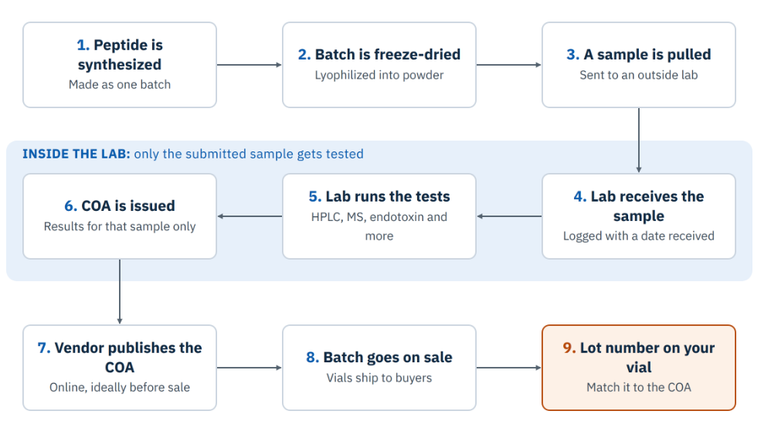
A COA Should Connect the Product to a Specific Lot
A COA must name the product, lot number, test date, purity result, identity result, and lab. It should be public so you know what you are paying for before you pay.
Supplier Transparency Extends Beyond the COA
Look for research-use labels, a real company name and address, contact options, written refund and shipping policies, and visible prices. A supplier that’s upfront about its terms and conditions is unlikely to engage in shady activities.
10 Best Peptide Companies to Compare
1. Kylo Peptides
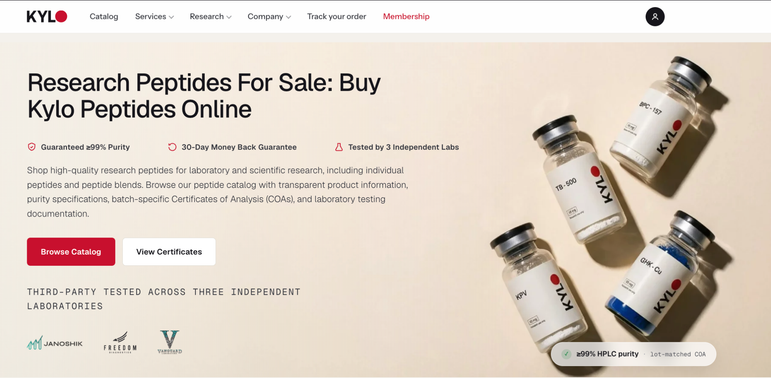
Kylo Peptides, run by Kylo Labs LLC in Sheridan, Wyoming, makes documentation its main selling point. Its tests include multiple assays per batch, including USP <85> endotoxin, HPLC-UV purity, LC-MS identity, and ICP-MS heavy metals. Four independent ISO-certified labs perform these screenings: Janoshik Analytical, Freedom Diagnostics, Optiq Health Labs, and Vanguard Laboratory.
COAs match the lot ID on the vial and go live before a batch goes on sale. We specifically checked the BPC-157 listing, which showed a member price of $24.98, free shipping over $150 on all weekdays, and a full refund for COA mismatch.
If checkable paperwork is your first filter, Kylo is the safest start!
2. PSPeptides
PSPeptides makes its compounds in cGMP-certified US facilities, with every batch independently tested by HPLC and mass spectrometry. Other screenings include heavy metals, endotoxin, and sterility. Reports for all shipped batches sit on a public Certifications page.
The lab isn’t named, and same-day shipping only applies to select orders placed before their 2 PM cutoff. We checked the MOTS-C listing, which was priced between $69.99 and $189.99 for different vial sizes. Full catalog access needs a quick login and account setup.
Ordering from Canada, the EU, the UK, or Australia? PSPeptides is available for shipping. (Additional shipping charges may apply)
3. American Peptides
American Peptides, based in Shreveport, Louisiana, carries 76 compounds across nine categories, including non-vial formats. It names its testing partner, Bioviridian, for HPLC-MS purity, MALDI identity, and endotoxin screening.
You can find lot-numbered COA PDFs for most products, and Safety Data Sheets, which report 99.7% average purity across its last 50 batches. Shipping is free over $300, and its BPC-157 listing started at $60 when we checked.
If you want a big document library, American Peptides is worth a look.
4. True Research Labs
True Research Labs offers a 99% purity guarantee and batch-specific COAs to confirm it, along with identity and endotoxin screenings. The lab and methods aren’t named. Buyers need to navigate to the COA library to check them.
Products come from third-party manufacturers, including international suppliers. Orders ship within 24 hours by 2-day FedEx, with free shipping and bacteriostatic water on orders over $250. The catalog star was GHK-Cu, priced at $54. Every third vial is free.
If you like stocking up, the math at TrueResearch Labs works in your favor.
5. Verified Peptides
Verified Peptides has been around since 2020, and its archive of “500+” published COAs is its calling card. Another flex is “60+ lab tests,” so browse the archive yourself. It tests each batch for purity, net content, identity, sterility, and endotoxins.
You can verify reports with the labs, too. Compounds like BPC-157 (10mg) start at $53, orders before 1 PM EST ship the same day, and $200+ orders get free FedEx 2-Day shipping.
If you’re looking for a vendor with a track record, Verified Peptides can be a good start.
6. Limitless Life Nootropics
Limitless Life Nootropics, now branded Limitless Biotech, runs a gated model: apply for research access, then log in for “professional pricing.” The site lists 90+ peptides, with HPLC and LC-MS testing on every batch, plus sterility and endotoxin screening, and a COA with each order.
Its catalog mixes non-vial formats with lyophilized vials. Orders ship in 3-5 business days, paid by major card or wire.
If you work through institutional accounts, this setup will feel familiar.
7. Umbrella Labs
Umbrella Labs sells peptides as one category in a wider research-chemical catalog, including non-vial formats. It describes HPLC and LC/MS-MS analysis, with third-party analytical chemists checking results and COAs on product pages.
A BPC-157 vial, for instance, runs $48.99 to $88.18, with 10% off orders over $100 and 20% off orders over $200. Shipping is free and US-only, payment is by debit card, bank, or Bitcoin, and they offer no refunds.
If you buy other research chemicals alongside peptides, Umbrella keeps it simple with combined orders in a single cart.
8. Swiss Chems
Swiss Chems runs a multi-category catalog, with peptides and bioregulators beside other compound types. It offers a 99% purity guarantee, an Independent Test Results page, and a product-verification page.
Shipping is free over $100 in the US, and you can pay by card, wallet, or crypto. The FDA sent Swiss Chems a warning letter in December 2024 about how it presented two of its listings. So, check the current test results for the compound you order beforehand.
9. AminoVault
AminoVault sources, synthesizes, tests, and ships in the US, with COAs from ISO/IEC 17025-accredited labs. Batches are “tested twice,” before and after lyophilization (freeze-drying).
The labs aren’t named, so check the Lab Results page before you order. Orders get 15% off, rising to 20% at 8+ vials, and shipping is always free with batch IDs. A 20mg Wolverine Blend, for instance, runs $110.50 to $174.25.
If you order in volume, AminoVault rewards it.
10. Thrive Peptides
Thrive Peptides, based in Arkansas, has the quickest vial-to-report link we saw: a QR code on each vial opens the batch’s lab report directly. New batches go to ILS Labs or Kovera Labs, and its sample COA comes from an ISO/IEC 17025-accredited lab.
The site advertises “8x” testing without listing the eight, so read the full COA. We found the BPC-157 (10mg) listing, on sale for $44.99 with free shipping.
If you are a scan-and-check pro, Thrive makes it easy before you buy.
How the 10 Companies Differ on Testing and COA Transparency
The 10 companies reviewed above differ in small details that matter big time, like naming the testing labs, checking identity through mass spec, and providing a clear vial-to-report link to the buyer before he pays for anything.
Here’s a quick rundown:
Company COA Access Lab Named Mass Spec Extra Tests Vial-to-Report Link Kylo Peptides Public library Yes (3) Yes Sterility, endotoxin, metals, content Lot ID on vial PSPeptides Public page Not stated Yes Metals, endotoxin, sterility Batch reports American Peptides Public PDFs Yes (1) Yes Sterility, endotoxin, metals, content Lot-numbered PDFs True Research Labs Public page Not stated Not stated Endotoxin Batch COAs Verified Peptides Public archive Not stated Not stated Sterility, endotoxin, content Lab-verifiable Limitless Life Nootropics With order Not stated Yes Sterility, endotoxin COA in box Umbrella Labs Product pages Not stated Yes Not stated Product pages Swiss Chems Results page Not stated Not stated Not stated Verification page AminoVault Results page Not stated Not stated Two-stage testing Batch IDs Thrive Peptides Public page Yes (2) Not stated Identity, mass QR on vial
What Does a Peptide COA Actually Tell You?
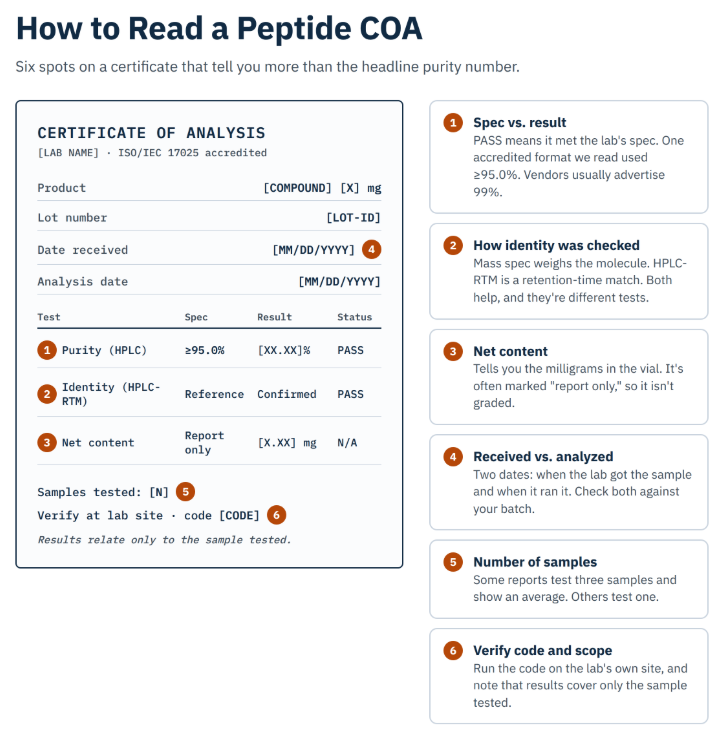
A COA tells you what a lab found in one sample from a particular batch on a specific date. Those results apply to every vial from the lot. That’s why we recommend checking and matching the lot number printed on your vial to the COA you’re viewing.
Purity Percentage
HPLC purity is the share of detected peptide signal that belongs to the target compound. It doesn’t measure milligrams, endotoxin, or metals. Insider tip: check the specification column. One accredited lab format we read graded “PASS” against a ≥95% spec, while vendors usually advertise 99%.
Molecular Identity
Mass spectrometry confirms the molecule’s weight matches the expected sequence. Read the method line, though. Some certificates confirm identity by HPLC retention time, which compares the sample against a reference. The standard, however, is mass spec.
Lot and Batch Numbers
The lot number ties a COA report to the vial you bought. Match it character for character. A vial without a lot number can’t be connected to any report.
Testing Laboratory
Many certificates carry a verification link or access code that leads you to the lab’s portal. You can check the reports here too. A report that checks out on the lab’s site offers an extra level of transparency compared to a COA PDF found only on the vendor’s page.
Additional Quality Tests
Endotoxin testing (USP <85>) screens for bacterial fragments. ICP-MS covers heavy metals, residual solvent testing finds synthesis leftovers, and net content confirms milligrams. Also note the “date received,” the “analysis date,” and how many samples were tested.
Comparing Peptide Companies by the Information They Publish
Past the COA, a company’s product pages, prices, checkout, and shipping terms show you how it runs day to day. Here’s what to compare.
Product Information
A good product page states the compound, quantity, format, and a short research description. Kylo Peptides attaches an info sheet to each product and lists each blend’s components.
Pricing Transparency
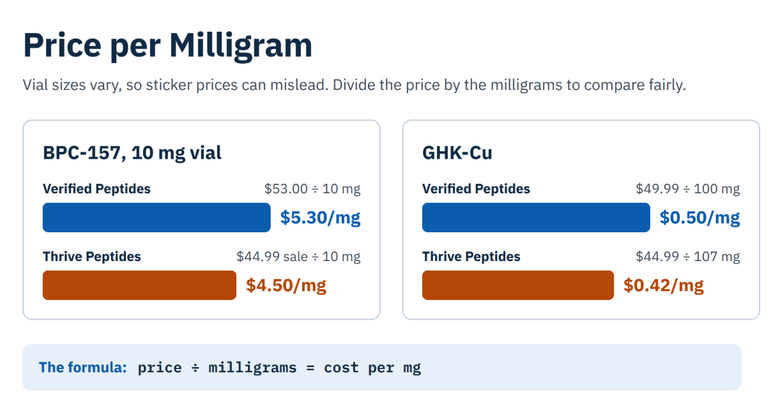
Compare price per milligram, since vial sizes vary. Verified Peptides lists BPC-157 (10mg) at $53, or $5.30 per mg, and Thrive’s 10mg BPC-157 was on sale at $44.99, or $4.50 per mg. For GHK-Cu, Verified Peptides charges $49.99 for 1100 mg, and Thrive charges $44.99 for 107mg.
Ordering and Payment
Checkout setups vary. Limitless Biotech requires an approved account before you see prices, and Thrive accepts cards, Venmo, Zelle, and Cash App. Read refund terms too: Kylo offers a 30-day money-back guarantee, and Umbrella doesn’t offer refunds.
Shipping Information
Shipping runs from same-day dispatch at Kylo Peptides, Verified Peptides, PSPeptides, and Thrive to 3-5 business days at Limitless Biotech. Free-shipping thresholds range from $0 at AminoVault to $300 at American Peptides. Check the carrier, cutoff, and tracking.
How to Compare 10 Peptide Companies Without Relying on a “Best” List
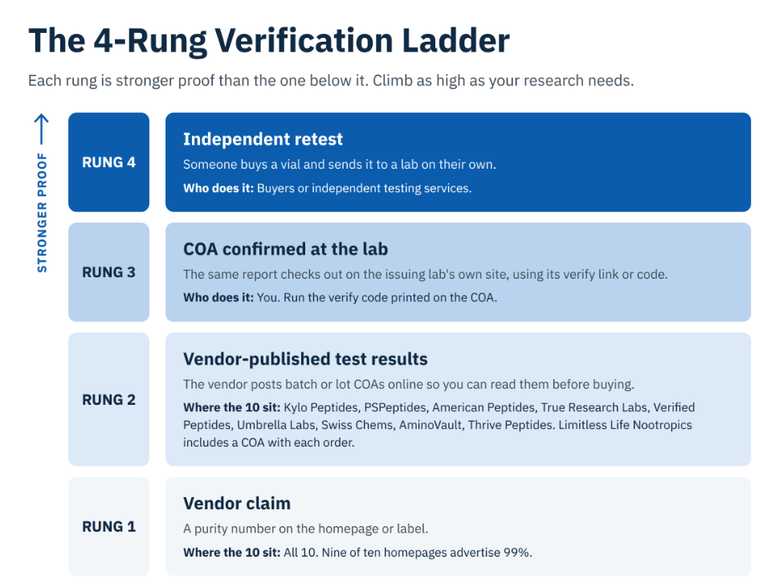
Compare using what we call the 4-Rung Verification Ladder. Rung 1 is the vendor’s claim, like a “99% purity” banner. Rung 2 is a lot-matched COA the vendor publishes. Rung 3 is that COA confirmed on the lab’s own site, and rung 4 is an independent retest of a purchased vial.
Start With the Exact Research Material
Confirm the compound, quantity, and formulation match your project. Check whether it’s a standalone peptide or a blend, since a blend needs its own COA. Then check stock, because a few listings we saw were sold out.
Verify the Documentation Before Ordering
Pull the COA for the exact lot and check the lab, HPLC result, mass spec result, and test date. Add endotoxin or metal panels if your work needs them. If a COA only ships with the order, ask for it first.
Check Whether the Website Makes the Research Status Clear
Look for research-use labels on product pages, an FDA disclaimer, and descriptions written for lab work. Reputable research sites keep human-use instructions and treatment claims off their pages entirely; Swiss Chems has already received a warning letter for this.
Compare the Actual Cost
A low sticker price can hide a smaller vial or high shipping costs. Work out price per milligram, add shipping, subtract automatic discounts, and compare only matching specs.
A Practical Checklist for Evaluating a Peptide Supplier
Run any supplier through this list before your first order.
- [ ] Compound name and quantity in mg are clear
- [ ] Research-use status is clear
- [ ] Batch or lot number is available
- [ ] COA is accessible before purchase
- [ ] Testing lab is named
- [ ] HPLC purity and mass spec identity are shown
- [ ] Testing date is visible
- [ ] Vial lot number matches the COA
- [ ] Extra testing is documented where relevant
- [ ] Prices and shipping terms are clear
- [ ] Company name, address, and contact details are listed
- [ ] No human-use claims appear
Research-Only vs. Human-Use Peptide Sources
Research suppliers sell laboratory materials. Clinical channels, where a prescriber works with a licensed pharmacy, sell approved medications for certain medical conditions instead.
Research Suppliers
Research suppliers sell lab materials labeled for research use only. They publish COAs and keep human-use instructions off their sites.
Clinical or Prescription Channels Are a Different Category
Prescribed peptide products go through a clinician and a licensed 503A or 503B compounding pharmacy.
Why “Research Use Only” Does Not Mean “No Due Diligence Needed”
A “research use only” label tells you who the product is for. It tells you nothing about what’s in the vial, so check the lot-matched COA either way.
Common Mistakes When Choosing Among Peptide Companies
Most sourcing headaches start with a few mistaken shortcuts. Here are the usual ones and their quick fixes.
Choosing Based Only on the Lowest Price
A cheap vial stops being a deal if it’s smaller or under-filled. Compare price per milligram and check the net content result before committing to a purchase.
Treating a 99% Purity Claim as Complete Verification
A label number is a claim until a report supports it. In a 2024 Journal of Medical Internet Research study, semaglutide vials bought from illegal online pharmacies were labeled 99% pure but measured 7.7% to 14.37% by LC-MS. Every sample also carried detectable endotoxin.
Accepting an Old or Generic COA
Last year’s report describes last year’s batch. Check that the date and lot ID match the vial shipped to your address, and skip COAs with no lot number.
Ignoring the Lot Number
Without a lot match, even a perfect COA cannot be referenced to your material. You want the results for the material you bought, not some random sample from a random lot.
Confusing a Product Page With Independent Verification
A product page is the vendor talking, and a third-party COA is the lab confirming the talk. The latter is the strongest proof that what you bought matches the vendor’s claims.
Assuming a Large Catalog Means Better Documentation
A big menu says nothing about the paperwork behind each item. Check the COA for your exact compound. Some smaller catalogs document every lot in detail.
Confusing Research Products With Products Intended for Human Use
Research peptides are lab materials, labeled and documented for research. Clinical products are used for medical reasons, prescribed by a licensed practitioner at a 503A and 503 B compounding pharmacy.
What Changed in the Peptide Supplier Market in 2026?
In 2026, scrutiny got tighter. On August 24, 2026, the FDA sent warning letters to five online peptide vendors. In its letter to NuScience Peptides, the agency treated a “peptide calculator” sold alongside bacteriostatic water as evidence of intended human use, despite research-use labels. Researchers now lean harder on COAs to comply with the rules.
Which Information Should You Verify Before Choosing a Peptide Company?
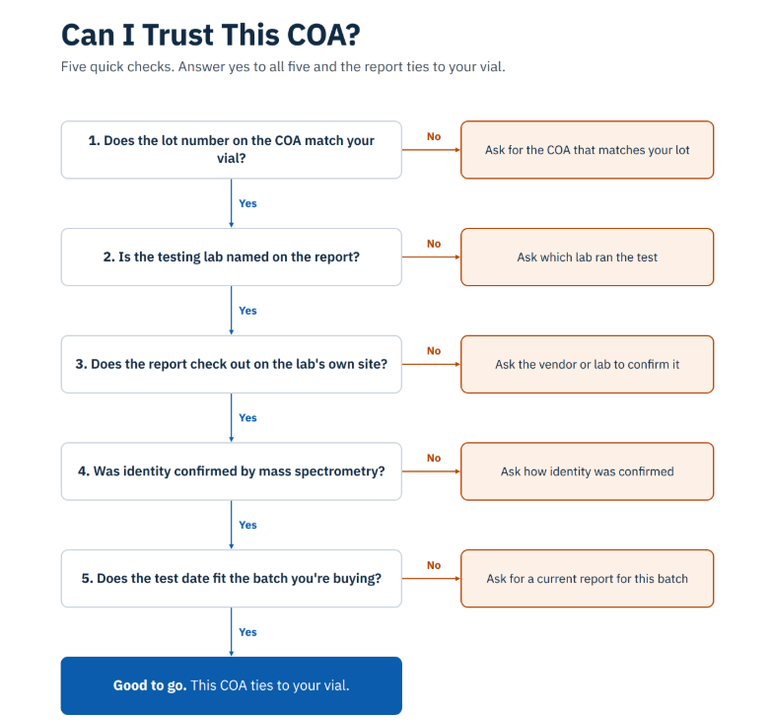
Recheck five things on the day you order.
Verify the Current Product Page
Confirm the compound, quantity, price, stock, and research-use label on the live page. Old screenshots don’t count.
Verify the Current COA
Pull the COA for the lot shipping now. Kylo, for example, shows a “COA coming soon” note while a new batch is still in testing.
Verify the Laboratory Information
Look up the named lab and run any verification code on the lab’s own site.
Verify the Current Price and Shipping
Prices, discounts, and cutoffs move around. Recheck the free-shipping threshold and same-day dispatch cutoff just before placing the order.
Verify That the Company Still Operates Under the Same Terms
Reread the refund and shipping policies before each order. Make sure the company name and address still match past orders.
Frequently Asked Questions
Do peptide companies use the same definition of “purity”?
Mostly, but the details vary. Most report HPLC purity, the share of detected peptide signal that’s the target compound. The method, detection settings, and pass spec differ by lab, and some vendors add net peptide content as a separate number. Read the method line before comparing two “99%” claims.
Can two companies report the same purity percentage using different testing methods?
Yes. Two vendors can both show 99% using different instruments or detection settings. One might add mass spec for identity while another relies on HPLC alone. Same number, different evidence.
Why might a COA date be different from the product purchase date?
Batches get tested before release, then sold over weeks or months, so a COA dated a month or two before your order is normal. What matters is that the lot number matches your vial.
What does a lot number on a peptide vial correspond to?
It points to the production batch your vial came from. That batch’s samples were tested, and the COA carries the same number, linking your vial to its results.
Can a supplier change laboratories between batches?
Yes. Thrive, for example, says earlier batches went to Freedom Diagnostics and newer ones to ILS Labs or Kovera Labs. Always check which lab tested your lot.
Why do peptide companies offer different vial sizes for the same compound?
Research projects need different amounts, and larger vials often cost less per milligram. Compare price per milligram across sizes to see the real difference.
Does a public COA library mean every current product has a current report?
Not always. New batches can still be in testing, and libraries can lag restocks. Search by your vial’s lot number to confirm.
Final Thoughts on the Best Peptide Companies
No single trait makes a research peptide company the best. So, a big catalog or a 99% purity banner isn’t all you need to check. Look for the assays tested and confirmed in the batch-specific COA, preferably with a named, independent lab.
Compare documentation first, then product info, price per milligram, shipping, and research-use labeling. Recheck everything the day you order, because info updates fast in this market.
Kylo Peptides, with public lot-matched COAs and seven-assay testing, is an easy, reliable place to start. Whichever you choose, make sure the vial and the report match before you start your research.
Disclaimer: This article covers laboratory research materials. It isn’t medical advice, and none of these products are meant for human or veterinary use.